The CSAT vs NPS debate is a red herring. Most of us in CX already know NPS has pitfalls, but we still fail to move the needle on customer satisfaction metrics.
As CS and CX managers, we constantly feel the squeeze. Leadership pressures us to slash churn, so we lean heavily on a single NPS score because it is the one metric the board trusts. But a single, isolated number never explains why customers actually pack up and leave.
I realized how much of a distraction this debate was about three years ago. I rebuilt our CX program from the ground up, switching to lifecycle CSAT and completely dropping NPS. A full year later, a colleague walked up and asked me, "Hey, what’s our NPS score?"
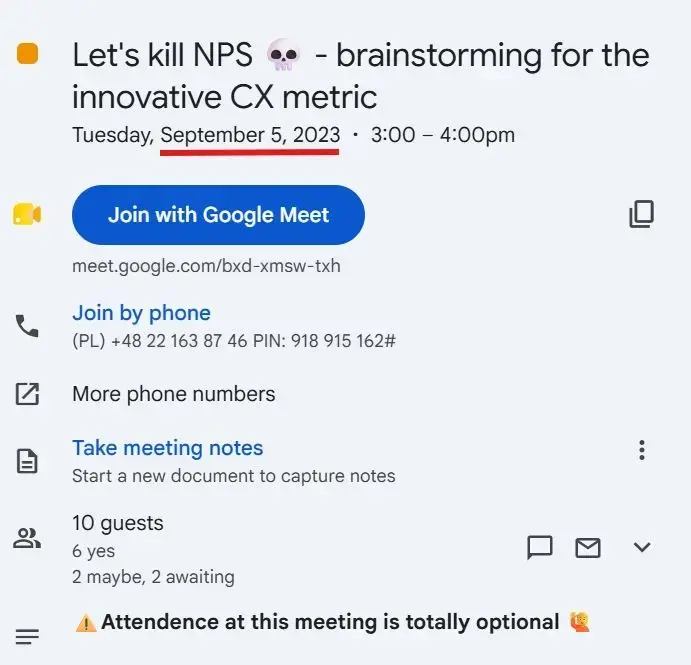
It was a hilarious, slightly tragic eye-opener. Nobody had missed the score for an entire year. Why? Because our new program, powered by regular CSAT touchpoints, consistently fed real-time feedback to our product, marketing, and customer-facing teams. We also had live customer pulse dashboards, so everyone already knew exactly how our users felt.
That was the moment the metric debate died for me.
In this article, I will share how to shift focus away from empty metric debates and build a highly actionable Voice of the Customer program that actually drives change.
The unrealistic expectations we place on CSAT and NPS
I don’t agree with those who circle the CSAT vs. NPS debate around choosing the right metric for a specific job. It's expecting a single metric to tell us everything about the customer experience.
I don't believe the score itself was ever the point. Whether you use NPS, CSAT, a five-star rating, or even a Lovable score matters far less than many teams think. Your customers don't care which number ends up on your dashboard. They care whether you listen to their feedback and use it to make their experience better.
I'd say there are at least three assumptions that come up again and again:
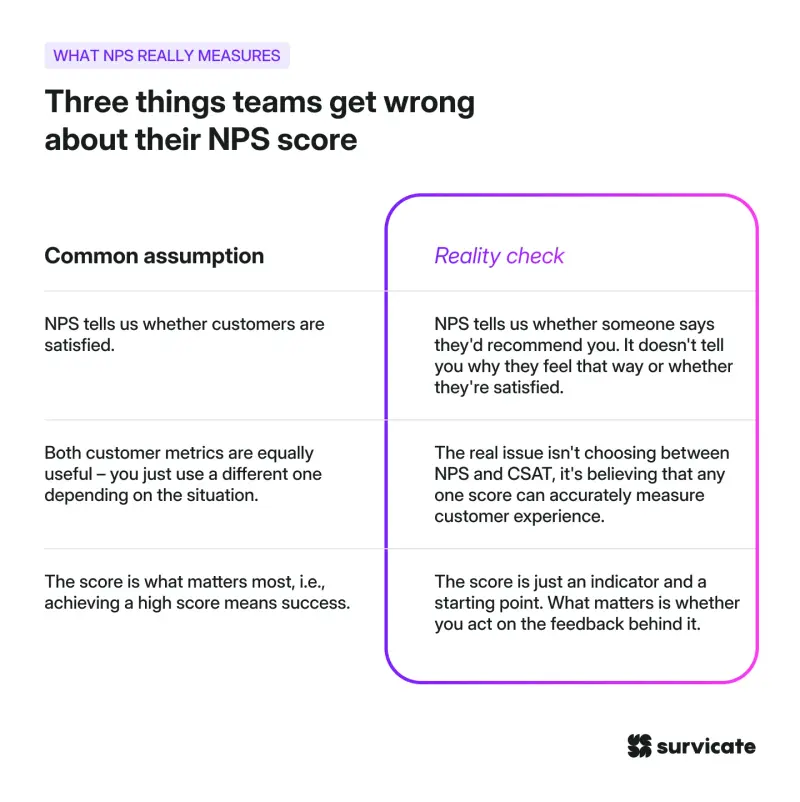
3 Common Assumptions About NPS and CSAT vs. Reality
| Common assumption | Reality check |
|---|---|
| NPS tells us whether customers are satisfied. | NPS tells us whether someone says they'd recommend you. It doesn't tell you why they feel that way or whether they're satisfied. |
| Both customer metrics are equally useful – you just use a different one depending on the situation. | The real issue isn't choosing between NPS and CSAT, it's believing that any one score can accurately measure customer experience. |
| The score is what matters most, i.e., achieving a high score means success. | The score is just an indicator and a starting point. What matters is whether you act on the feedback behind it. |
When we know these NPS vs. CSAT specifics within the team, we're able to change the conversation. Instead of asking which metric is better, we can start asking what we're trying to learn and how we'll use the answers.
Does NPS measure customer satisfaction?
The short answer is no.
When people compare NPS vs. CSAT, they often assume both metrics measure satisfaction in different ways. They measure different things, and that difference matters a lot.
NPS asks customers whether they'd recommend your company to someone else. It's a question about future intent. CSAT, on the other hand, asks customers to evaluate something they've already experienced. That makes it much better suited to answering questions about satisfaction because it focuses on a real interaction rather than a hypothetical scenario.
Customer satisfaction vs. customer loyalty: they're connected, but not interchangeable
Someone can recommend a product because it's the market leader, because switching costs are high, or because it's still the best option available. Even if they're frustrated with parts of the experience.
On the other hand, a customer can leave a great CSAT score after a smooth support interaction without becoming a long-term advocate for your brand.
The two influence each other, but they don't always move together.
One of the leaders who have been making this point repeatedly is Annette Franz, CEO at CX Journey Inc. She argues that organizations put too much emphasis on the NPS number itself instead of trying to understand what sits behind it.
As a sales and customer success leader, I fully agree. A recommendation score can tell you that something deserves a closer look, but it rarely tells you what to fix or who owns the problem. That's why I never treat NPS as a complete picture of the customer experience.
So I asked Annette Franz (CEO at CX Journey Inc.) what she thinks about the habit of managing the number rather than the experience behind it. She said:
"When leaders talk about metrics, they're often just focused on collecting data and achieving the number rather than on doing what it takes to improve the experience. Doing what it takes to move the needle, often including gaming the system, is very different from doing what it takes to improve the experience."
This is also how I interpret Gartner's 2025 prediction about the decline of NPS (something I’ve also written about previously on the Survicate blog). The consulting firm did not attack the metric itself, but how casually many organizations used it. Too often, they adopted NPS as a post-transaction survey to measure a single interaction, even though it wasn't designed for that purpose.
Combining multiple metrics into a single health score can cause trouble, too
Some companies try to split the difference between NPS and CSAT by rolling them, along with other signals, into a single “customer health” score. While that approach can make reporting easier, I'm afraid it's not ideal either. It often makes decision-making even harder.
If one number combines satisfaction, loyalty, effort, and other signals, it's much more difficult to understand what actually changed, which team should respond, or what action will improve the experience.
None of this means you should stop using NPS entirely. Used correctly, it can be a valuable way to understand advocacy and long-term customer sentiment.
But if your goal is to understand whether customers are satisfied with a specific experience, CSAT gives you a much more direct answer. Rather than choosing NPS vs. CSAT, I believe we should start by asking a different question: “What are we trying to learn from our customers?”
Why does NPS keep surviving?
Net promoter score keeps surviving because it is comfortable, not because it provides the best signal.
NPS is the metric executives and investors already understand. It is the safe choice. Most feedback tools on the market were originally built around it, which makes it incredibly easy to deploy.
But survival does not equal validation. Momentum and habit keep NPS in place, not actual evidence that it serves as the right primary signal for your customer experience.
The issue was never the metric itself, but how we deployed it. Somewhere along the line, companies started using NPS as a one-off, post-transactional survey, which is the exact thing it was never designed to be. We started treating a high-level relationship metric like a daily operational tool.
Why CSAT struggles for executive love
While NPS enjoys its comfortable legacy, CSAT remains positioned as the challenger. Even though CSAT offers highly actionable, real-time insights, it still struggles to gain the same boardroom popularity.
Why? Because executives love the simplicity of a single, company-wide "loyalty" score. CSAT, by its nature, is transactional and hyper-targeted. It tells you how a customer felt about a specific support ticket, a new feature, or an onboarding flow.
Since it is fragmented across different touchpoints, leadership often views it as "too tactical" to report on a slide deck, even though those tactical insights are exactly what keep customers from churning.
The "supposed to track" trap

My colleague Justyna Parmee, a User Researcher who talks to customers daily, constantly sees this dynamic play out. When I asked her how often NPS comes up in her research, she pointed out just how deeply entrenched this habit is:
"I honestly can't remember interviewing someone who wasn't measuring NPS. It feels like one of those metrics that everyone knows 'they're supposed to track.' I've even spoken with users who said they run NPS surveys but weren't sure what other surveys they should run."
This is the core of the problem. Companies treat NPS as a default setting. They measure it because management expects a quarterly report, not because the team on the ground finds it useful for their day-to-day work.
The most common NPS mistakes aren't about NPS itself
So, what are the most common NPS mistakes I see? Interestingly, very few of them have much to do with the metric itself:
- Treating NPS as the entire Voice of the Customer strategy. NPS should be one signal, not the whole story. A recommendation score can tell you something deserves attention, but it can't replace ongoing customer feedback collected throughout the journey.
- Asking at the wrong moment. NPS measures long-term advocacy, so if you want to understand how a recent support conversation or onboarding experience went, CSAT is usually the better fit.
- Stopping at the score. This is, arguably, the biggest NPS pitfall out there. You collect the number but forget to ask for an explanation of what caused them to give the answer they did. A score points you in a direction, but there’s no way you’ll know how to improve it by guessing.
- Leaving the feedback without an owner. If nobody follows up on the results, they won’t be turned into specific actions within your product, your approach to customer support, or anywhere else clients might feel you’re lacking.
None of these issues make NPS a bad metric, but they're another case for what I've said – no score, on its own, can replace listening to customers and acting on what they tell you.
Build a Voice of Customer program, skip the metric obsession
When teams ask, "Which metric should we prioritize, CSAT or NPS?" my answer is: neither.
By now you already know that the question itself is a trap. Instead of obsessing over which acronym to put on a slide deck, prioritize building a Voice of Customer program that captures feedback in context and actually closes the loop. NPS can absolutely be a part of that system, it just should not be the dominant part.
Where NPS actually shines is as a periodic, strategic snapshot. Run it once a year, right after renewal, specifically to identify your advocates. Who would vouch for you? Who is your reference pipeline? NPS is genuinely good at surfacing that.
A tale of two surveys
To see what this looks like in practice, contrast the substance of an NPS-style survey with an in-the-moment CSAT survey.
Imagine using a customer feedback platform like Survicate to trigger feedback.
The NPS approach. You send a generic email three months after signup asking, "On a scale of 0 to 10, how likely are you to recommend us?" The customer has to stop what they are doing, think about your entire company abstractly, and pick a number. You get a score without a real context.
The in-the-moment approach. Right after a user finishes onboarding, a targeted Survicate pop-up asks, "How satisfied are you with the onboarding process?"
The second survey captures the customer's raw, immediate reality. It asks about a concrete experience, making it incredibly easy for the customer to answer and even easier for your team to take action. If they select a low score, you do not have to guess what went wrong. You know exactly which part of the journey broke down.
The blueprint for a lean, actionable VoC program
If you are a CX manager looking to build a proper customer experience measurement system without drowning in complexity, focus on these four core pillars:
1. Continuous, event-driven triggers
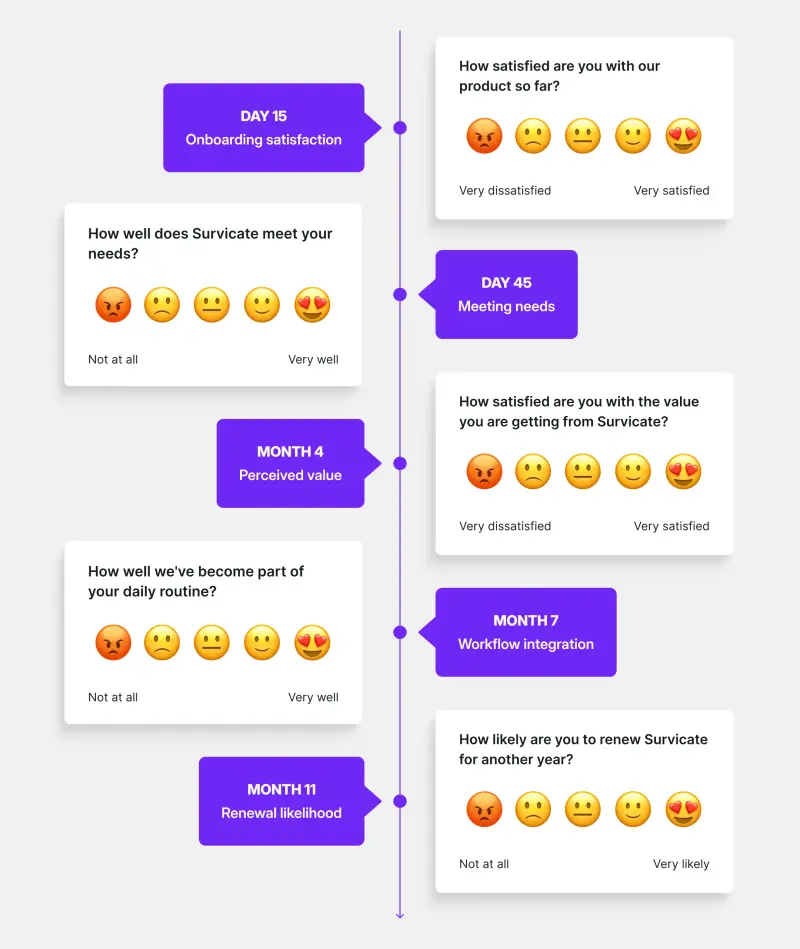
Ditch the internal company calendar. Instead of declaring "Q3 is NPS season," set up surveys that fire based on customer behavior or lifecycle milestones, like finishing onboarding, reaching active adoption, or approaching renewal.
Explained in more detail here.
2. Multi-dimensional questions
A real program measures more than one thing. Instead of relying on the abstract "would you recommend us" question, which people often answer based on their mood, ask highly actionable questions: Are you getting the value you signed up for? Did support resolve your issue? Is the product keeping up with your needs?
This is why I lean on CSAT for this layer; a 1–5 scale is highly intuitive for the customer and provides clear direction for your team, whereas a 0–10 NPS scale often creates more internal debate than it is worth.
3. Real-time distribution
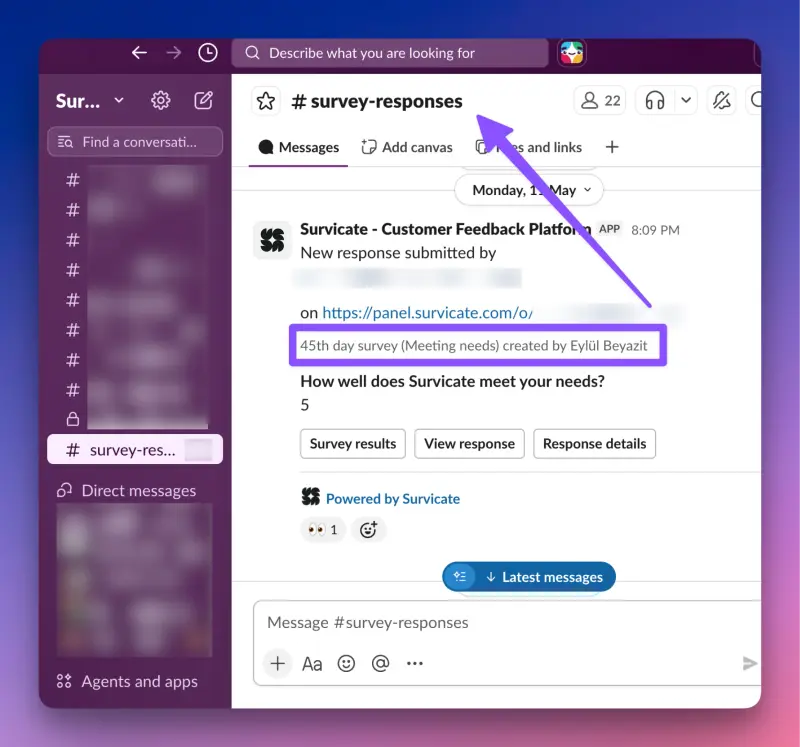
Feedback must land in front of the people who can act on it instantly. At Survicate, we feed our survey responses directly into a public Slack channel. We also host a feedback-specific session during every quarterly planning meeting to review the big picture and maintain live customer pulse charts so sentiment remains highly visible.
4. Closing the loop
This is the step most companies miss. You must follow up with customers so they know their feedback actually went somewhere. Whether you are working to turn NPS passives into promoters or addressing a poor CSAT score, closing the loop is what turns a survey into a relationship.
If you decide to leave NPS out entirely, you will not miss much, as long as you still capture and act on customer sentiment. I have removed NPS before, and the only thing we lost was a number nobody remembered anyway.
That said, if you want to drive this change in your organization, do not walk into the boardroom demanding to "kill NPS." Start by showing your team that the score itself is not the goal. What matters is how that feedback actually impacts your daily work and what you change because of it.
Stop scoring, start acting
CX is still stuck debating which metric should guide the company forward. It is time to stop obsessing over CSAT vs NPS and instead build a proper voice of customer program that actually improves customer satisfaction metrics.
If leadership pressures you to "fix" your NPS, ask them a hard question: Do you want to fix the score, or do you want to improve the experience?
Fixing a score is embarrassingly easy to game. Just survey your power users right after an "aha!" moment. But if your goal is real improvement, remember that CX does not start and end with you. Every department touches the customer. Your job is not to hold a thermometer, but to feed actionable data to the teams who can actually change the temperature.
Here is how to start:
Challenge leadership. Be honest about how easily teams game scores, and push for real outcomes over shiny metrics.
Route feedback instantly. Send raw insights directly to the product, marketing, and support teams who can act on them.
Recruit allies. Find one advocate in each department to help back customer-first decisions.
You cannot fix your company's CX alone. Your role is to be the voice of reason, the advocate who makes the customer impossible to ignore.
Frequently Asked Questions
Is NPS better than CSAT for measuring customer satisfaction?
No – CSAT asks about a real experience directly; NPS asks a hypothetical question about future behavior.
Which is better, CSAT or NPS?
Neither wins outright – the better question is whether you're capturing ongoing, contextual feedback at all, versus a one-off score.
When should I use NPS vs. CSAT surveys?
This is the wrong framing – instead of choosing per situation, use CSAT/in-context feedback as your default and let NPS play a small, specific role (e.g., an occasional relationship check-in), not your whole program.
Why is NPS considered flawed?
Because it measures a hypothetical intention (recommending) rather than an actual experience, and it's commonly deployed in ways it wasn't designed for (e.g., generic post-transaction surveys).
Is NPS outdated?
Not outdated, but frequently misused – the metric isn't the problem, the way most companies operationalize it is.
What's replacing NPS?
Nothing is "replacing" it 1:1 – it's being folded into broader, ongoing Voice of Customer programs where it's one signal among several, not the headline metric.