


TL;DR
Why look for Typeform alternatives?
There are definitely some good reasons:
- You may hit response caps earlier than expected, especially on lower-tier plans.
- Some important features are locked behind higher plans, which can make the entry tiers feel restrictive.
- The pricing structure may feel suboptimal if you only need a subset of features.
- You may need broader payment options or deeper integrations than Typeform offers out of the box.
- For longer or more complex workflows, the builder and exports can feel slower than you’d like.
Any tool hunt should begin with proper research. If you are considering subscribing to Typeform, it’s a good idea to investigate similar alternatives or competitors to find the best solution. And even if you are already using Typeform, you may be unhappy with some features, aspects, user experience, or the tool's price. This article will present you with 15 alternatives categorized into tools specifically designed to cater to surveys, forms, and quizzes.
How do you know if Typeform might be right for you?
Typeform is hyper-focused on the visual design of its forms. Many customers highlight how appealing their solution looks compared to some other tools. The approach is built around the idea that visually attractive forms can help improve completion and response rates.
Typeform is a conversational form builder designed to make forms feel more engaging. If visual design matters most to you, their solution could be right for you.
But this form experience often works best for short and simple forms. Typeform itself highlights short forms as a sweet spot, and some reviewers say it isn’t very suitable for more complex workflows.
Let’s dive deeper into what customers like and dislike about the tool.
What are some main Typeform pros?
- If the target audience requires a conversational approach, Typeform can be an interesting option
- Some customers appreciate Typeform’s logic mapping, including support for numerical formulas
- Overall, Typeform is intuitive and easy to set up
- Themes are visually attractive, and there is an option to add images and videos to match your branding and needs
- Keyboard shortcuts can make answering faster and more convenient, at least for supported answer formats
What are some main Typeform cons?
- Lower-tier plans can feel restrictive. For example, spam prevention based on invisible reCAPTCHA is available on Plus plans and above, but not on the free and Basic plans.
- Response restrictions can become limiting quickly for larger samples:
- Free: 10 responses per month
- Basic: 100 responses per month
- Plus: 1,000 responses per month
- Typeform’s monthly response cap is account-wide, not per form. Once you hit it, your forms go private until the next month or until you upgrade, and deleting responses does not restore your quota
- Many reviewers claim there are too many features locked behind a paywall
- The interface tends to lag when a user is creating long or complex forms. Some users also say exports can feel slow with heavier datasets
- Customers often say the pricing structure is suboptimal and pay for many features they will never use
- While Typeform is optimized for visual appeal, this can also cause issues. For example, all forms tend to feel and look similar, even when you add your company’s logo or custom images
- Typeform is not the ideal solution for payment forms. While they offer the option, Typeform currently supports payments through Stripe and PayPal, while many competitors collaborate with Square, Braintree, and more
- Overall, some online reviews compare Typeform unfavorably with simpler or free tools because of its response caps and paywalled features
Typeform pricing
Let’s walk through Typeform’s plan options.
Typeform Free Plan
Here are some of features available on the Typeform free plan:
- Unlimited typeforms
- 10 questions per published typeform
- 10 responses per month
- Logic, including branching and calculations
- Templates
- Embed your typeform in a web page
Typeform Basic
Price: $29 per month (or $25/month when billed annually)
It allows you to collect up to 100 responses from unlimited typeforms.
Typeform Plus
Price: $59 per month (or $50 when billed annually)
The first paid plan contains everything on the Basic plan, but you can collect up to 1,000 responses and invite two more users.
You will be able to remove Typeform branding and add your logo, and you also get spam prevention.
Typeform Business
Price: $99 (or $83 per month when billed annually)
Typeform's highest standard self-serve subscription plan is practically the only one that gives medium, large, and enterprise businesses a reliable response limit. You can collect up to 10,000 responses from unlimited typeforms and analyze drop-off rates to improve your forms.
Unlike the Basic and Plus plans, Business comes with a Salesforce integration. You’ll also get priority support and the option to live chat with customer service.
How we put the Typeform alternatives list together
We treated this guide as a practical, buyer-style review. The goal is not to “score” Typeform alternatives on dozens of criteria, but to help you shortlist faster by showing what each tool is best at and what trade-offs you will run into early.
We grouped 15 tools by their primary use case: customer & survey feedback, forms, and quizzes. For each option, we focused on:
- What the tool is mainly built for
- The few features that define the experience (for example, quiz logic, calculators, payment forms, and customization)
- Clear pros and cons that reflect real-world strengths and limitations
- Pricing reality: paid plan ranges, the free plan when available, and the plan gating that matters most in practice (response caps, branding removal, integrations, payment options, and similar constraints)
How we kept it grounded
We didn’t rely on vendor marketing copy alone. We verified key details using official sources like pricing pages, plan tables, and documentation, then checked the “human reality” using community signals mainly from G2, Capterra, Trustpilot, and Reddit. When something was unclear or easy to misread, we leaned on deduction from the official limits and feature rules, and kept the wording conservative.
What are some Typeform alternatives for customer & survey feedback?
Consider these tools as alternatives to Typeform if you want a customer & survey feedback solution:
- Survicate
- SurveyMonkey
- Qualtrics
- Conjoint.ly
While researching Typeform alternatives in this category, we focused on the ease of use and setup, customizability, time to reach ROI, support, integrations, and key features.
Survicate
Survicate is a customer feedback platform, offering multi-channel feedback collection and AI-assisted analysis for continuous customer insights. It lets you automate surveys like NPS and CSAT and use the recurring feature. That way, you don’t have to keep asking customers to fill out surveys or do interviews to get their thoughts and ideas.
All results populate in the reporting tab in real time. You can use the filters to see a bird’s eye view of score changes across days, weeks, months, quarters, and years.
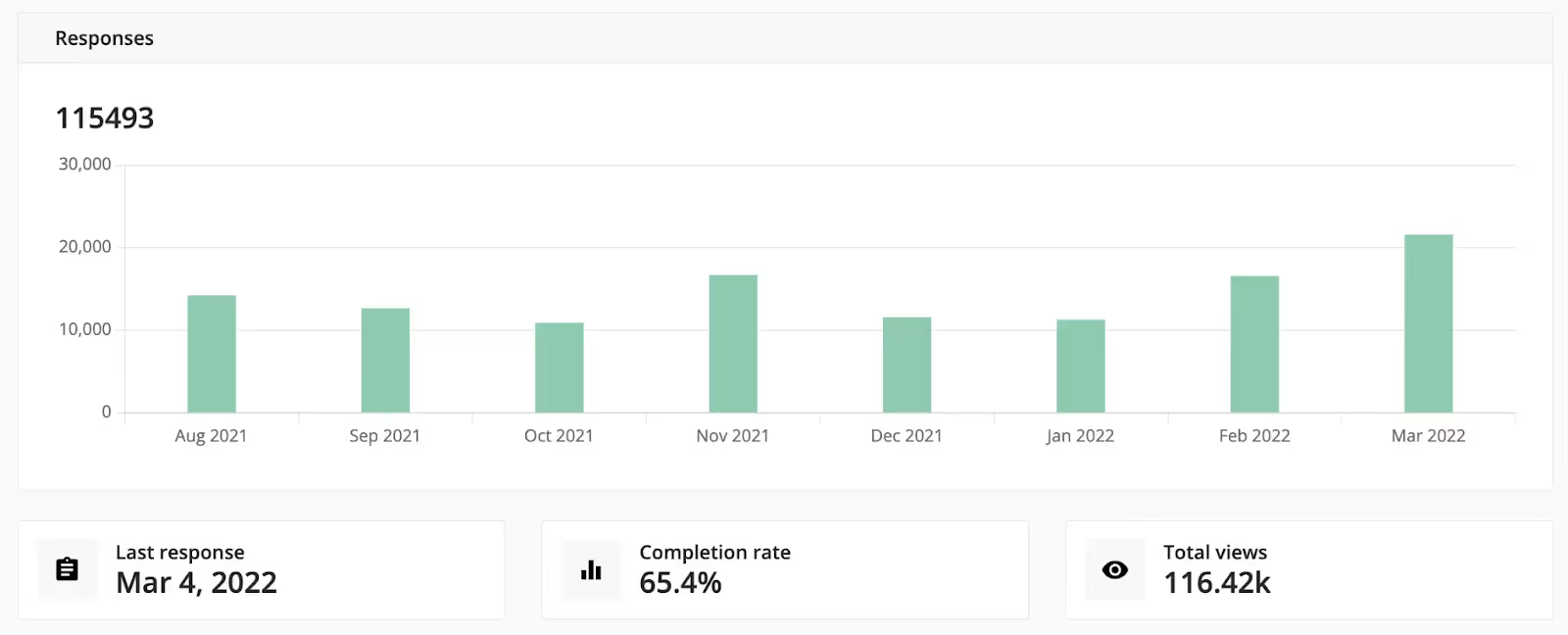
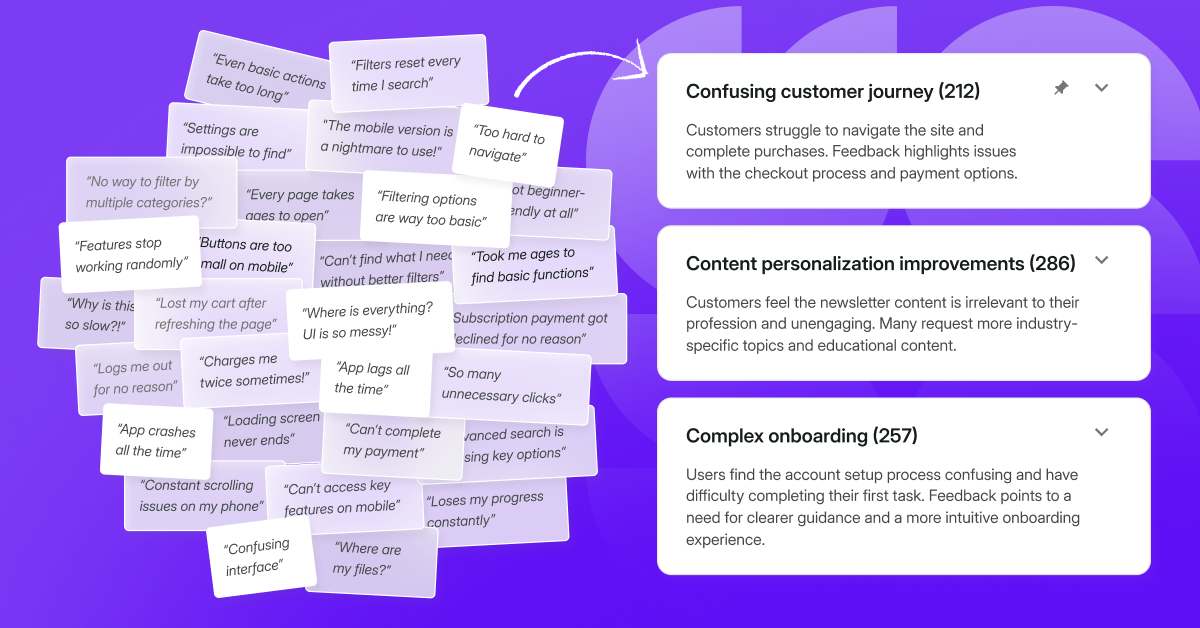
Survicate generates graphs and bar charts automatically and also uses AI to help you make sense of open-ended answers. Instead of reading responses one by one, you get them automatically grouped into meaningful topics and themes. The same grouping happens in Insights Hub across sources like surveys, support tickets or chats, reviews, interviews, and sales calls. Plus, you can enrich it with CRM attributes to slice insights by customer segments.
Why do customers choose and continue to use Survicate?
Our user research shows customers most appreciate the following features that make Survicate stand out:
- AI-assisted topic grouping and analysis across all feedback sources
- Intuitive and clean UI – edit with drag & drop feature as well as over 400 templates optimized for best response rates
- Multichannel distribution
- Ability to capture partial responses
- A multitude of solid, native, one-click integrations
- Easy to integrate, code-free, and no need to bother developers
- Easy to automate with recurring survey feature and automatic notifications and score calculations
What value do customers get from using Survicate?
Customers commonly use Survicate for the following jobs-to-be-done:
- Easily gathering data to back up arguments when pitching new ideas
- Validating feature ideas and product development roadmaps
- Prioritizing features based on feedback from real users and customers
How does Survicate compare to Typeform?
Users looking for a survey tool often compare Survicate and Typeform on G2. On their current compare page, Survicate scores higher than Typeform on several fields:
- Quality of support (9.4 vs 8.4)
- Branching & skip logic (8.8 vs 8.7)
- Branding (8.8 vs 8.5)
- Survey builder (9.2 vs 9.0)
- Templates (8.6 vs 8.4)
- Multilingual surveys (8.4 vs 7.9)
- Being a good partner in doing business (9.3 vs 8.8)
In direct comparison with Typeform, Survicate offers better control over branding and advanced customization, including custom backgrounds. Customers report Survicate’s survey builder is more intuitive, and they appreciate the feature of capturing partial responses.
However, you may want to go with Typeform if you want to make “fun” content or simply quizzes.
Survicate offers a 10-day free trial that comes with all Pro plan features.
Besides the free trial, Survicate offers a full suite of plans – from a lightweight entry point to robust enterprise-grade solutions – designed to fit teams of all sizes and needs.
Starter plan (from $89/month)
- Up to 500 responses/month
- Basic branding (company logo)
- Data export (raw results)
- Core analytics and reporting
- AI-powered response tagging (available in product)
- Human support
Best for: small teams getting started with structured feedback collection.
Growth plan (from $56/month)
- Unlimited active surveys across all channels
- Multichannel distribution (web, app, email, link, etc.)
- Multilingual surveys
- Advanced targeting (by user attributes and events)
- 25+ native integrations
- Access to API/webhooks
- Custom branding (remove Survicate branding)
- 10 user seats across 2 teams
- 1 dashboard for analysis
- Insights Hub and AI Research Assistant
Best for: running continuous feedback programs (NPS, CSAT, product feedback) at scale.
Pro plan (from $349/month)
- Custom response and data limits (higher scale)
- Advanced survey logic and targeting
- Pro integrations (e.g., Salesforce, advanced workflows)
- Custom branding with CSS
- 10 dashboards for multi-survey analysis
- Flexible team and seat management
- Dedicated onboarding support, training, and success guidance
- SAML SSO and advanced security features
Best for: product teams and mid-sized companies needing deeper control, integrations, and analytics.
Enterprise plan (from $569/month)
- Fully custom response and data limits
- Custom number of dashboards
- Enterprise-grade security (SAML SSO, access logs, HIPAA compliance)
- Custom legal terms (DPA, NDA, etc.)
- Dedicated Customer Success Manager
- 1:1 onboarding, training, and ongoing support
Best for: large organizations with advanced security, compliance, and scalability requirements.
SurveyMonkey
What is SurveyMonkey mainly used for?
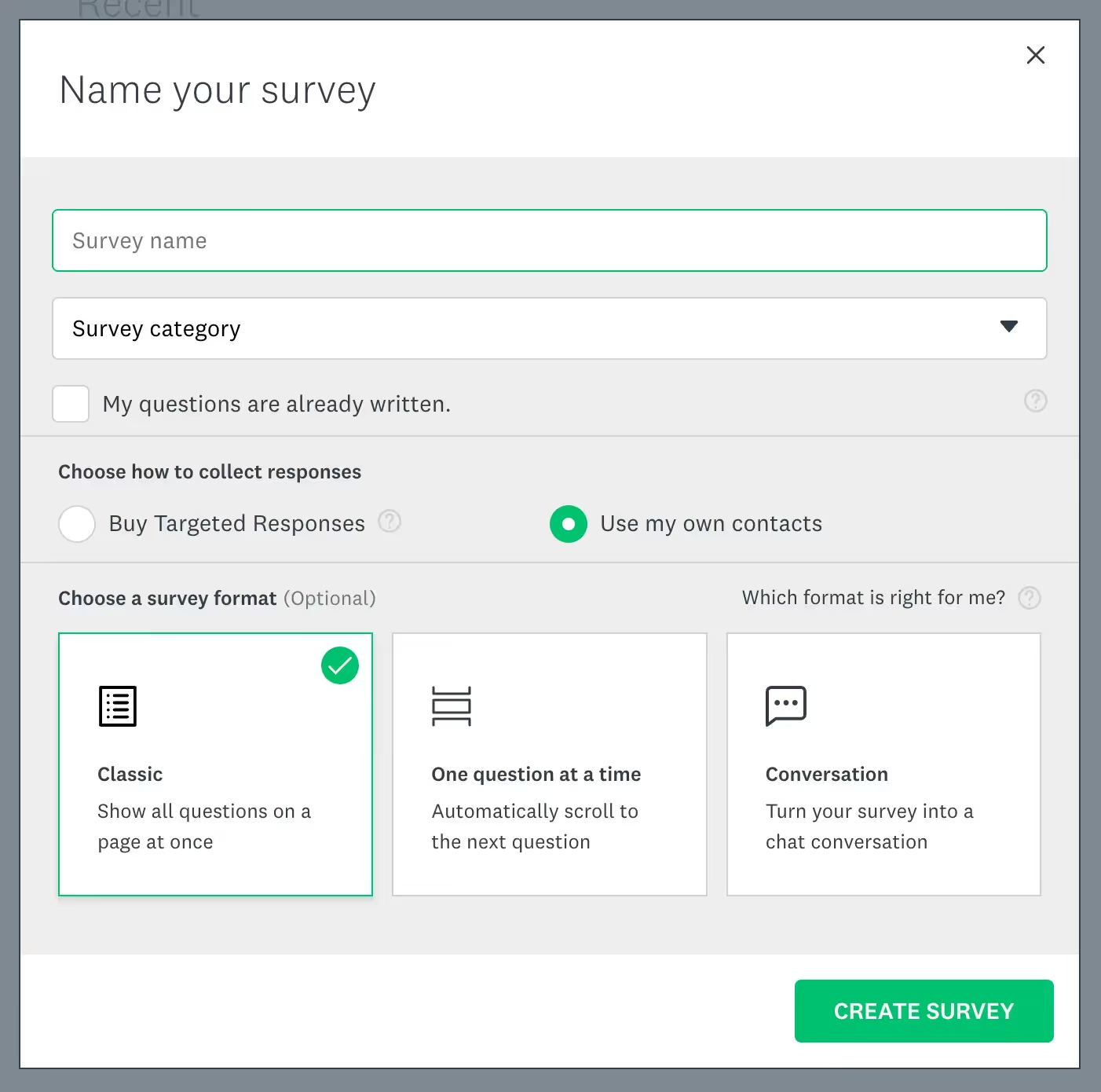
SurveyMonkey is an established player in the survey niche and a popular tool for many businesses. It offers surveys, quizzes, and polls via several distribution channels, and is suited to structured feedback collection, employee research, and broader survey-based research workflows.
How does SurveyMonkey compare to Typeform?
How does SurveyMonkey stack up against Typeform? On the downside, SurveyMonkey is less visually polished and offers less flexibility for highly branded, conversational forms. Users also point to pricing friction, especially around free-plan limits and the need to upgrade for more advanced functionality.
On the other hand, SurveyMonkey gives you more flexibility in how you structure a survey (layout, pages, question blocks) and is generally a stronger fit for more formal survey workflows, reporting, and research-heavy use cases.
What are some SurveyMonkey pros?
Users most often highlights SurveyMonkey’s:
- Ease of use
- Quick setup
- Variety of templates and question types
- Practical reporting and analytics
- Broad usefulness across customer, employee, and research surveys
What are some SurveyMonkey cons?
The main drawbacks include:
- Restrictive free-plan limits
- Pricing pressure as needs grow
- Limited design and branding customization
Pricing
SurveyMonkey subscription plans are divided into Individual, Team, and Enterprise options. It also offers a free Basic plan. The free plan lets you create unlimited surveys, forms, and quizzes, but it is limited to:
- up to 10 questions per survey or form
- viewing up to 25 responses per survey or form
Paid plans remove the 10-question cap and unlock more advanced functionality, but features and allowances vary by tier. Enterprise is available through sales.
Qualtrics
What is Qualtrics mainly used for?
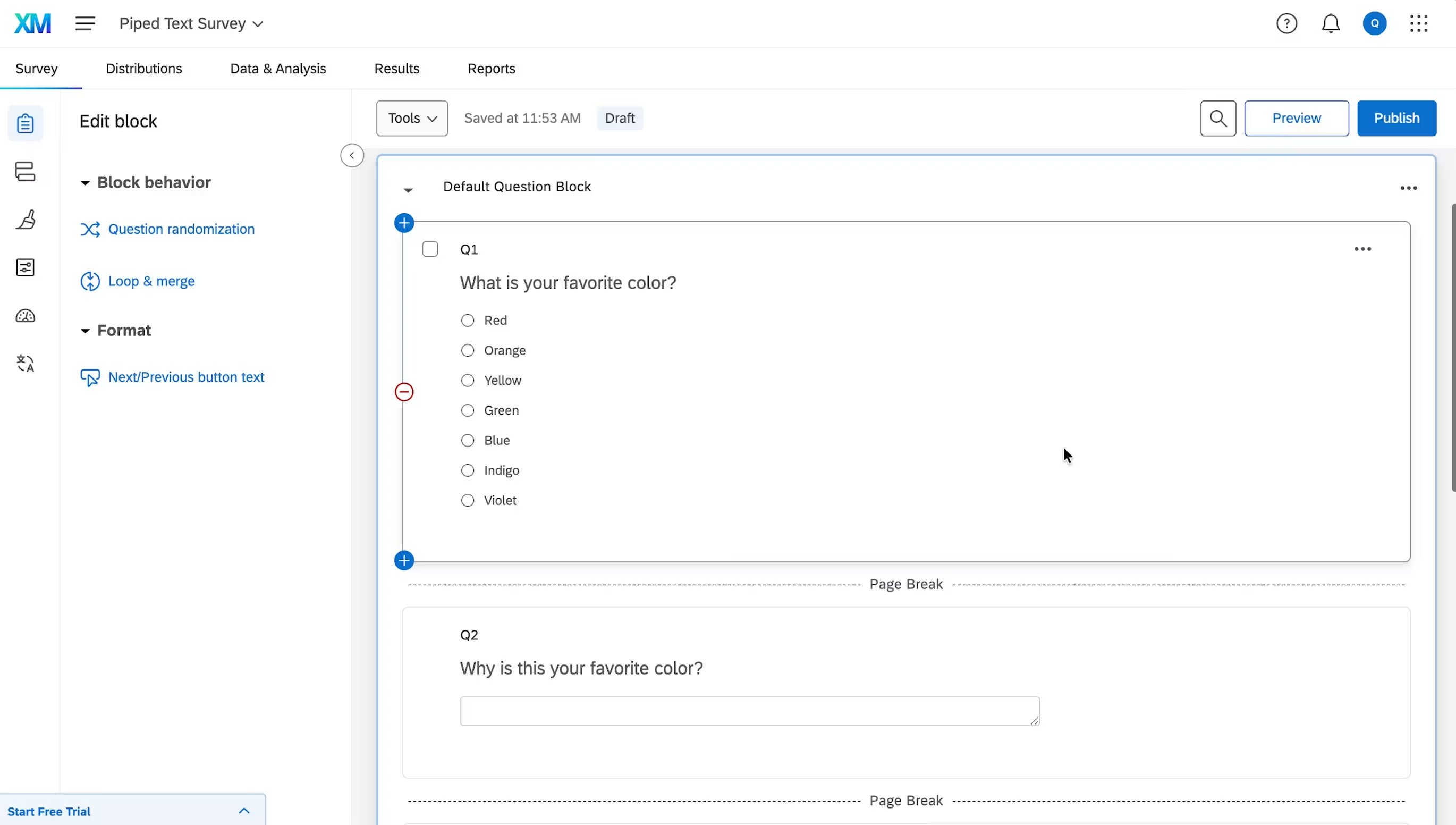
Qualtrics is a research platform with repository capabilities designed for enterprises. It is built for gathering large amounts of data through more advanced surveys, research programs, and experience management workflows. If you are an individual or small business, it can easily feel like overkill.
So while Qualtrics is powerful, it usually makes more sense for enterprise teams with complex research or experience management needs than for simpler form-building use cases.
What are some Qualtrics pros?
The main advantages of Qualtrics are:
- Advanced survey design and logic for complex research needs
- Strong analytics and insight capabilities
- Flexible customization for sophisticated survey programs
- Solid customer support
What are some Qualtrics cons?
The main drawbacks are:
- Quote-based pricing that can be hard to justify for smaller teams
- A steeper learning curve
- More complexity than many smaller teams actually need, especially if you're mainly interested in running surveys – you'll then overpay for that functionality
- An interface that some users find cumbersome or slow to navigate
Pricing
You can start with a free trial, but Qualtrics pricing is largely customized based on what you need from the tool. You need to contact sales for details.
Qualtrics also has a public self-serve Strategic Research offer at $420/month billed annually for 1,000 responses shared across all users, while other packages still require contacting sales or booking a demo.
Conjoint.ly
What is Conjoint.ly mainly used for?
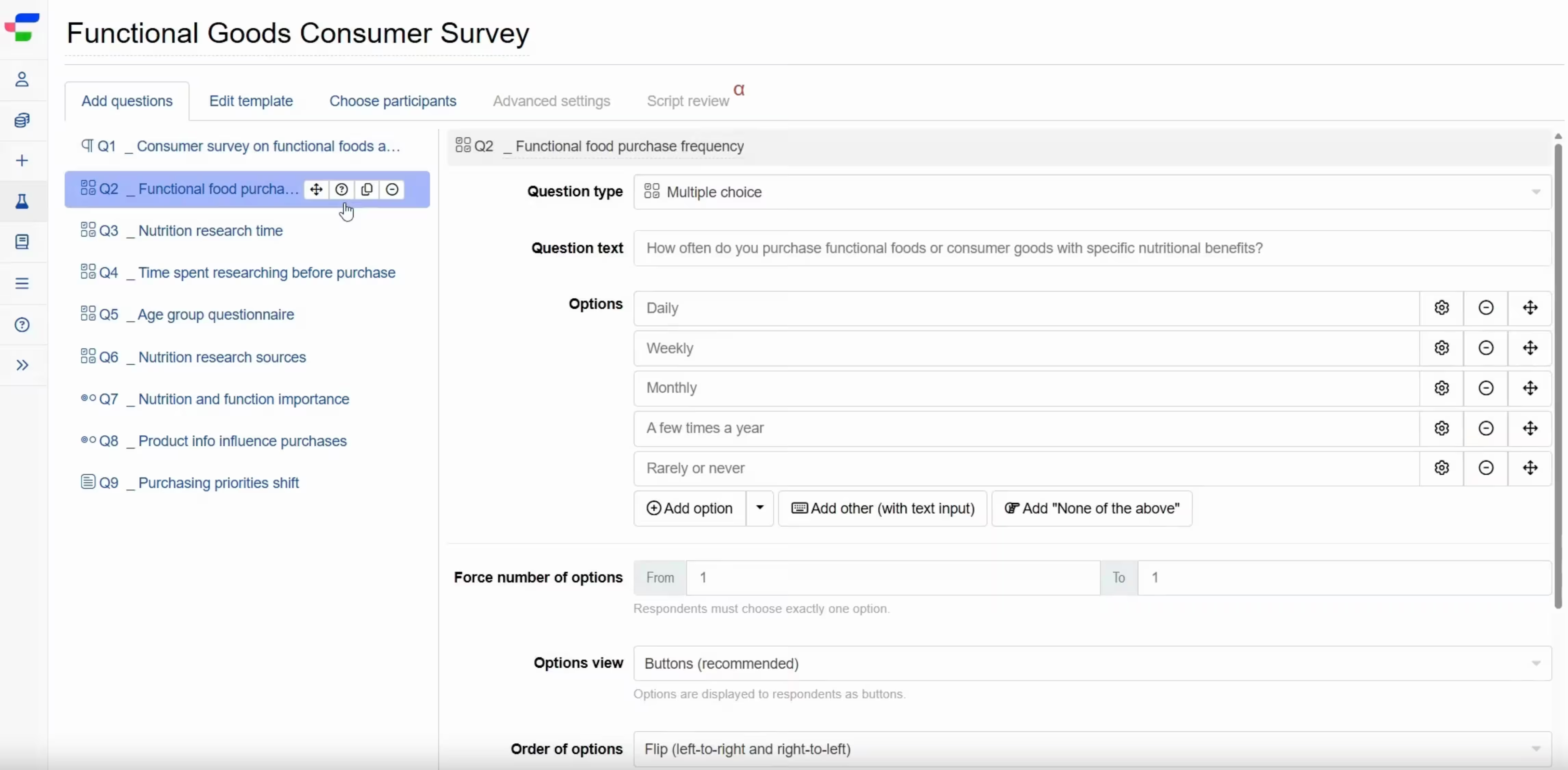
Conjoint.ly is an all-in-one survey research platform focused on product, pricing, and conjoint research rather than general purpose form building. It is a more research-heavy tool than Typeform, and that is why it can feel like overkill if you only need simple forms or lightweight surveys.
What are some Conjoint.ly pros?
Conjoint.ly has some upsides to it:
- No caps on responses, questions, or the number of surveys you want to run (on the Basic tier)
- Access to panel respondents if you lack your own audience
- Multilingual survey support
- Built-in analysis and exports
- Strong support
What are some Conjoint.ly cons?
The main drawbacks are:
- Pricing may be hard to justify for smaller teams
- A complicated interface
- A steeper learning curve
- Limited design and formatting flexibility
- Limited native integrations
Conjoint.ly has limited integrations, but you can redirect from other tools like SurveyMonkey or Qualtrics and perform your analysis there. The downside is you may need to pay for both subscriptions.
Pricing
Conjoint.ly has a free plan with no limits on the number of:
- Responses
- Surveys
- Questions
- Team members
However, for advanced research methods, full analysis is limited on the free plan.
Paid plans start at $2,895 per team per year. Additional services like panel responses, extra support, and tailored team training are available for an additional fee.
Typeform alternatives for forms
These five tools are good Typeform alternatives if you want to make forms:
- HubSpot form builder
- forms.app
- Google Forms
- Jotform
- Paperform
- Woofoo
- 123formbuilder
- Formstack
We picked them based on the ease of use and setup, customizability, price, and payment partners.
HubSpot form builder
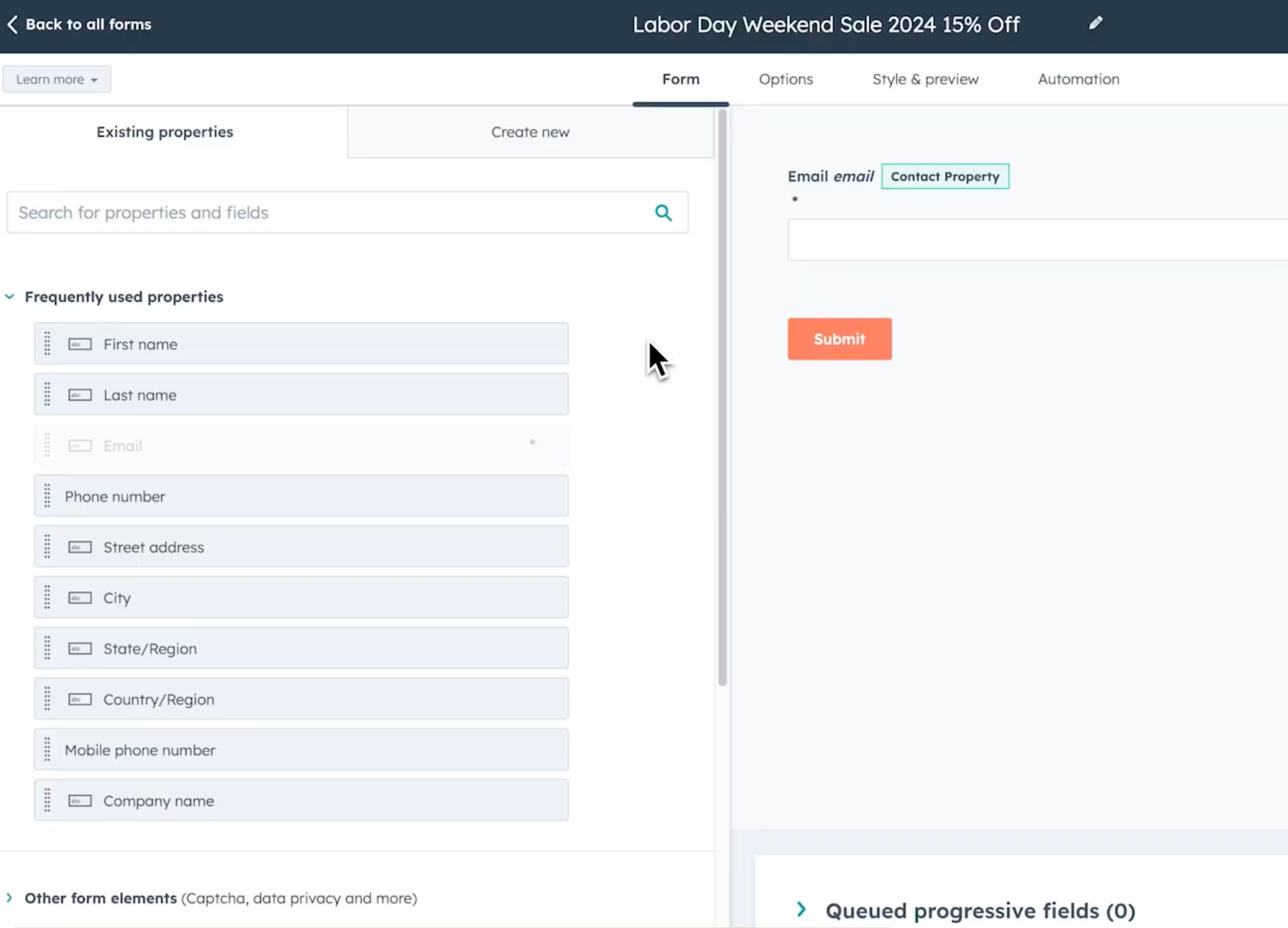
What is the HubSpot form builder mainly used for?
HubSpot’s form builder is mainly used for lead capture inside the broader HubSpot ecosystem. It lets you:
- create embedded or standalone forms,
- send submissions straight into HubSpot’s CRM,
- and use them as the starting point for follow-up emails, routing, and nurture flows.
HubSpot also supports multi-step forms, while some more advanced features, such as conditional logic, are gated to higher-tier plans.
Key features include:
- Drag-and-drop form creation
- Pre-built templates
- Automatic sync with HubSpot CRM
- Standalone forms and embeddable forms
- Form reporting and conversion tracking
What are some HubSpot form builder pros?
- Forms plug directly into the rest of the HubSpot platform
- Intuitive interface and relatively easy setup
- Convenience of having forms, CRM, email, and automation in one place
- Solid reporting and visibility into performance
- Strong fit for teams already using HubSpot for marketing and sales
What are some HubSpot form builder cons?
- Pricing that can climb quickly as your needs and contact volume grow
- A broader platform learning curve if you only want a simple standalone form tool
- Complaints that parts of the builder feel clunky
- Better value for businesses already inside the HubSpot ecosystem than for teams shopping for forms only
Is HubSpot a good alternative to Typeform?
HubSpot’s biggest strength as a Typeform alternative is that it makes form submissions possible to immediately become contacts in your CRM and feed into broader marketing workflows. That makes it especially appealing for lead gen teams already invested in HubSpot.
That is the main tradeoff here: HubSpot forms are compelling when you want CRM-connected lead capture, but they can feel like too much platform if your priority is simply creating polished standalone forms or surveys. This is also where Typeform may still feel lighter and more specialized.
Pricing
HubSpot’s form builder is available on the free plan, so you can start using forms without paying extra. However, some advanced capabilities tied to forms are reserved for paid tiers. For example, conditional logic for forms requires Marketing Hub or Content Hub Professional or Enterprise.
So, in practice:
- Free: basic form building and CRM-connected lead capture
- Paid tiers: more advanced capabilities inside the wider HubSpot platform
- Higher-tier plans: where features like advanced form logic come in
forms.app
What is forms.app mainly used for?
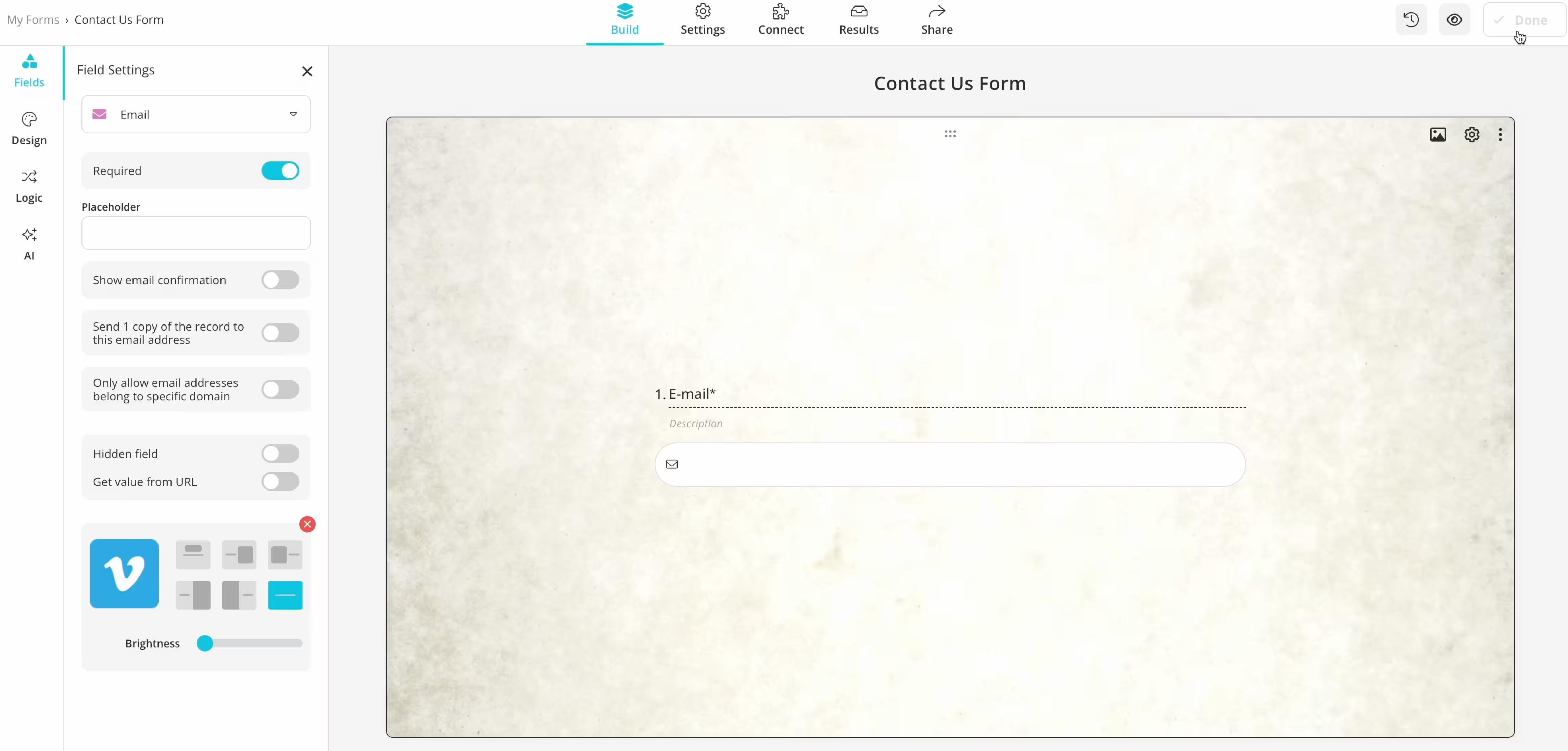
With forms.app, users can quickly create forms, surveys, and quizzes by using a large library of pre-built templates or its AI-powered form generator. The platform is positioned as an easy, no-code tool for collecting registrations, feedback, payments, and other responses online.
What does forms.app offer?
forms.app keeps its original appeal as a beginner-friendly form builder. Key capabilities include:
- A large template library with 5,000+ templates
- AI-powered form generation
- Free theme options for visual customization
- Multiple question types
- Conditional logic
- Calculators
- Product baskets
- A mobile app for creating forms and tracking results on the go
In addition, forms.app provides an AI-powered form generation feature that enables you to create forms and questionnaires more quickly. You describe what you want to build, and the platform generates a starting version for you.
What are some forms.app pros?
Here’s where forms.app shines:
- A user-friendly, easy-to-navigate interface
- Quick setup without technical skills
- A strong range of templates
- Generous free access to useful features
- Visually polished forms for a no-code tool
What are some forms.app cons?
The most recurring drawbacks are:
- Free-plan response limits
- Pricing that feels less attractive once you need to upgrade
- Limited design customization compared with some more flexible tools
- Some friction with more complex form-building workflows
Pricing
forms.app has a free forever plan, plus three paid plans: Basic, Pro, and Premium, with prices ranging from $19/month to $79/month.
The free plan is generous in terms of feature access (such as 30+ field types, conditional logic, and AI-powered features), but it still comes with important limits:
- up to 5 forms
- 100 responses/month
- 10 MB file storage
Google Forms
What is Google Forms mainly used for?
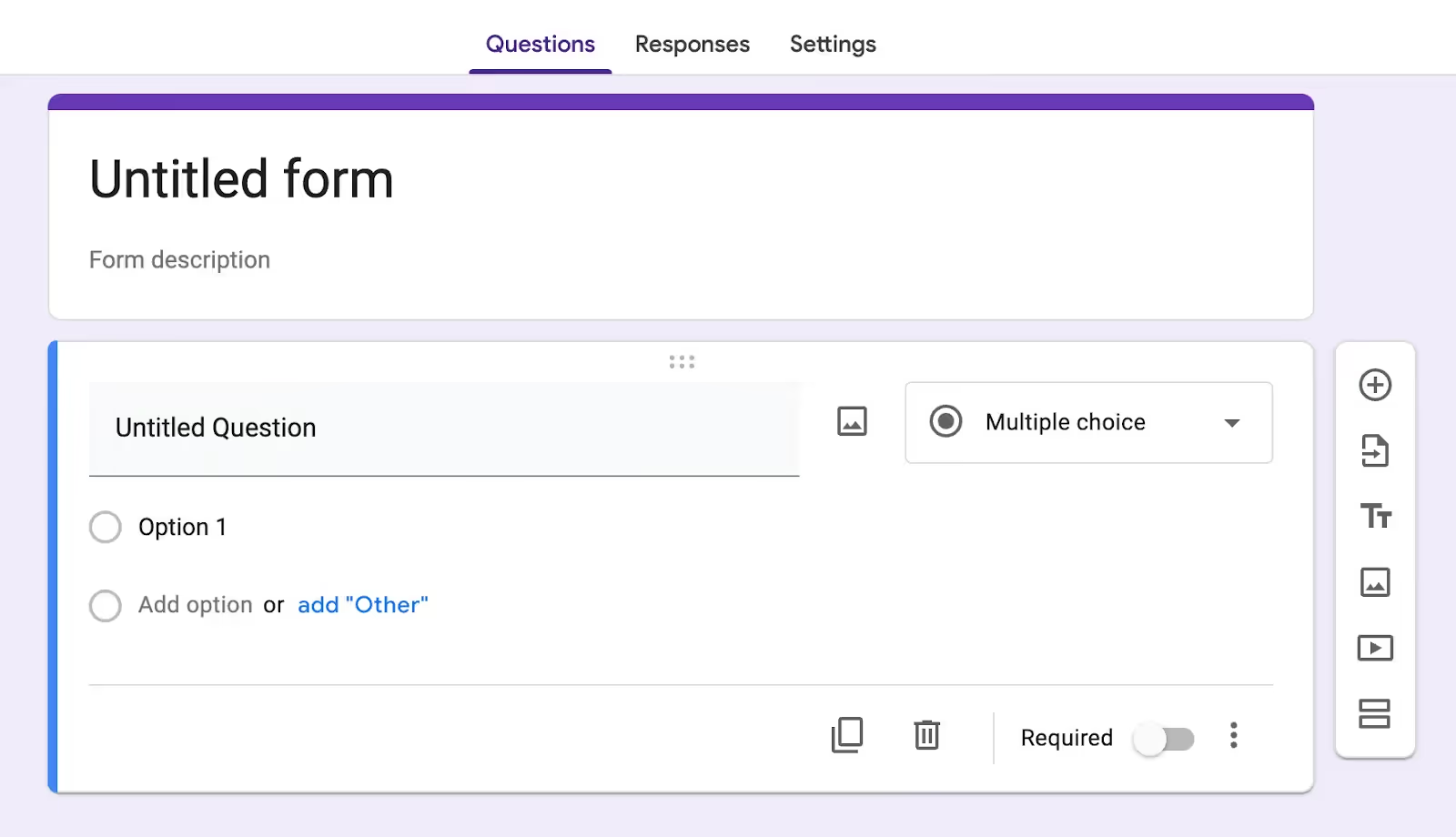
Google Forms is a popular and simple tool for creating forms, quizzes, and surveys. While it is limited in features, it is entirely free – all you need is a Google Account. Since most users are already familiar with Google tools, the process is usually intuitive and easy.
What does Google Forms offer?
Google Forms lets you create simple forms and quizzes and review incoming responses in real time. You can also set up basic survey logic and export responses for further analysis.
Key features include:
- Form, survey, and quiz creation
- Basic survey logic
- Basic response summaries and charts
- CSV export
- Google Sheets integration
How does Google Forms compare to Typeform?
Compared to Typeform, Google Forms is much simpler and more limited, but it is completely free. Its forms look less polished because customization and advanced features are more basic. There are no integrations besides Google Sheets, while Typeform offers connections with, for example, Slack and Zapier.
Generally, Google Forms is a better fit for straightforward internal, private, or low-cost use cases, while Typeform is stronger for more branded and visually polished forms.
What are some Google Forms pros?
The main advantages of Google Forms are:
- Being completely free
- Ease of use
- Quick setup
- Easy response handling through Google Sheets
What are some Google Forms cons?
The biggest limitations are:
- Limited customization and no branding
- Only basic analytics
- Few advanced features
- A less professional look than more design-focused tools
Pricing
Google Forms is entirely free to use with a Google Account.
Jotform
What is Jotform mainly used for?
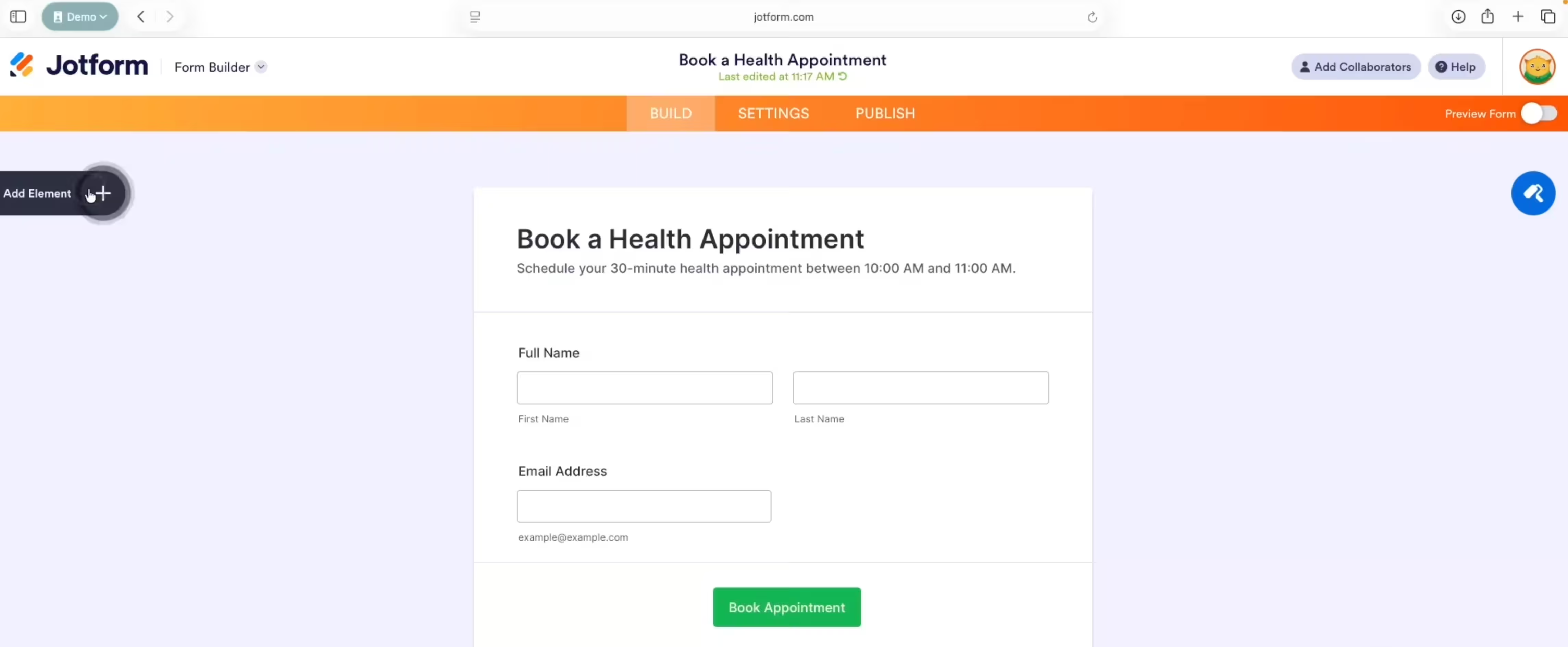
Jotform is an online form builder that makes it easy to build forms with over 10,000 templates. As of 2026, Jotform offers 20,000 form templates and promotes 40+ payment gateway integrations, including:
- PayPal
- Stripe
- Square
- ClickBank
How does Jotform compare to Typeform?
Online marketplaces show users rate Jotform as superior to Typeform in areas like Ease of Admin and “good partner in doing business”. Jotform is another piece of software that allows users to choose from a static or question-per-page view.
Jotform’s “card form” (question-by-question) layout is a direct alternative to Typeform’s signature flow.
Both tools can feel quite complex once you go beyond simple forms – especially when you start adding advanced logic, integrations, or workflows.
What are some Jotform pros?
The main advantages are:
- Easy to get started with
- Strong customization options for many everyday use cases
- Plenty of integrations that help automate what happens after the form is submitted
- Good “all-in-one” option when you need lots of features in one place
What are some Jotform cons?
Some drawbacks include:
- Pricing can feel expensive, especially if you don’t use it frequently or want a smaller step-up plan
- Some users report missing features or limitations in how far they can customize certain elements
- Occasional “form issues” (e.g., navigation/resizing quirks) are mentioned in reviews
- UI can feel less polished and more “busy” compared to Typeform-style form experiences
Pricing
Jotform’s subscription model is mainly based on usage limits (like forms, submissions, and storage) rather than per-seat pricing – but Starter/Bronze/Silver/Gold are single-user plans. If you need multiple users in one account, you typically need Enterprise.
The pricing ranges from $34/month to $129/month, depending on plan and billing method (monthly or annual payment).
While Jotform offers a free plan (Starter), it is fairly limited:
- 5 forms
- Up to 100 monthly submissions
- Not possible to remove Jotform’s branding
Paperform
What is Paperform mainly used for?
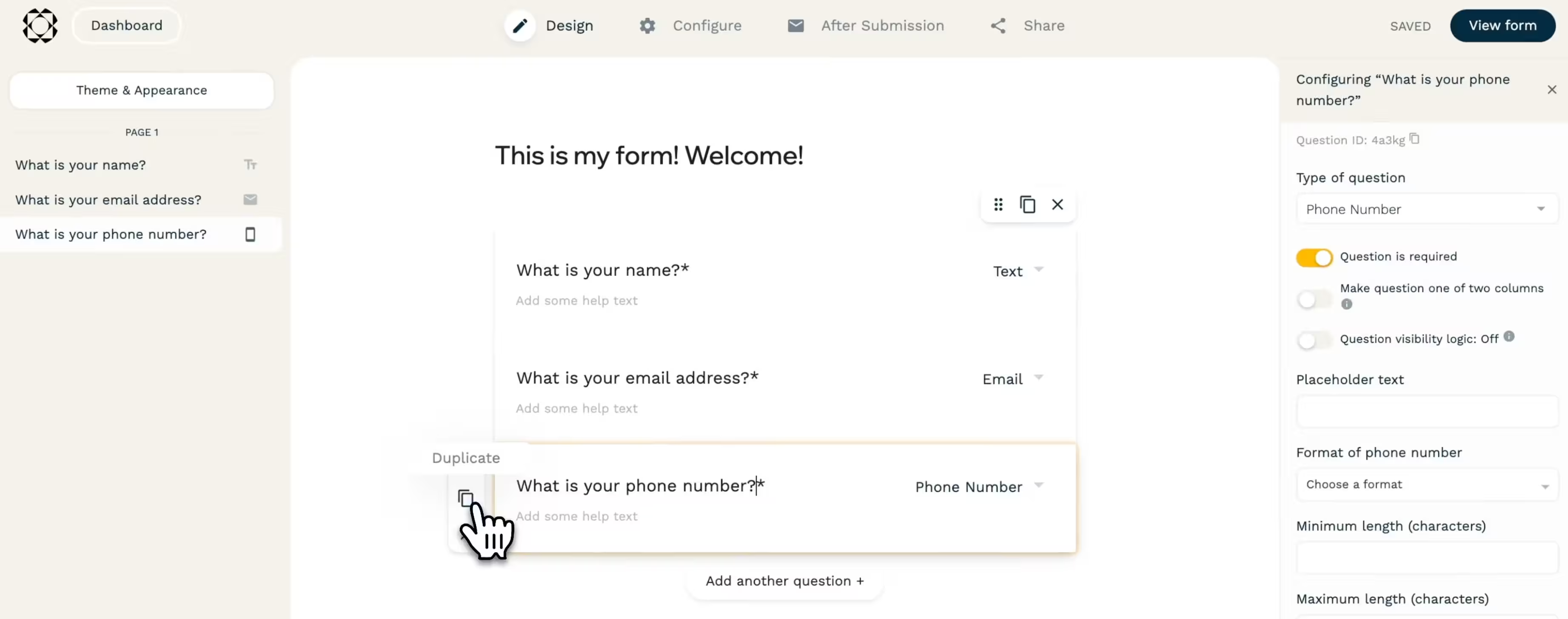
Paperform is a versatile form software for making responsive forms, payment forms, and bookings using conditional logic. The tool feels more like a lightweight page builder than a classic form tool – so it might be a fit if you want “website-like” forms, landing-style layouts, and flexible customization without heavy dev work.
When is Paperform a good pick for payment forms?
Paperform could be the way to go if you want to make payment forms. They pair with:
- Google Pay
- Stripe
- PayPal (via PayPal Business / Braintree)
- Square
- Braintree
What’s Paperform like for design and customization?
Paperform has a fun feature wherein you can use an “I’m feeling lucky” button to generate random designs for the forms. They offer unique templates and solid customization options. They also pair with email marketing integrations to make distribution easier.
Paperform also supports a one-question-at-a-time mode which gets you closer to the Typeform-style flow.
What are some Paperform pros?
The main advantages are:
- Strong customization for forms that need to feel “website-like” (not just a basic survey)
- Good for operational use cases beyond simple lead forms (payments, bookings, signatures, conditional logic)
- Solid integrations ecosystem, so it’s easy to push submissions into your CRM, support, etc.
- Support is consistently described as a standout (especially for non-technical users building advanced forms)
What are some Paperform cons?
Some drawbacks include:
- Pricing can feel high if you “just need forms” (it’s positioned more as a premium, flexible builder)
- Usage limits are real (submissions/payment submissions/appointment submissions), so costs can rise with volume
- Multi-user collaboration and some brand-control features kick in on higher tiers – not available on the entry paid plan
Pricing
Paperform paid plans range from $24/month to $129/month (depending on a plan and billing method).
There is also a free plan, and new accounts are placed on a 7-day Pro trial (not 14 days).
Wufoo
What is Wufoo mainly used for?
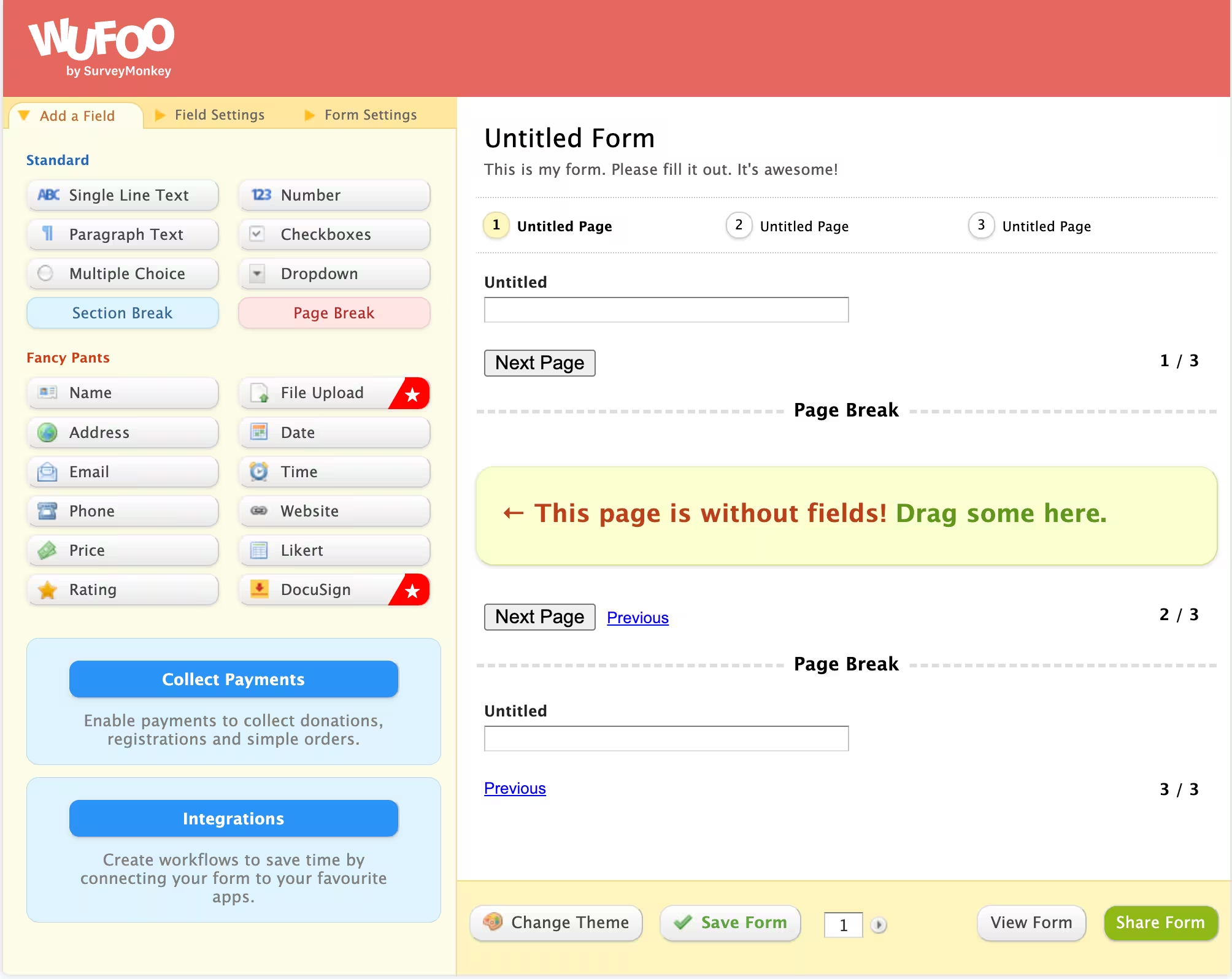
Wufoo, acquired by SurveyMonkey already back in 2011, is a straightforward form builder for creating classic, static web forms, like contact forms, registrations, and simple checkout forms. It might be worth considering when you value speed and simplicity over a Typeform-style conversational flow. The tool is owned by SurveyMonkey (acquired in 2011) and is generally considered easy to pick up.
What payment partners does Wufoo support?
Wufoo pairs with payment partners like:
- PayPal
- Stripe
- Authorize.net
How does Wufoo compare to Typeform?
Typeform is best known for its one-question-at-a-time flow, while Wufoo is the opposite – its forms are primarily static.
There are fewer customization options, and some customers complain of an “outdated feel.” On the other hand, Wufoo is cheaper than Typeform on entry tiers, especially if you care about response volume more than a conversational form experience.
What are some Wufoo pros?
The main advantages are:
- Very easy to set up and use for classic, embeddable forms
- Solid customization for everyday use cases – forms look good “out of the box” without heavy technical work.
- Integrations are a real plus (users often mention connecting Wufoo with other apps).
- Practical admin features: email notifications/confirmations and easy exports (e.g., downloadable spreadsheets).
What are some Wufoo cons?
Some drawbacks include:
- The design is frequently described as outdated compared to newer form builders
- It can feel clunky and harder to navigate once you go beyond simple forms
- Entry limits come up as a recurring frustration for higher-volume use cases.
Pricing
Wufoo pricing ranges from $16.25/month to $210.25/month when billed annually – and there’s also monthly billing available at a higher monthly rate.
If you’re choosing Wufoo mainly for paid workflows, note that accepting payments starts on the Professional plan, and multi-user access also begins there.
Wufoo also offers a Free plan, which includes:
- 5 forms
- 100 entries/month
- 10 fields
- 1 user (with email support).
123FormBuilder
What is 123FormBuilder mainly used for?
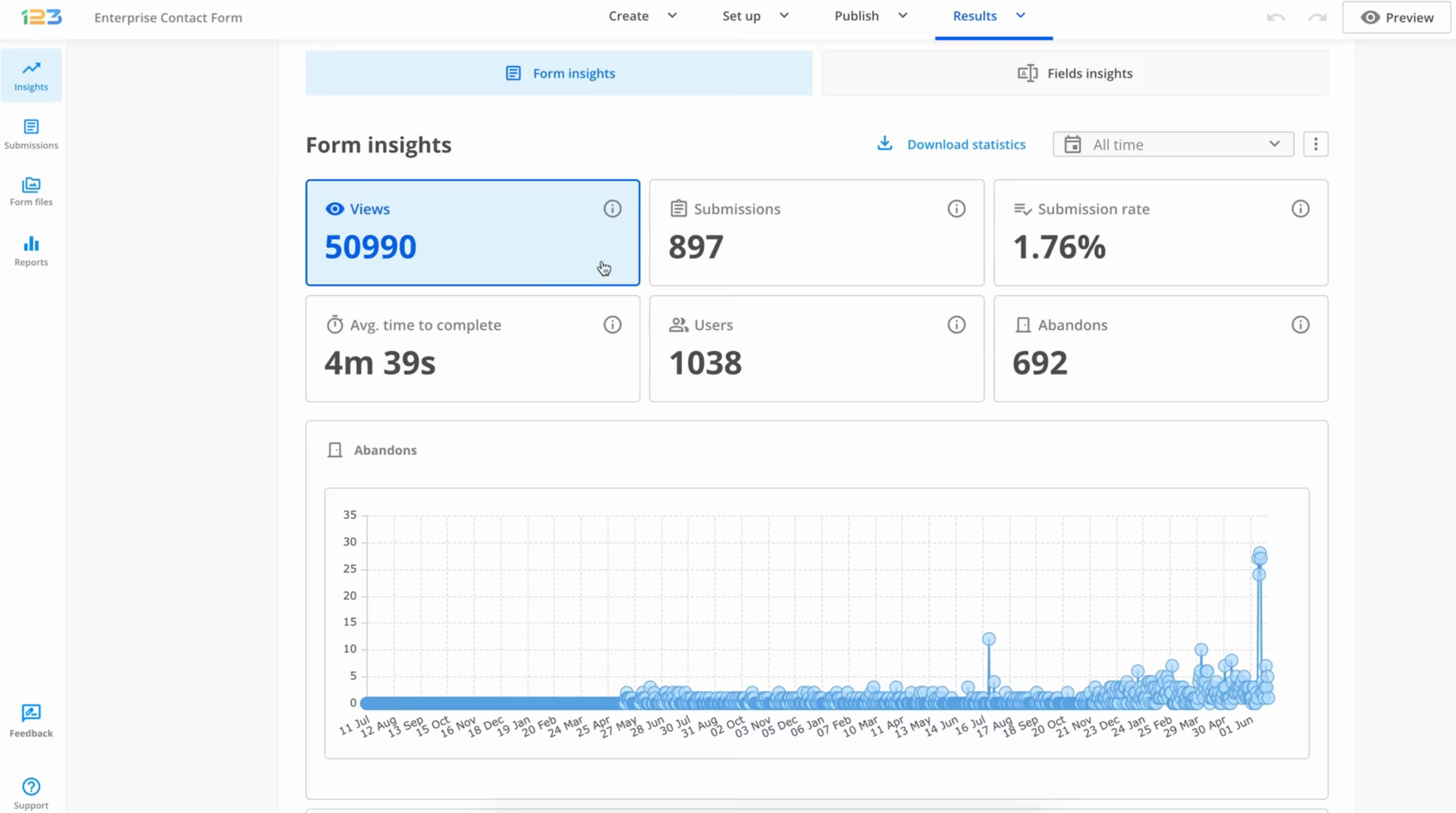
123FormBuilder is a form builder geared toward teams that need workflow-friendly forms, with CRM integrations and multiple payment gateways (beyond the usual Stripe-only setup). It’s commonly used for lead capture and operational workflows where submissions need to go somewhere specific after they’re collected. 123FormBuilder also has an interesting feature: convert paper forms into digital forms.
How do 123FormBuilder integrations work?
123FormBuilder connects with tools like HubSpot, Mailchimp, and Salesforce. Salesforce has deeper capabilities, including pushing data into the tool and prefilling forms with CRM data.
What payment options does 123FormBuilder support?
As with many form tools, 123FormBuilder offers more payment options than Typeform, including:
- PayPal
- Stripe
- Authorize.Net
- PayU
- Braintree
- PayFast
- (and others, depending on region)
What are some 123FormBuilder pros?
The main advantages are:
- Strong CRM fit (especially if Salesforce is central to your process)
- Broad payment gateway support compared to design-first builders
- Practical operational features like approvals, signatures, and document generation
- Solid scalability in submission volume across tiers (from small to very high volume)
What are some 123FormBuilder cons?
Some drawbacks include:
- Some key “serious” capabilities are tier-gated (payments, advanced analytics, higher security controls)
- If the main goal is a polished, Typeform-like respondent experience, 123FormBuilder’s design may feel a bit outdated
- The “native integrations” story varies: some connections are built-in, while others are commonly done via Zapier
Pricing
123FormBuilder pricing ranges from $18.50/month to $225/month per user (depending on plan and billing method).
Plan-gated things worth knowing (because they change the “real” price for common use cases):
- Payments (15+ gateways) start from Platinum
- Advanced analytics also starts from Platinum
- Higher security controls like data encryption appear from Diamond; HIPAA is handled via sales
Formstack
What is Formstack mainly used for?
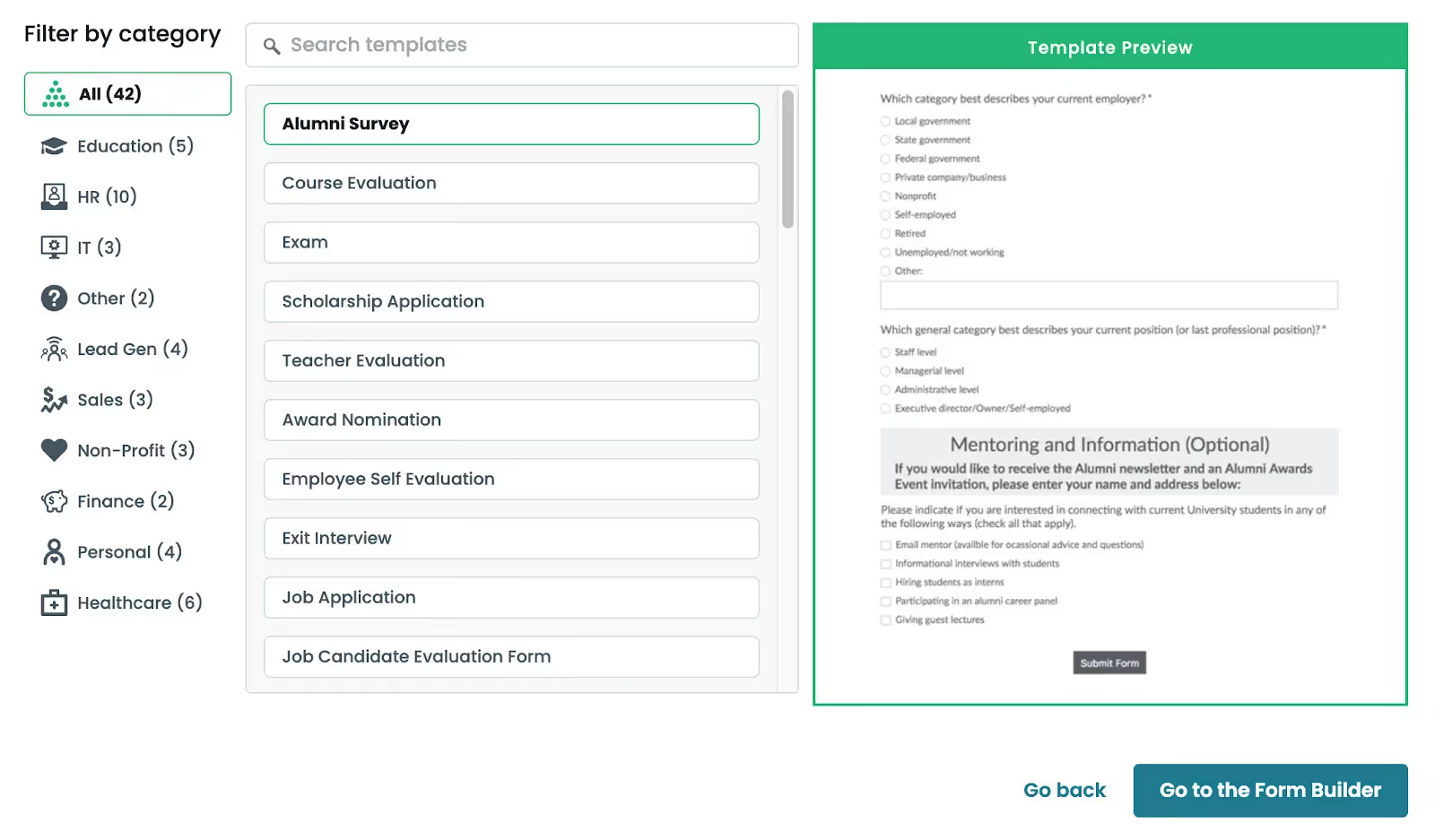
Formstack is a no-code form builder designed for operational workflows – where you don’t just collect data, but also validate it, route it, and use it downstream (often across teams and systems).
What features stand out in Formstack Forms?
Formstack’s most significant advantages are its field validation and ability to collect e-signatures on your forms without integration. It also supports form prefill and SSO user management, which matters when forms become part of repeatable internal processes.
What should you know about the builder and logic setup?
Their editor can be a bit tricky, but templates and AI-assisted form creation can help you get started faster.
On the other hand, Formstack’s conditional logic is a bit more complicated to set up. There is no flowchart-style visualizer, so you must be careful when setting up your branching.
What are some Formstack pros?
The main advantages are:
- Easy to build and publish forms without code
- Strong integrations that help you route submissions into your stack
- Reliable data capture for operational use cases (validation reduces errors early)
What are some Formstack cons?
Some drawbacks include:
- Pricing is enterprise-leaning and can feel expensive for simple needs
- Customization can feel limiting compared to design-first builders
- Logic and navigation can become confusing as forms and rules get more complex
- Support experience is inconsistent: some users hit slow response times and unhelpful resolutions
Pricing
Formstack Forms pricing ranges from $83/month to $99/month (depending on billing method) for the core Forms product, and Formstack also sells a Suite bundle that ranges from $250/month to $299/month (annual vs monthly). Enterprise is quote-based.
On the entry Forms tier, expect key limits like:
- 1 builder user
- 25 forms
- 1,000 submissions per form
Formstack offers a 14-day free trial, but no free plan.
Typeform alternatives for quizzes
These five tools are good Typeform alternatives if you want to make quizzes:
- Opinion Stage
- Outgrow
- Leadquizzes
- Involve.me
- Bucket.io
We picked them based on customization, pricing, and extra features.
Opinion Stage
What is Opinion Stage mainly used for?
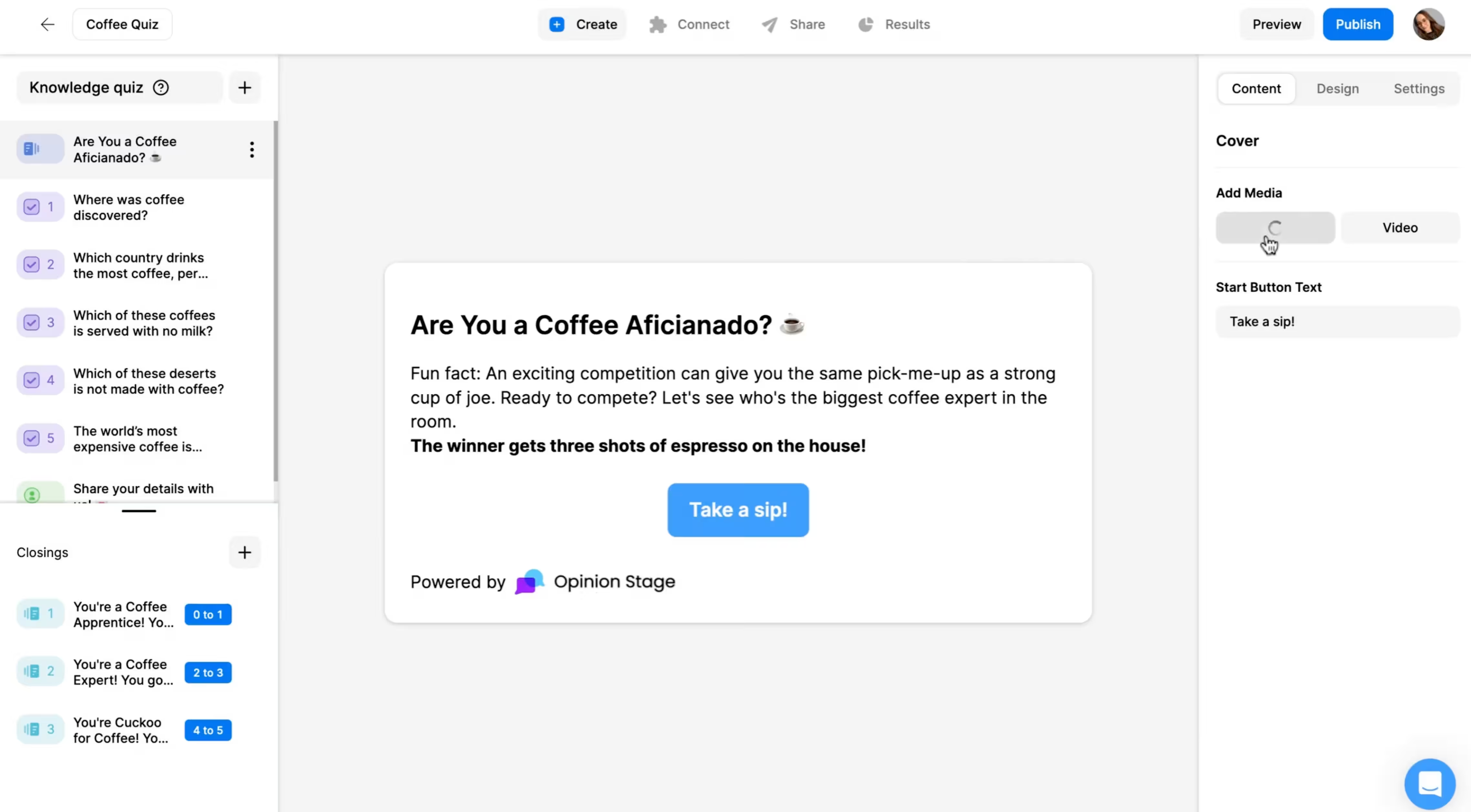
Opinion Stage is a form, survey, and quiz platform built for creating interactive, engagement-first content (quizzes, polls, surveys, forms) without code.
Notable features include:
- 100+ templates and AI capabilities
- Real-time visual analytics for keeping track of the responses
- Conversational style with smart logic, which adjusts the flow based on respondent’s answers
What customization options does Opinion Stage offer?
If you're looking for a platform that allows for customization, you might take interest in Opinion Stage. The tool lets you upload your own custom CSS and logo, and there's also a white label option to make it look like you made your content in-house.
Important nuance: removing Opinion Stage branding is part of Business plans, while custom CSS branding is listed under Enterprise.
What are some Opinion Stage pros?
The main advantages are:
- One-question-at-a-time and smart logic gives you a Typeform-like, conversational flow that works well for quizzes
- Conversion tracking and drop-off reports (on Business tiers) make it easier to optimize completion and ROI for campaigns
- Easy distribution, including a strong WordPress presence, which matters if quizzes live on content pages
- Clear, visual reporting and exports for sharing results
What are some Opinion Stage cons?
Some drawbacks include:
- The free plan’s 25 responses cap is tight, so you hit limits fast
- Key “marketing polish” features (e.g., remove branding, conversion tracking, drop-off) sit on higher tiers
- It’s strongest for interactive marketing content; for deep survey research programs, you may outgrow the analytics and governance depth.
Pricing
Opinion Stage paid plans range from $25/month to $500/month, depending on plan and billing method. Enterprise is custom.
Opinion Stage also offers a free forever plan, which includes:
- 25 responses/month
- 1 user
- core creation features
On higher tiers, key additions include removing Opinion Stage branding, conversion tracking and drop-off reports, team features, and higher response limits.
Outgrow
What is Outgrow mainly used for?
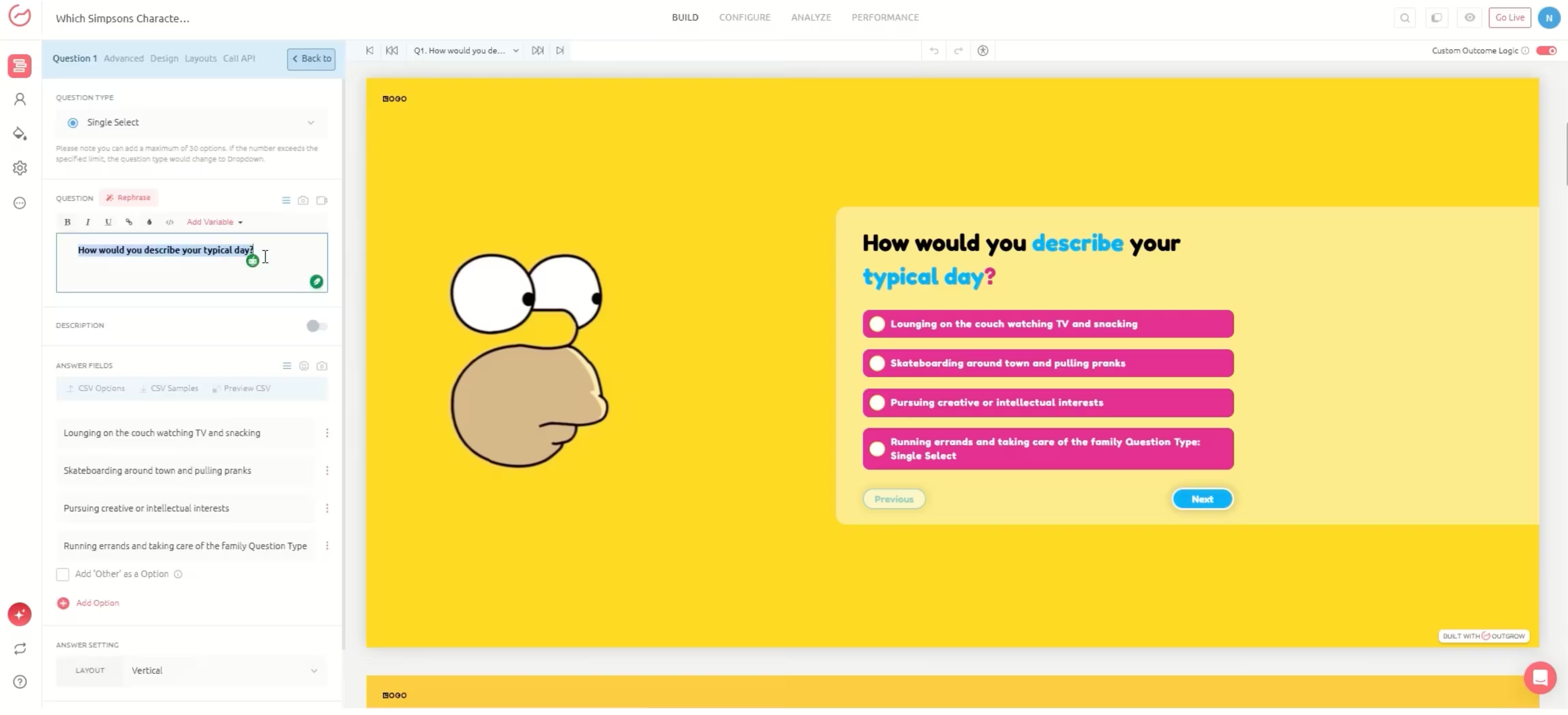
Users choose Outgrow to make interactive calculators, quizzes, polls, and chatbots with a no-code drag-and-drop builder.
How is Outgrow a better fit than Typeform for quizzes and calculators?
If you are looking for a tool to create complex or highly custom quizzes, Outgrow could be a better choice than Typeform. Customers highlight the customization features, which go beyond Typeform’s one layout.
You can also customize the URL your quiz is hosted on. Outgrow supports hosting calculators and quizzes on your own custom domain, instead of an Outgrow subdomain.
What are some Outgrow pros?
The main advantages are:
- Strong set of interactive content types (especially calculators and quizzes) built for lead gen and qualification
- Plenty of templates you can adapt quickly instead of building from scratch
- Helpful support is a recurring strength
- Robust logic and calculations once you go beyond basic “form” complexity
What are some Outgrow cons?
Some drawbacks include:
- A learning curve for advanced logic (simple builds are easy, but more complicated ones take time)
- Features are notably limited on cheaper tiers (common friction is “limited features for the price”)
- Pricing can scale quickly once you need more content pieces, higher lead volume, or higher-tier features
Pricing
Outgrow paid plans range from $14/month to $720/month (depending on plan and billing method). Enterprise plans are custom.
Outgrow also offers discounted pricing for new businesses and eligible startups (via its Startup plans).
Outgrow offers a free plan, but it’s limited to “Forms & Surveys” only (no calculators or quizzes):
- 4 content pieces
- 100 leads a month (1,200 a year)
There is also a 7-day free trial and you don’t have to provide credit card info.
LeadQuizzes
What is LeadQuizzes mainly used for?
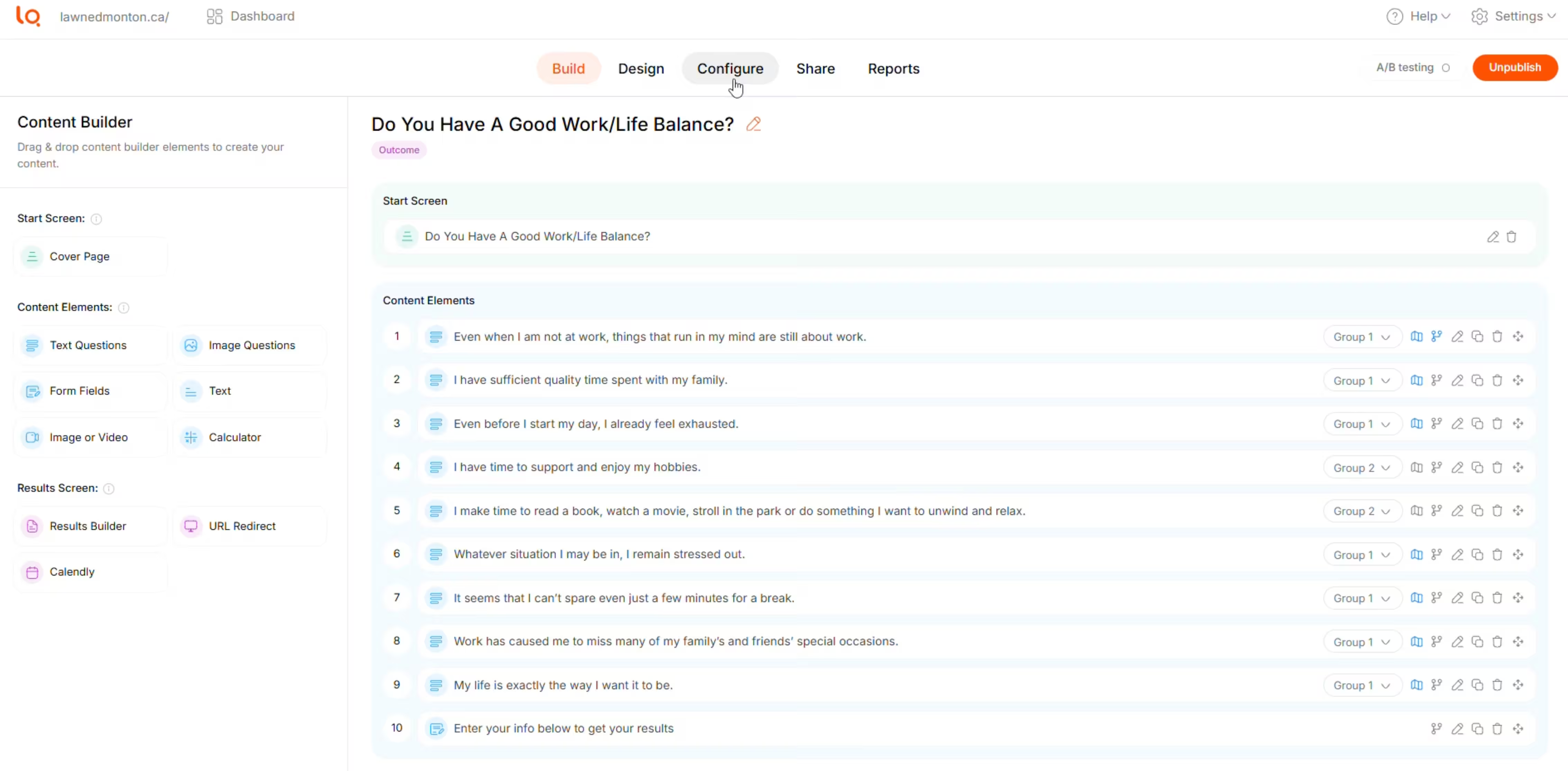
LeadQuizzes is a quiz-first platform for building interactive quizzes, assessments, and lead capture experiences. It’s built to help you qualify leads, segment audiences, and follow up based on outcomes. It also supports surveys and forms, so it’s not limited to quizzes only.
When is LeadQuizzes a better fit than Typeform?
LeadQuizzes can be a better choice than Typeform when you want to run quizzes at scale and you care more about lead qualification and routing than a design-first form experience. Plans scale mainly with monthly response limits and the number of websites you manage.
What about integrations and automation?
LeadQuizzes has an integrations directory and also works with Zapier, but integrations are not available on the entry plan. You unlock “pro integrations” starting from the Standard tier.
What are some LeadQuizzes pros?
The main advantages are:
- Easy way to build lead qualification quizzes and assessments with branching and scoring
- Branding control even on lower tiers, so quizzes can feel fully in-house
- Scales better than many form builders when response volume is the main constraint
- You can run content across multiple websites once you move up to higher plans
What are some LeadQuizzes cons?
Some drawbacks include:
- No permanent free plan, only a time-limited trial
- Integrations are locked behind higher tiers, so the entry plan can feel restrictive
- Response caps are strict, and overages can add up when a quiz suddenly takes off
- If you mainly need flexible forms and surveys for research workflows, you may find it more specialized than necessary
Pricing
LeadQuizzes paid plans range from $9/month to $229/month, depending on the plan and whether you pay yearly or monthly. Overage fees apply if you exceed your included response limit.
LeadQuizzes offers a 14-day free trial.
Involve.me
What is Involve.me mainly used for?
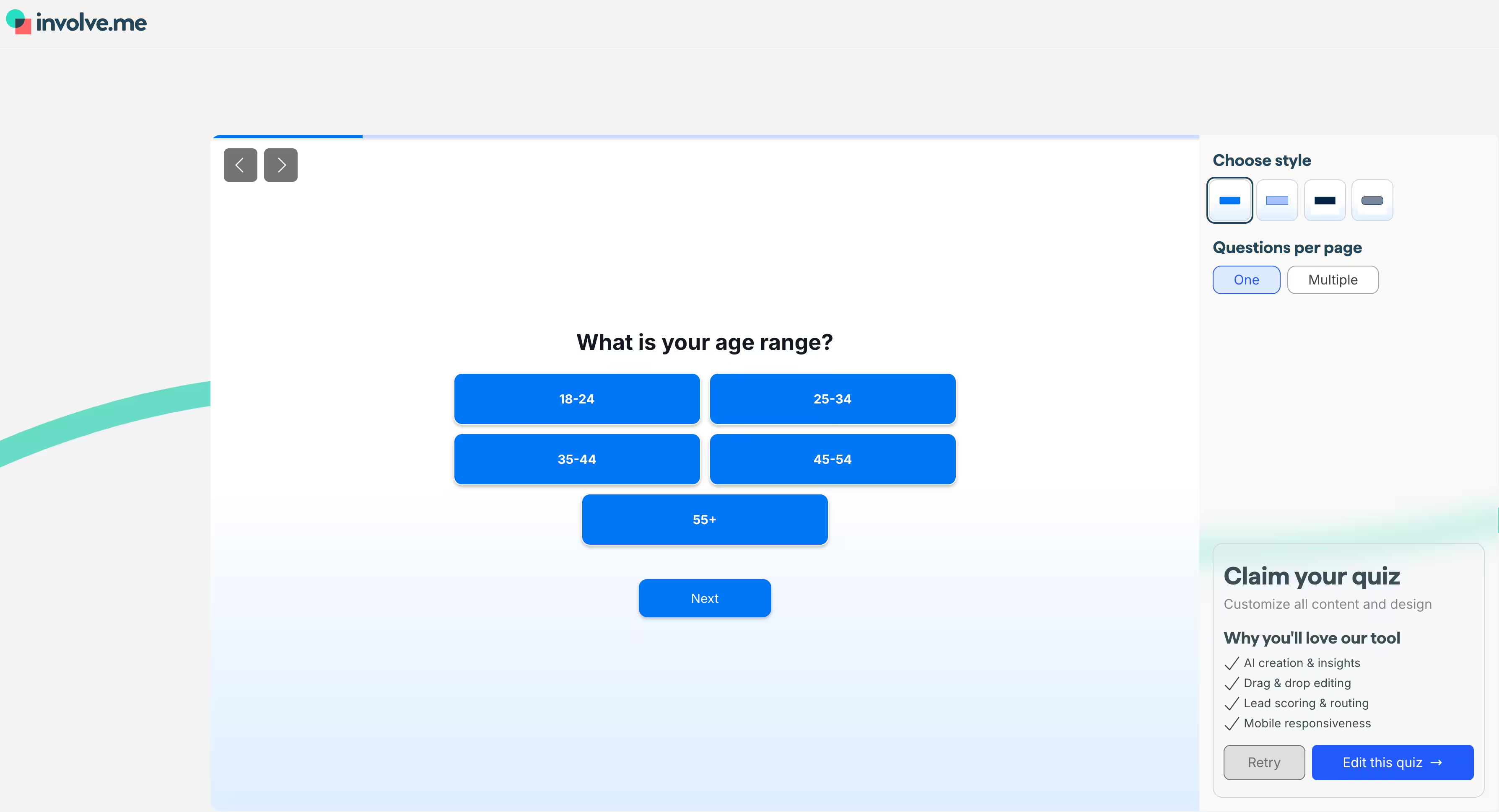
Involve.me is a no-code platform for building interactive funnels such as quizzes, calculators, payment forms, and landing pages. You can publish them as standalone landing pages, embeds, or pop-ups, so it works well for lead capture and qualification across a website. The tool offers native integrations, Zapier, and webhooks on higher plans.
What analytics and optimization features does Involve.me offer?
Involve.me has built-in funnel analytics, so you can see how people move through your funnel, where they drop off, and what answers they give. On higher plans, you can also pass UTM parameters and run A B tests, which is useful when you treat quizzes and calculators as performance assets, not just forms.
What are some Involve.me pros?
The main advantages are:
- Easy to build interactive funnels quickly, especially quizzes and calculators
- Strong customization for branded experiences
- Helpful support is a common strength (support chat for active accounts plus email tickets)
- Solid set of built-in integrations
What are some Involve.me cons?
Some drawbacks include:
- Some key features are gated: removing branding starts on Pro, while custom CSS and webhooks start on Business
- Pricing can feel steep if you only need a simple form tool, especially as you move into Pro and Business tiers
- The free plan is quite limited for real campaigns, so you often outgrow it quickly
Pricing
Involve.me paid plans range from $29/month to $199/month depending on the plan and billing method. Enterprise starts from $399/month on annual contracts.
Involve.me offers a free plan with up to 50 submissions or 500 visits per month, no credit card required.
There is also a 14-day trial, but it requires billing details and it autostarts the selected plan unless you cancel in time.
ScoreApp (formerly Bucket.io)
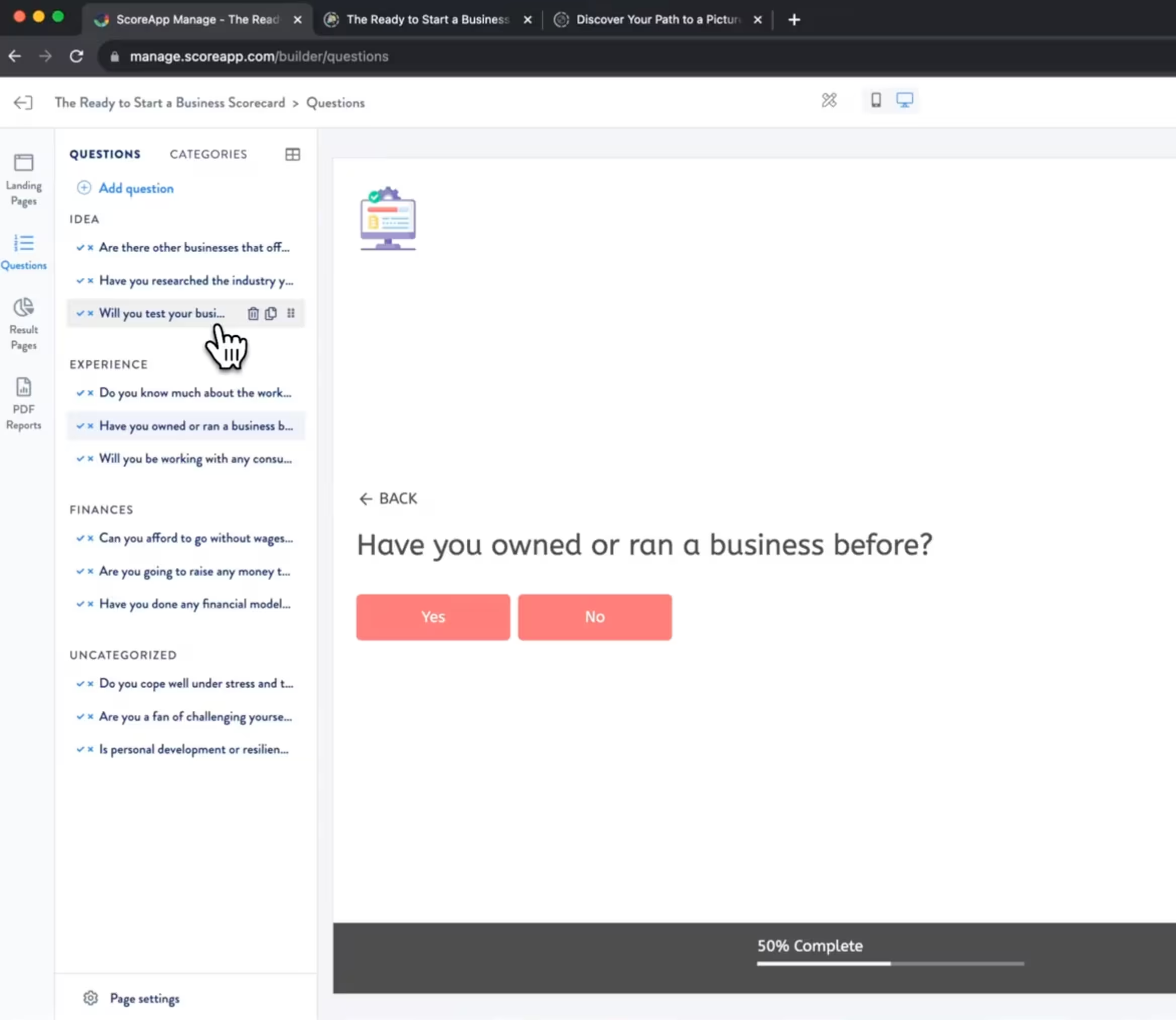
What is ScoreApp mainly used for?
ScoreApp is a quiz and assessment tool built for lead capture and qualification. It helps you run scorecard-style funnels where respondents get a tailored outcome, and you can route leads based on their answers and score.
What makes ScoreApp a good Typeform alternative?
ScoreApp is closer to a quiz funnel builder than a general purpose form tool. If your main goal is segmentation, scoring, and follow-up automation, it may be a better fit than Typeform.
Notable features include:
- Scorecards with scoring and outcome logic
- Landing pages and templates for quiz funnels
- Funnel analytics focused on drop-off and conversions
- Multi-language support
What are some ScoreApp pros?
The main advantages are:
- Strong for score-based lead qualification and segmentation
- Built to optimize quiz performance, not just collect responses
- Integrations plus Zapier and webhooks make it easier to push leads into your stack
What are some ScoreApp cons?
Some drawbacks include:
- Less flexible than Typeform for general forms and surveys
- Advanced scoring funnels can take time to design well
Pricing
ScoreApp paid plans range from about $30/month to $799/month, depending on plan and billing method.
ScoreApp also offers a free plan with a small monthly response allowance, which is useful for testing a scorecard before you commit.
Choosing the right Typeform alternative for customer feedback & surveys, forms, and quizzes
If you made it this far, you’ve probably already figured out the pattern: Typeform is specialised at making forms feel polished and “easy to answer,” but it’s not always the easiest tool to live with once you scale volume, need more payment options, or want fewer features gated behind higher plans. That’s why the best Typeform alternative depends less on “which tool is best” and more on what you’re actually building: surveys, forms, or quizzes.
If your use case is surveys and customer feedback, the strongest alternatives are the tools that were built for feedback workflows first (not for lead capture). That’s where Survicate typically wins: you can collect feedback across customer touchpoints, uncover AI-assisted feedback insights, and plug the results into your workflow.
The platform is consistently praised for requiring minimal dev implementation support, quick to launch across channels, and genuinely helpful when it comes to support – so you can focus on acting on feedback rather than wrestling with tooling. Survicate comes with a 10-day free trial that offers a wide range of features. Sign up today and start collecting customer insights with Survicate!
If you’re here mainly for forms, think about whether you want “feature-rich and flexible” or “website-like and beautifully customizable.” For example, Jotform offers a huge template ecosystem and broad payments support and Paperform can be a good pick when you want forms that feel like landing pages.
If you’re building quizzes, calculators, and assessment-style funnels, you’ll get more mileage from tools designed for that: Outgrow for interactive calculators, Opinion Stage for engagement-first quizzes, or ScoreApp if you want a scorecard funnel that’s built around lead qualification and outcomes.





.svg)

.svg)


