Hotjar earned its reputation on heatmaps and session recordings. But a lot of the people who actually log in every day are product managers using the on-site surveys, the feedback widget, or the exit-intent poll that catches someone before they bounce. If that is you, Hotjar is probably where you go between bigger research projects: to validate an assumption, watch for friction, and catch a signal early enough to act before the next sprint.
That is the lens I use in this guide. I looked at seven Hotjar alternatives through the main question: which tools help a product team trigger the right question at the right moment inside the product, then turn the answers into a decision? I left the pure heatmap-versus-heatmap comparison for another day, because the survey and feedback side is where most product managers feel Hotjar's limits first.
A quick note on me before the table: I’m with Survicate, so Survicate is on this list. I have tried to keep the comparison fair by judging every tool, including ours, against the same product-team yardstick.
TL;DR
- For product teams that want behavioral, in-product feedback they can act on, Survicate and Sprig cover the most ground, for different reasons: Survicate pairs multichannel targeting with an AI research repository that closes the loop into your roadmap and CRM. Sprig goes deepest on AI-driven in-product research if your budget stretches to it.
- Pendo makes sense when surveys ride alongside heavy product analytics.
- Qualtrics is the enterprise option you grow into, not the one you start with.
- Typeform wins on design but is built for standalone forms, not in-product targeting.
- Refiner and Iterate are lighter, focused in-app survey tools that fit smaller product teams.
7 Hotjar Alternatives for Product Teams Compared
| Tool | G2 rating | Known for | My 2 cents |
|---|---|---|---|
| Survicate | 4.6 / 5 | Multichannel surveys plus an AI research repository | Strongest when you want behavioral in-product surveys and a way to act on them across your stack. No native heatmaps or recordings. |
| Sprig | 4.5 / 5 | AI-powered in-product research | Deepest behavioral targeting and AI analysis on the list. Costs climb fast and the best AI sits behind Enterprise. |
| Pendo | 4.4 / 5 | Product analytics with in-app guides and polls | Great if you already live in product analytics. Feedback is more of a side feature, and pricing is opaque. |
| Qualtrics | 4.4 / 5 | Enterprise experience management | The most capable platform here and the most expensive. Overkill for a product team that just wants quick in-product feedback. |
| Typeform | 4.5 / 5 | Design-forward conversational forms | Nice forms with a strong respondent experience. Weak on in-product behavioral targeting, and partial answers can be lost. |
| Refiner | 4.6 / 5 | Lightweight in-app microsurveys for SaaS | Clean and easy for a solo PM or small team. Limited logic, no AI analysis, and a small public review base. |
| Iterate | Limited G2 reviews | In-product and mobile surveys for product teams | Solid for on-brand web and app surveys. Smaller player with custom-only pricing and a thinner review base. |
Why are people leaving Hotjar?
Most product managers do not wake up wanting to replace Hotjar. They hit a wall, usually one of these.
Hotjar’s move into Contentsquare changed the package
As of July 2025, Hotjar merged into Contentsquare, and the heatmaps, recordings, surveys, and feedback widgets now live inside the Contentsquare platform. New sign-ups go straight to Contentsquare, while existing accounts are migrating through 2026. According to the Contentsquare help center and several pricing breakdowns, the old single bill split into separately priced product lines, with surveys and feedback (formerly "Ask") sitting apart from behavior analytics.
The practical result is that two teams of the same size can be quoted with very different structures in the same month, which makes budgeting harder.
Pricing is the second reason
Hotjar’s behavior analytics side is tied to sessions, so traffic growth can push teams into higher tiers. Surveys and feedback are now a separate budget question, too.
That is where the bill can start to feel unpredictable: once feedback volume grows across more journeys, segments, or brands, surveys stop feeling like a small Hotjar add-on and start looking like a separate product cost.
Then there are the survey limits themselves
Public G2 reviews of Hotjar repeatedly flag the same gaps for people who use it mainly for feedback:
- shallow conditional logic (one reviewer wanted "if rating is less than 4 then ask this question" and could not build it),
- a small set of question styles,
- and limited segmentation of results.
Teams we have spoken with wanted to slice NPS responses by more than "paid versus free trial" and could not. Others wanted to send a survey by email to a churned segment, which Hotjar does not do, or run a survey inside a mobile app, which it also does not cover. That is where the limits show up for product teams. You may want to slice NPS responses by behavior, lifecycle stage, plan, or user segment, not just by a basic “paid versus free trial” split. You may also want feedback to work beyond a web popover or link survey, for example through email-embedded questions, CRM-triggered churn surveys, or mobile app surveys.
None of this makes Hotjar a bad tool. It makes it a behavior-analytics tool with a survey feature attached, at a moment when that survey feature is being repackaged. If feedback is the job you care about most, that is reason enough to look around.
How I did this review
What I looked for
I judged every tool against the way a product manager actually uses on-site and in-product feedback:
- Behavioral and event targeting: can you trigger a survey when a user does (or fails to do) something specific?
- In-product reach: web and mobile app, not just a link you have to distribute.
- Setup effort: how much engineering does a new survey or a new trigger really need?
- From answer to action: how easily does feedback reach your roadmap, your CRM, and the rest of the team?
- Total cost as you grow, including the way pricing scales with traffic or tracked users.
How I validated the claims
I checked each vendor's own product, feature, and pricing pages for what the tool does and what it costs. For the reality of using it, I read recent reviews on G2 and Capterra and discussions from teams that have switched, so the pros and cons reflect actual user experience. Where I quote a rating or a complaint, it comes from those public sources. Pricing and packaging change often, so treat every figure as a starting point and confirm with the vendor.
Inside look: how 7 feedback tools handle in-product, behavioral surveys
I’ll start with Survicate, simply because it is the tool I know in the most detail. The other six follow in no particular ranking.
Survicate: multichannel in-product feedback with a path to action
Survicate is a customer feedback platform built for product, research, marketing, and CX teams. For this guide, the relevant part is how it handles behavioral feedback inside a product and on a website, and what happens to the answers afterward.
What does Survicate do?
Survicate runs surveys across website, in-product, mobile app (through a lightweight SDK), email (as an embedded question), link, and QR code, plus Intercom and Braze in-app messages. You can trigger surveys on behavior using its JavaScript API and event targeting, so a question can fire after a specific action, on a specific page, or for a specific segment. Surveys support advanced logic and AI-generated follow-up questions that dig past a first answer.
The part product teams tend to underrate is what happens next. Survicate's AI research repository, Research Hub, pulls feedback from surveys and other connected sources into one place, then categorizes it and surfaces themes automatically. Research Assistant lets you ask a plain question, like "what are power users asking for," and get an answer backed by real quotes. With 40-plus native integrations (HubSpot, Salesforce, Braze, Intercom, Zendesk, Amplitude, Mixpanel, and more), a response can become a Jira ticket, a CRM property, or an automated workflow without manual exporting.
That is the part that makes the feedback useful after it has been collected. The survey catches the signal in context, Research Hub helps you understand what it means, and the integrations move it into the places where the team already works. For a PM, that means fewer orphaned survey answers and a clearer path from user comment to product decision.
Who is Survicate primarily for?
Product managers and product teams at SaaS and digital-product companies who want contextual feedback inside the product, and who want that feedback to feed roadmap and lifecycle decisions rather than sit in a separate dashboard. It also serves CX, research, and marketing teams, which matters when feedback ownership is shared.
What is Survicate's ease of use?
Surveys are no-code to build, and the SDK install is light, so a PM can launch a targeted in-product survey without booking engineering time for every change. On G2, ease of use rates 9.3, with reviewers calling out the intuitive builder and quick setup, although more advanced targeting, segmentation, and customization can take extra work once you move beyond straightforward surveys.
What is Survicate's customer support like?
Support is a consistent strong point in reviews, with a 9.4 quality-of-support score on G2. Survicate offers human live chat (no bots), and its homepage cites a 97 percent satisfaction rate and a two-minute first response time.
What are the main pros of using Survicate?
- True multichannel targeting: web, in-product, mobile app, email-embedded, link, Intercom, and Braze in-app, from one tool.
- Behavioral and event triggers plus advanced logic and AI follow-up questions.
- Research Hub and Research Assistant turn scattered answers into themes and decisions.
- 40-plus native integrations that push feedback into the tools your team already uses.
What are the main cons of using Survicate?
- No native heatmaps or session recordings. You connect a tool like Smartlook or FullStory for that.
- Fewer raw question types than some dedicated forms tools.
- Not built for heavyweight statistical research like conjoint analysis or crosstabs.
Pricing
Paid plans start with Growth from $56 per month on an annual commitment, which covers multichannel surveys and advanced features. A Starter plan is also available at $89 per month if you want a smaller monthly option, and Pro and Enterprise plans sit above Growth for higher volumes. A 10-day free trial gives you all the pro features, no card required. After that, it turns into a more limited forever-free plan.
My hot take: how does it compare to Hotjar?
Where Hotjar treats surveys as one feature beside heatmaps, Survicate treats feedback as the whole product and then connects it to action. For a PM who wants to fire a survey on a behavioral event, read the open-ended answers with AI, and route the result into Jira or HubSpot, it covers more of that loop than Hotjar's survey module does. The trade-off is simple: if session recordings are the main reason you use Hotjar, Survicate will not replace that part on its own.
Survicate won't be the right fit for everyone, here's when you should pick someone else
I’m on the team at Survicate, so I know where the tool falls short. Here’s when I’d pick a competitor instead.
- If you want heatmaps and session recordings in the same tool as your surveys, stay with Hotjar (now Contentsquare) or look at Sprig, which bundles replays and basic heatmaps with its surveys. Survicate deliberately does not build those and integrate instead.
- If you need an enterprise-level research platform with conjoint analysis, crosstabs, advanced statistical testing, or panel sourcing, Qualtrics is built for that.
- If all you need is a polished, design-first standalone or link survey, with a good chance of higher completion rates and maybe payment collection, Typeform is the more natural fit.
Sprig: AI-powered in-product research

Sprig (formerly UserLeap) is a product-experience platform aimed at research and product teams that want fast, AI-analyzed insight from inside the product.
What does Sprig do?
Sprig runs in-product surveys on web and mobile, plus feedback buttons, session replays, basic heatmaps, and longer link surveys across email, SMS, and chat. Its calling card is targeting and AI: detailed behavioral and event targeting (including some logic between events) and AI that summarizes open-ended answers and suggests themes in real time.
Who is Sprig primarily for?
Product and UX research teams at well-funded, high-growth companies. Many of its best-known customers are fast-growing tech companies, and the product is clearly built for teams that run research continuously.
What is Sprig's ease of use?
G2 reviewers (Sprig rates 4.5 out of 5) praise the easy install and quick targeting of user segments. The builder is easy to get started with, but more complex survey logic can be troublesome once you move beyond the basics.
What is Sprig's customer support like?
Reviews are mixed. Users like the product but report slow response times, especially in EMEA time zones, and thin self-service documentation for some setups.
What are the main pros of using Sprig?
- Some of the most detailed behavioral and event targeting on this list.
- AI analysis of open-ended responses, plus video and voice question types.
- Built-in replays and heatmaps for teams that want behavior data beside surveys.
What are the main cons of using Sprig?
- Cost rises quickly with monthly tracked users, and the strongest AI features sit on the Enterprise tier. Additionally, you can run up usage if you forget to archive events, according to reviewers.
- Fewer question types, simpler logic (skip, not full display logic), and no AI follow-up questions.
- The mobile SDK opens surveys in a WebView, which is a rougher respondent experience.
Pricing
Sprig has a free plan (one in-product survey, around 5,000 monthly tracked users, AI analysis). Starter is about $175 per month billed annually (two in-product surveys or replays, around 25,000 tracked users), and Enterprise is custom. Reviewers on G2 note that the volume-based model can add up fast.
My hot take: how does it compare to Hotjar?
Sprig is the tool on this list that out-targets Hotjar on the product side. If your team's whole job is continuous in-product research and you can fund it, the depth is real. For a smaller product team that just wants a few well-targeted surveys and predictable cost, it tips into overkill, and the pricing climbs in a way that feels closer to Qualtrics than to a lightweight feedback tool.
Pendo: feedback that rides alongside product analytics
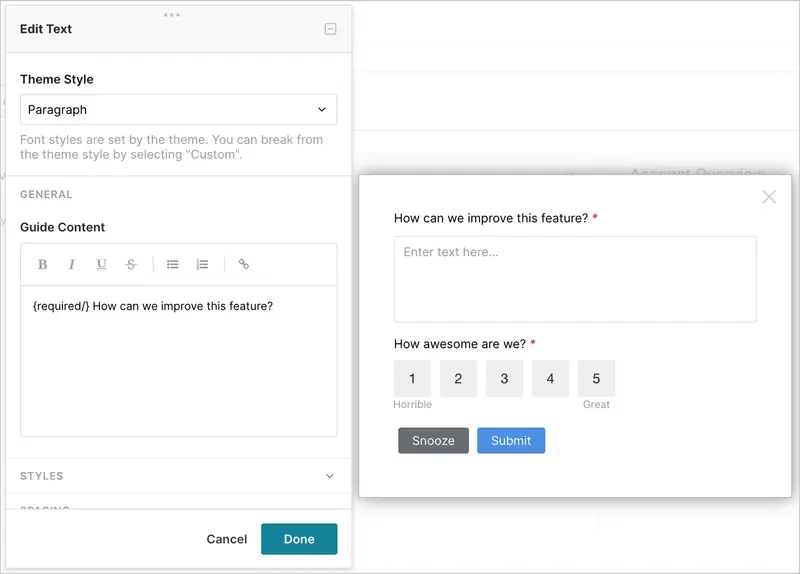
Pendo is a product-analytics and digital-adoption platform with in-app guidance and a feedback layer on top.
What does Pendo do?
Pendo tracks product usage without manual tagging, delivers in-app guides and walkthroughs, and collects feedback through in-app polls, NPS surveys, and a separate Pendo Feedback module for feature requests. It also adds AI sentiment analysis over the data it gathers.
Who is Pendo primarily for?
Mid-market and enterprise product teams that want analytics and in-app engagement in one place, and treat surveys as one input among many. That also comes through in the G2 reviews, where much of the feedback is from mid-market users.
What is Pendo's ease of use?
The no-code tagging and in-app guide builder get strong marks, but reviewers (Pendo rates 4.4 out of 5 across more than 1,500 reviews) note that deeper reporting takes time to master, and getting full value from advanced features can be heavy to learn.
What is Pendo's customer support like?
Generally rated solid for a platform of its size, though some reviewers point to the learning curve rather than support response as the main friction.
What are the main pros of using Pendo?
- Product analytics, in-app guides, and feedback in a single platform.
- No-code event tracking, so you can analyze usage without engineering tagging.
- Polls and NPS that you can target by behavior inside the product.
What are the main cons of using Pendo?
- Feedback is secondary to analytics, and reviewers say the survey side can feel like an afterthought.
- Pricing is not published and is based on monthly active users, so overages and mid-contract upgrades are common as usage spikes.
- The reporting depth that makes Pendo powerful also makes it heavier to learn than a focused survey tool.
Pricing
Pendo offers a free plan and custom-quoted paid tiers. There is no public price list (you need to contact sales), and cost is tied to monthly active users, which several reviewers flag as a source of budget surprises.
My hot take: how does it compare to Hotjar?
Pendo approaches one of Hotjar’s survey limits from the analytics side: it ties what users say to what they actually do in the product, with usage data underneath. If you already run Pendo for adoption analytics, adding in-app polls is a small step. If you mainly want feedback and you are not buying the analytics suite, you are paying for a lot you will not use. Hotjar can feel too narrow on surveys, and Pendo can feel too heavy around them.
Qualtrics: the enterprise option you grow into
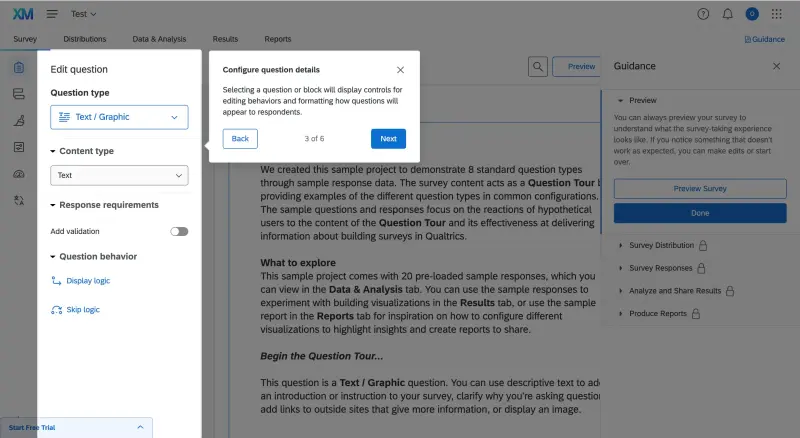
Qualtrics is an enterprise experience-management platform spanning customer, product, and research use cases, including website and mobile feedback through its Customer Frontline and CoreXM products.
What does Qualtrics do?
Qualtrics covers website and in-product intercept surveys, advanced survey logic, multilingual surveys, and heavyweight analysis: Text iQ for open-ended text, Stats iQ for statistics, workflows that turn a response into a ticket or an email, and research tooling like conjoint analysis and crosstabs. It can cover the feedback jobs in this guide, but as part of a much larger enterprise research stack.
Who is Qualtrics primarily for?
Large organizations and dedicated research or CX teams with the budget and the staff to run the platform. Qualtrics is widely used by publicly traded companies and in academic research.
What is Qualtrics's ease of use?
Power comes with complexity. Qualtrics rates 4.4 out of 5 on G2, but reviewers point to a steep learning curve around advanced features, setup, and integrations. Complex surveys are doable; getting the platform fully under control can take quite a lot of time and training.
What is Qualtrics's customer support like?
The support picture is uneven in public reviews. Some teams praise the workflows and dashboards, while others on G2 mention slow or hard-to-reach support and long implementations.
What are the main pros of using Qualtrics?
- The deepest analysis and logic on this list, including statistical tooling and text analytics.
- Workflows and automation that route responses to the right team or system.
- Strong multilingual and enterprise governance features.
What are the main cons of using Qualtrics?
- Expensive, with sales-led pricing and no public price list. Reviewers regularly call the cost steep.
- Heavy to set up and run, which several users summed up bluntly as "bloatware" for their needs.
- Far more capability than a product team validating ideas week to week will use.
Pricing
Qualtrics has only one public self-serve paid plan: Strategic Research at $420 per month, billed annually, for 1,000 responses shared across all users. That sounds accessible for Qualtrics, but it’s still a research license, not a full CX platform. Larger deployments go through sales-led quotes, and buyer-reported contracts often run into the tens of thousands per year.
My hot take: how does it compare to Hotjar?
Qualtrics is the most capable platform here, and for an enterprise research team that capability earns its cost. For the product manager who picked Hotjar because it was a quick way to spot friction and ask users questions in context, Qualtrics is the wrong direction. The setup alone would absorb weeks, and you would pay enterprise prices to do what a focused feedback tool does in an afternoon. It makes more sense when research operations are already big and formal. For quick friction checks inside the product, it is too much platform.
Typeform: design-forward forms, less behavioral targeting
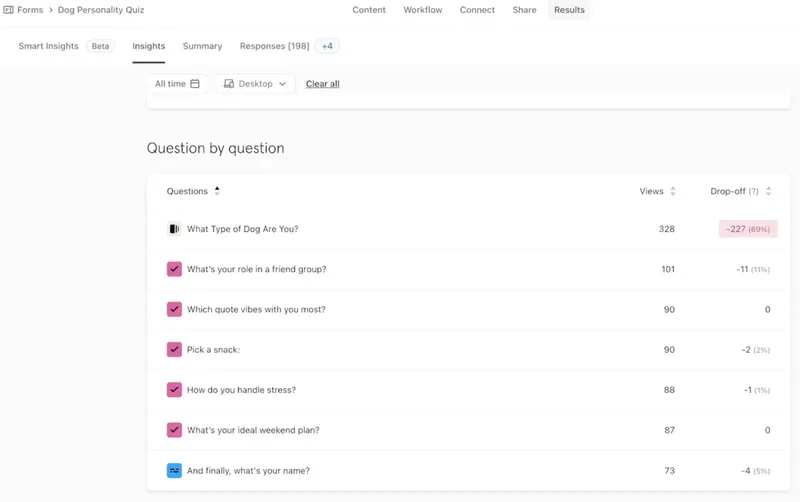
Typeform built its name on conversational, one-question-at-a-time forms that look great and convert well.
What does Typeform do?
Typeform creates surveys, forms, quizzes, and polls with a strong focus on design and completion rates. You can embed a form on a site as a popup, full page, or inline block, share it by link, and connect it to more than 120 integrations. It also supports payment collection and quizzes, which most survey tools do not.
Who is Typeform primarily for?
Marketing teams, small businesses, and anyone who needs polished standalone or link-based forms for lead generation, feedback, or content. It is less of a product team tool for in-product targeting.
What is Typeform's ease of use?
Typeform rates 4.5 out of 5 on G2 and the builder is generally considered approachable. The caveat that comes up in reviews is that the conversational, one-by-one format and the design constraints can take time to get exactly right.
What is Typeform's customer support like?
Support looks decent. G2 comparison data puts Quality of Support at 8.4 (although several reviewers single out support as a weak spot) while Capterra rates customer service at 4.4 out of 5.
What are the main pros of using Typeform?
- Standout survey design and high completion rates.
- A large integration catalog, plus extras like quizzes and payment collection for standalone forms.
- Easy embedding on a website as a popup or inline block.
What are the main cons of using Typeform?
- No native in-product behavioral targeting or event triggers, so it does not fire surveys on user actions the way Hotjar or Survicate do.
- Partial responses can be lost. A respondent who quits before the end leaves no recorded answer, which breaks NPS follow-ups (unless Partial Submit Points were set up).
- Multilingual surveys rely on a workaround, and pricing climbs steeply between tiers.
Pricing
Typeform has a free plan, with 10 responses per month. Paid plans start at $25 per month, and the higher Growth tiers reach up to $349 per month.
My hot take: how does it compare to Hotjar?
Typeform is stronger than Hotjar on the form experience itself, but it is solving a different problem: Hotjar's whole point is catching someone in context, on the page, mid-behavior, and Typeform is built for forms you send people to. For a product manager who wants the survey to appear at a friction point inside the product, that gap matters more than the prettier interface. If you want to see how the dedicated comparison shakes out, we cover it in our Typeform alternatives guide.
Refiner: lightweight in-app microsurveys for SaaS
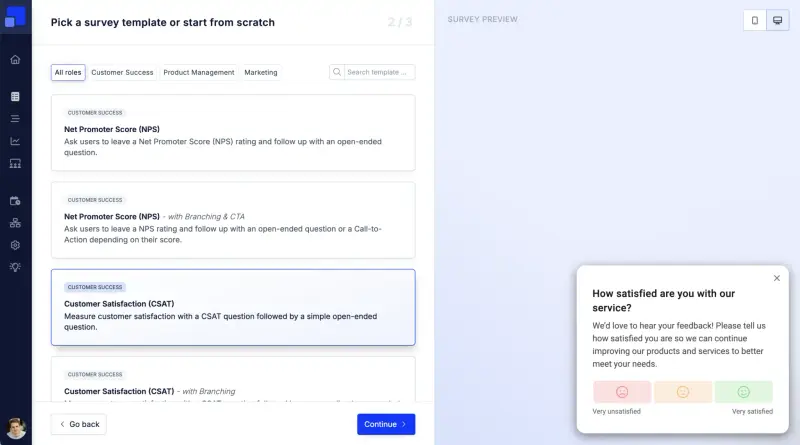
Refiner is a focused in-app survey tool built specifically for B2B SaaS products.
What does Refiner do?
Refiner runs in-product and website microsurveys, plus email, link, and embedded surveys, with NPS, CES, and CSAT built in. It is developer-friendly (JSON config, REST API, SDKs) and has clean targeting with sampling and recurrence, so you can show the right survey to the right cohort.
Who is Refiner primarily for?
Solo product managers and small product or growth teams at SaaS startups who want a tidy, low-cost in-app survey footprint. It is not aimed at multi-team or large organizations.
What is Refiner's ease of use?
Ease of setup is its strongest review theme. On G2 (Refiner rates 4.6 out of 5 across a small set of reviews) and Capterra, users describe it as quick to install and easy to target, with one Capterra reviewer calling it one of the easiest ways for a small team to gather quality feedback.
What is Refiner's customer support like?
Reviewers describe support as responsive, though the review base is small. The caveat is scale: Refiner is a leaner company than the larger platforms here, so you should not expect the same roadmap pace, documentation depth, or support resources.
What are the main pros of using Refiner?
- Clean in-app experience and fast deployment.
- Developer-friendly setup with strong targeting, sampling, and recurrence.
- Low cost relative to the heavier platforms here.
What are the main cons of using Refiner?
- Limited question types and simpler logic, and no AI analysis or sentiment.
- Pricing is based on monthly active users, which becomes a tax on growth.
- Built for product and growth, not for marketing, CX, or cross-team feedback.
Pricing
Refiner’s pricing is based on monthly active users. Essentials starts at $99 per month, while Growth and Enterprise scale with usage and requirements. All plans include unlimited survey responses, but the MAU model means the bill grows with your active user base.
My hot take: how does it compare to Hotjar?
Refiner does the in-product survey job more cleanly than Hotjar's survey module, with better targeting and a tidier in-app feel. The catch is scope. It is a focused microsurvey tool, so there are no heatmaps, no recordings, and no AI analysis to read the open-ended answers for you. For a solo PM at an early-stage SaaS company who only needs in-app NPS and CSAT, that focus can be a feature, not a flaw.
Iterate: on-brand surveys for web and mobile product teams
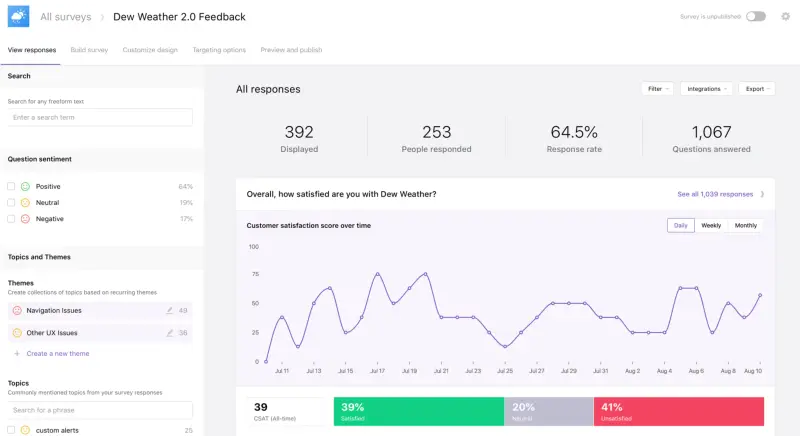
Iterate is a survey tool aimed at product teams that want targeted feedback inside their website and mobile apps.
What does Iterate do?
Iterate runs website, in-product, mobile app, and email surveys, with NPS, CSAT, and CES, plus a general feedback button. You can trigger surveys on behavior or schedule them, embed them in emails for higher response, and connect to analytics tools to fire surveys on specific events.
Who is Iterate primarily for?
Product teams that want highly targeted, on-brand surveys for web and mobile users, and that value design control over a broad platform.
What is Iterate's ease of use?
Reviewers describe it as easy and efficient to build and distribute surveys, and they single out fast, responsive support. The review base is smaller than for most tools here, so I would read the individual reviews rather than relying on an aggregate score.
What is Iterate's customer support like?
The reviews that exist consistently praise quick, responsive support, which is a common strength among smaller, focused vendors like Iterate.
What are the main pros of using Iterate?
- In-product, mobile, website, and email surveys with behavioral triggers.
- On-brand, design-controlled surveys with a mobile SDK.
- Responsive support and a straightforward builder.
What are the main cons of using Iterate?
- A smaller player with a thinner public review base, so there is less independent signal to lean on.
- Pricing is custom only, with nothing published, and some reviewers note the paid tier is pricey for small businesses.
- No research-repository layer to analyze open-ended feedback at scale.
Pricing
Iterate does not publish pricing. Plans are quoted on request, which makes quick budgeting harder than with the tools that post their tiers.
My hot take: how does it compare to Hotjar?
Iterate matches Hotjar on targeted web surveys and goes further on mobile app coverage, with behavioral triggers and better design control. Where it trails the bigger names is reach and proof: a smaller footprint, custom-only pricing, and less independent review data to validate the experience before you commit.
Is Hotjar right for you? The final verdict
Hotjar still does one thing better than most: it shows you what people do on a page through heatmaps and recordings. If that visual behavior data is your primary need, the move to Contentsquare does not change the core value, and you may not need to leave at all.
The reason to switch is almost always the survey and feedback side. If you are a product manager who wants to ask the right question at the right moment inside the product, Hotjar’s survey feature can start to feel narrow. Especially when you also need to slice the answers properly, read open-ended feedback without manual tagging, and push the result into your roadmap or CRM. Add the post-merger pricing changes, and it becomes a good moment to compare your options.
Which Hotjar alternative should you choose?
- For behavioral in-product surveys that you can act on across your stack, with an AI research repository to make sense of open-ended answers, Survicate covers all of that territory. You can prioritize features and run product-market fit checks off the same feedback you collect in-app, and it can be a great fit if you do not need native heatmaps, but want to close the feedback loop instead. That is where Survicate is strongest: in turning scattered customer feedback into something a product team can actually use.
- For deep behavioral targeting and AI-driven in-product research at a funded team, choose Sprig, and budget for how its pricing scales. The depth is real, but so is the cost. Our short Survicate versus Sprig page goes deeper on the trade-offs.
- For surveys that sit beside heavy product analytics, choose Pendo, if you are buying the analytics too. It makes the most sense when feedback is one layer inside a broader adoption and usage-tracking setup.
- For enterprise-grade research, CX programs, and advanced analysis, choose Qualtrics. It is powerful, but the cost, setup, and operating model are built for larger teams with formal research or CX operations. We compare the lighter options in our Qualtrics alternatives guide.
- For polished standalone or link-based forms, choose Typeform. It is the better fit when form experience and completion rate matter more than behavioral in-product targeting or completing the full collect-analyze-act loop.
- For a lightweight in-app microsurvey tool, choose Refiner. It works well for smaller SaaS teams that want clean in-product NPS, CSAT, or CES without a larger feedback platform around it.
- For mobile app coverage and design control, choose Iterate. It is a smaller player, but a good fit if you care about targeted web and mobile surveys with more control over how they look.
Whichever you pick, the test is the same one I used throughout: does the tool only collect a microsurvey response, or does it help you understand the signal and act on it? For product teams, that is the real gap between a survey widget and a feedback system. If you want to see how the collect-analyze-act loop works in practice, our guides on product research, automating customer feedback, and managing product feedback are good next reads.
FAQ
What can product teams actually do with Hotjar's survey feature that the alternatives improve on?
Hotjar's surveys cover on-site polls, feedback widgets, and exit-intent questions with behavioral targeting. The common upgrades product teams look for are deeper conditional logic, richer segmentation of results, mobile app surveys, email-embedded surveys, and a way to analyze open-ended answers automatically instead of reading them one by one.
What features matter most for in-product, behavioral feedback?
Four things separate the tools: behavioral and event targeting (firing a survey on a specific action), in-product reach across web and mobile, how little engineering a new survey needs, and how the answers flow into your roadmap, CRM, and the rest of your stack. A pretty survey that you cannot target on behavior or act on afterward solves only half the problem.
Why does session-based or MAU-based pricing matter when choosing a tool?
Several tools here (Hotjar by sessions, Pendo and Refiner by monthly active or tracked users) tie cost to traffic or audience size, so your bill grows as your product does, sometimes unpredictably during launches. Response-based or tiered pricing is easier to forecast. Always model your expected volume over the next year, not just today's, before you commit.
What do teams most often overlook when replacing Hotjar?
Two things. First, that Hotjar's heatmaps and recordings are a separate job from its surveys, so if you switch for better feedback you may still want a behavior-analytics tool (or an integration) for the visual side. Second, the analysis step: many teams pick a tool for how easily it collects answers, then discover months later that nothing helps them read hundreds of open-ended responses or route them to the right team.
Author's note
Author's note (last verified: August 14, 2026): Statements such as "best" reflect our opinion and typical use cases, not a universal guarantee. This comparison is based on publicly available information and our best understanding at the time of writing. Vendors may change features, pricing, and packaging without notice. For the latest details, please check the official sources or reach out to the vendor directly.