Ever wonder what happens when companies treat customer feedback like junk mail?
Spoiler: it gets ugly, expensive, and hilariously tone-deaf. From iconic brands torching their heritage to platforms alienating the very users who built them. These stories prove one brutal truth – ignore the people who pay your bills, and watch the receipts pile up.
In this article, I'll dive into five spectacular face-plants. Expect sarcasm, sharp lessons, and zero corporate fluff.
The cost of not listening: 5 businesses that learned the hard way
Jaguar’s move from leaping cat to leaping off the cliff
Jaguar spent decades cultivating an image of effortless British swagger – sleek cats leaping across hoods, villains in tailored suits letting V8s do the talking, that unmistakable "Jaaaag" vibe from campaigns like "Good To Be Bad."
Then, in November 2024, Jaguar decides to torch it all for a rebrand that's basically high-fashion performance art.
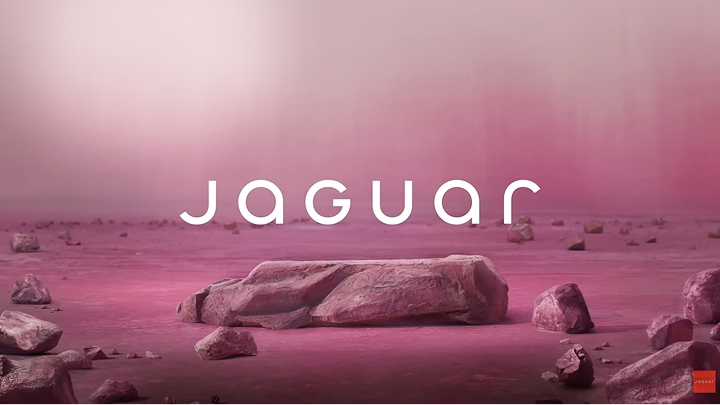
They drop a new monogram badge (a circled "J" and "r" that looks like it got lost in a barcode factory), a wordmark that flips between upper and lower case like it's having an identity crisis ("JaGUar"), and wipe their entire social media history clean.
Their launch video didn’t even feature a car…
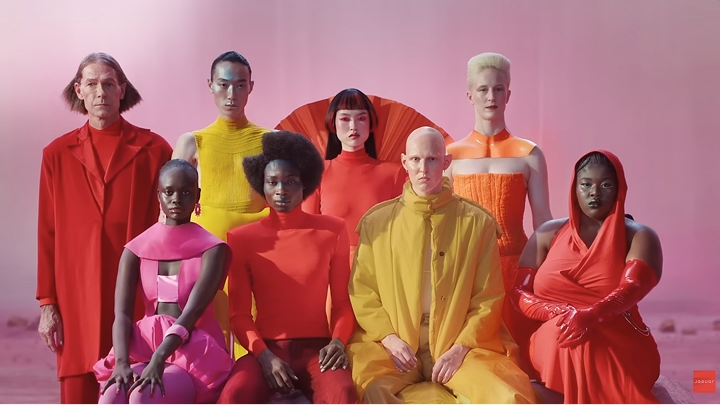
The launch video? Thirty seconds of androgynous models in an elevator, waving paintbrushes and mallets in a kids' soft-play area – no cars in sight. The taglines flash: "Copy Nothing," "Delete Ordinary." Bold move or suicidal.
The internet did what the internet does best – erupted. The YouTube clip racked up over two million views fast, the Instagram reel hit 6.9 million, and the comments sections turned into a funeral for a brand. "RIP Jaguar" trended alongside "go woke go broke."
People were furious. Why fix a badge nobody complained about? Why pretend you're a fashion house when you sell performance machines? Even Elon Musk couldn't resist piling on, he replied directly to the post with a deadpan:
Fans had always loved Jaguar for its unapologetic character. Debonair, a bit unreliable, and classically pretty. The new direction felt like the brand was embarrassed by its own history, ashamed of the cads, the cats, the British cheek.
Jaguar made a huge decision to rebrand, without any customer insights
And the worst thing is there is no solid evidence that shows Jaguar leaned on customer feedback or market research before pulling the trigger. Official statements framed it as an internal pivot to "Exuberant Modernism," chasing originality ("Copy Nothing") and a fully electric, ultra-luxury future for a younger, design-obsessed crowd.
They worked with Accenture Song, aimed at Tesla and Bentley territory, but skipped the part where you ask the people who actually buy your stuff what they think. It was vibes over data, "feel" from the Chief Creative Officer over surveys.
The fallout was brutal. By April 2025, Jaguar registered just 49 vehicles in Europe – down 97.5% from 1,961 the year before. Year-to-date sales through April tanked 75.1% to 2,665 units. Sure, Jaguar had paused production on most models to prep for an all-electric relaunch (no new cars rolling off lines meant slim pickings at dealers), but the timing lined up perfectly with a rebrand that left loyal buyers feeling ditched and newcomers wondering if this was even a car company anymore.
Why replace a logo that was simply timeless?
The old leaping cat? One glance and you knew it was a Jag – timeless, unmistakable. The new abstract "J"? Could be anything from a startup gadget brand to some obscure Asian import. Customers who once felt seen now felt ignored, and the numbers screamed the price.
Moral of the story?
When you ditch what your core audience loves without checking if they'll follow you into the unknown, don't be shocked when they don't. Feedback isn't optional – it's the difference between evolution and extinction. Jaguar bet big on reinvention without the safety net of listening. The crash was spectacular.
Zoom backtracked so hard it earned side-eye for life
In terms of virality, Zoom’s story definitely pales in comparison to Jaguar’s. But it also concerns a very sensitive topic, i.e., people’s online privacy. The company kept stubbornly brushing off widespread customer concerns until the backlash escalated all the way to the CEO.
It all started when, in March 2023, Zoom updated its Terms of Service. It appeared to grant the company a perpetual and royalty-free license to use customer content like meeting audio, video, chats. One of the use cases was training their AI and machine learning systems.
Users and privacy influencers quickly raised their concerns, because they used the tool for sensitive business, healthcare, or even legal discussions. They worried these could be mined without clear opt-out or explicit consent.
People complained, but Zoom didn’t seem to worry
Complaints flooded in, but Zoom's first response was, well, not what people expected. It only clarified that the company wouldn't use audio, video, or chat content for AI training without consent, while generative features were opt-in. This felt like a deflection for some users, because the ToS still permitted wide data use for other purposes. Paradoxically, it even deepened client distrust.
Eventually, CEO Eric Yuan called it an internal "error" and "process failure" on LinkedIn, promising fixes.
Personally, I have mixed feelings on this one – on the one hand, Zoom backtracked and revised its ToS to state that it wouldn’t use any customer communications content for internal use. But on the other hand, they did it only after sustained pressure. And the initial downplaying? It prolonged the controversy and felt “fishy.”
I also think that it earned the company extra scrutiny for life – compared to companies that handled similar rollouts more transparently (or, at least, resolved customer concerns quicker).
Twitter to X – fixing what wasn’t broken and breaking what worked
Ah, Twitter – the once-glorious dumpster fire of real-time snark, memes, and breaking news that somehow worked. Everyone knew the bird, the blue check meant something, and you could scroll without needing therapy afterward.
Then Elon drops $44 billion in 2022, slaps an "X" on it in 2023, and turns it into his personal science experiment. Cue the changes:
- algorithms that bury your actual friends to shove rage-bait videos in your face,
- rate limits that choke normal scrolling,
- paid verification that turned the blue check into an $8 joke,
- mandatory “For You” feeds stuffed with whatever the algorithm decides you need,
- moderation gutted so toxicity can bloom unchecked, and endless hype about becoming the “everything app” that mostly feels like a glitchy tweet deck on bath salts.
What people had to say about the changes was far from nice
Users complained – loudly. With GIFs and everything. @hailey_cryptoo in January 2026, basically pleading, “The X algorithm is worst right now. Reach has totally tanked… Whole timeline is filled with AI slop. Real conversations are near to 0. Please give the old Twitter back.”
@wabdoteth the same month, calling it like it is – “the new algorithm is destroying the platform… they do not understand who their user base of creators is.” Even X’s own product head admitted heavy reply-farming was nuking reach. Feedback received. Then cheerfully ignored.
Most of the rawer complaints? Let's just say they'd require heavy censorship to feature here – plenty of users vented with colorful language about the algorithm. The frustration runs deep, but I'll stick to the family-friendly samples.
Most Americans still call X Twitter – that says it all
The scoreboard doesn’t lie. U.S. monthly actives down 8–10%+ year-over-year into 2024–2025. The 18–29 crowd bailed hard – usage dropped from 42% to 33%. Advertisers read the room and bounced. And the funniest part? A year after the rebrand, half of Americans (49%, 55% among daily users) still call it Twitter. Because nothing says “we nailed the transformation” like everyone refusing to say the new name.

TP-Link’s “isolated cases” isolated the entire market
TP-Link – you know, that big Chinese company that makes super affordable routers, Wi-Fi extenders, switches, and all kinds of smart home gear – ran into a bit of a bump pretty soon after they started selling their hardware and B2B stuff in the Philippines.
Laviet Joaquin, Head of Marketing at TP-Link Philippines, was very straightforward when she told us that the company messed up, big time. What did they do wrong? Well, a few things simultaneously.

They ignored recurring support tickets, bad online reviews, and retail partner signals about unstable firmware after updates on a mid-range router. Returns started rising, but that didn’t raise any eyebrows. Leadership dismissed them.
Why? Joaquin said they were blindsided with the fact that sales were strong.”We convinced ourselves the issues were edge cases, and chose roadmap speed over what was happening on the ground,” she admitted.
The consequences were tangible
Eventually, that choice did carry real costs. Returns didn’t stop for another two quarters, and support teams were drowning in repeat customer complaints. What I believe shows the scale very well, too, is that retailers (i.e., their distributors) also lost confidence in the brand and shifted shelf space to competitors.
As they were part of a larger, multinational organization, they had the conditions to course-correct decisively. Joaquin told us that customer support insights are now so important, that they even have “veto” powers on product launches.
How about regaining retailer trust?
The Philippines branch reviews feedback in weekly sprints, and B2B customer complaints are scaled straight to regional leadership, with clear account ownership.
In hindsight, the problem here was that TP-Link tried to see patterns in customer behavior as anomalies, because everyone wanted to focus on the more thrilling aspects of their work, i.e., new releases and launches. In a business like this, though, where updates affect millions and returns hit the bottom line directly, this is too risky of a game to undertake.
Sandra’s Matcha – opened with 1.1M Followers, closed with 3.8 stars
Summer 2025 was peak matcha madness. Ads flooded feeds, everyone turned into an instant connoisseur, and new spots kept opening faster than you could say “ceremonial grade.” Sandra Kubicka, an American-Polish influencer, jumped in with perfect timing.
Everything seemed to be working in her favor – huge following (over 1.1 million on Instagram) and a spot right in the heart of Warsaw. The launch of Sandra’s Matcha drew crowds. Queues snaked down the block, and influencers and TikTokers rushed to film their first sip. It looked like a slam dunk.
Sandra’s matcha was far from what they usually serve in Japan
Then the drinks actually arrived (oh dear…). What was billed as premium, organic ceremonial matcha tasted… off. Dull color, nothing like the bright, smooth stuff you’d get in Japan. Reviewers started politely, then got blunt: “tastes like Costco bulk powder,”, “fishy notes,” “rotten green,” and “generic cola vs. the real thing.” One after another, people said the same: this isn’t what she advertised.
Here’s where the problems started. Kubicka’s team responded with a vague “we treat each piece of feedback as an improvement signal,” or was quite harsh in her commentary. Here’s an example of what Kubicka herself said:
"There is no 'Great Book of Matcha.' If someone wants to, they can throw matcha into a pot or toss it in a bottle and shake it – they won’t get a ticket for it. Let other places use a chasen (bamboo whisk). Our lines are too long, and we just don’t have the time for that."

TikTok didn’t hold back, either. Taste tests turned into viral roasts – exaggerated spit-takes, mocking the drinks, the branding, even Sandra herself. What started as honest feedback snowballed into something meaner. She later shared how much it stung, how hard it became to focus on the loyal fans who kept showing up instead of the endless negativity.
The physical store lasted a little longer than the hype
The physical shop lasted only a few months before going “temporarily closed” in early 2026. Sandra insisted foot traffic wasn’t the issue. The real weight came from the nonstop online pressure and the toxic vibe it created. She pivoted to pop-ups, food trucks, and events while keeping online sales going. Google still shows a middling 3.8 from nearly 1,000 reviews.
Massive hype and a celebrity name can pack the place on day one. But when customers keep saying “this doesn’t match what you promised,” brushing it off doesn’t quiet the noise. Quite the opposite, it makes it louder until the doors have to close.
Has there been a time a company ignored user feedback and still succeeded?
Not that I'm playing devil’s advocate, but actually, yes. Netflix’s story with banning shared accounts is a prime example. That said, before you see this as permission to cherry-pick your customer feedback, keep in mind Netflix has the risk management muscle of a giant. They calculated the odds carefully and figured that even if only some shared accounts converted to paid ones, profits would climb.
So, they weren't blindly ignoring backlash, but monitored existing customer sentiment closely and anticipated the initial resistance to change.
Did Netflix's password sharing ban annoy users? It sure did, and resurfaced old X posts like this one, with people calling out the hypocrisy:
However, just as Netflix likely predicted, the move caused immediate subscriber growth and revenue gains. They saw 15.7% year-over-year revenue growth between 2023 (the year of the shared-password ban) and 2024. And if anyone needs any extra evidence to know they’re doing OK, let’s not forget their loud acquisition of Warner Bros.
To sum up, Netflix did well, but we should treat them as an exception to the rule – one where the company knew exactly what they were going for.
Don't be like Jaguar or X… listen to feedback
The brands in these stories didn’t act out of malice. They either overestimated their grasp of the market or underestimated the early signals customers were sending through feedback. And I feel this comes down to a very humane trait, i.e., misjudgment. We can’t simply rely on gut feel or wing our business decisions like some of these brands did.
So, if I was to share one, universal advice (whether you’re a small startup, a mid-sized player, or a large corporation), it’s this: make deliberate space for customer voices.
Run your own research, listen actively, and – perhaps most of all – look at what customers are saying about you on third channels. That’s where they tend to be the most honest and straightforward. You might uncover some hard truths, but, hey, you’ll end up knowing way more about how to keep customers on the happy side.
FAQ
How does ignoring feedback impact customer trust?
Silence is often felt as rejection. When a customer takes the time to share their thoughts and receives nothing in return, it feels like "ghosting." This dismissal builds quiet resentment that can quickly turn into genuine frustration. Rather than giving the brand a second chance, many customers simply assume the company doesn't care and decide to leave for good.
Can ignoring feedback damage your public reputation?
Absolutely. An ignored complaint can easily escalate on social media or review sites, signaling to prospective buyers that the brand is risky to deal with. This perception erodes the confidence of investors and stakeholders who view reputation as a key indicator of business health.
How can customer feedback improve your products and services?
Think of your customers as an external quality assurance team. They spot "blind spots" that internal teams often miss. Whether it is a glitch in an app or a friction point in a store, their feedback will offer you immediate, high-value direction. A customer feedback platform should have all the tools you need to collect, analyze, and act on feedback.


.webp)
.webp)
.svg)

.svg)