


If you’re a B2B leader wondering why your Net Promoter Score looks modest compared to a viral consumer app, you can breathe a sigh of relief. You aren't failing but simply playing by a different set of rules.
Data from the Survicate NPS Benchmarks 2025 report confirms that consumer apps consistently outpace business software. This gap exists because the relationship between a person and their work tools is fundamentally different. The psychological stakes and the way we define success shift the moment we clock into the office.
This article explores the hidden dynamics that keep B2B scores grounded. We’ll help you stop comparing apples to enterprise-grade oranges and show you how to interpret your results within your own industry context.
Survicate’s NPS benchmarks 2025: data & methodology
At Survicate, we’ve analyzed NPS survey results from 599 unique companies, which ran nearly 2,200 surveys and collected over 5.4 million responses between January and October 2025.
We’ve also compared the results against the numbers for 2024, when we’ve looked at ~655 companies and 6.5 million responses. The dataset spans 11 industries and includes small, medium, and large companies worldwide.
Here is the headline number: the global median NPS for 2025 sits at 42. But if you stop there, you’ll miss the real story hidden in the sectors.

Our analysis exposes a striking divide, because B2C companies are outpacing B2B firms by an 11-point margin (median 49 vs. 38). Why is it that consumer-facing businesses enjoy a "loyalty advantage" that business-focused firms often struggle to replicate?
And crucially, how should you interpret your own NPS, considering relevant benchmarks?
Why B2C apps achieve higher NPS than B2B software
Consumer apps and brands often enjoy stronger NPS results than B2B products. But this isn’t because all B2C apps are magically better. The gap can be explained by fundamental differences in audience, usage, and perceived risk.
Let’s break down the main reasons why B2C apps achieve higher NPS than B2B software:
1. Recommending B2B products carries higher risk
A recommendation changes shape depending on the setting. In the consumer world, endorsements happen by accident. You might mention a new delivery app during dinner or post a quick review on social media without a second thought. These are informal, low-friction interactions.
The B2B world operates on a more rigid stage. Here, a recommendation takes the form of a formal case study, a professional reference call, or a strategic introduction to a peer company.
Arthur Favier, Founder and CEO of Oppizi, notes that this creates a much higher bar for the user. When a survey asks a B2B user if they would recommend a tool, they don't think about a casual chat, but their public professional standing.
Favier argues that this stems from the high-stakes nature of business relationships. He observes that while a consumer might move past a poor product quickly, a business user feels the "danger" of a bad outcome. Because a bad tool can disrupt an entire operation, users treat their endorsement like a legal guarantee.
Many software vendors add to this weight by actively managing their "star" references. They specifically ask their most successful clients to advocate for them. This practice frames the idea of being a "Promoter" as a significant commitment rather than a simple gesture.
The data reflects this professional hesitation. According to a QuestionPro study, business clients actually respond to surveys more often than casual consumers do. They want to provide feedback to improve the tools they use every day. However, they rarely get gushy. They offer their insights with a level of professional reserve that naturally keeps scores lower. In their eyes, a product shouldn't just be good to earn a ten; it must be beyond reproach.
2. B2B satisfaction depends on more people
When you buy a pair of running shoes, you are the only judge that matters. If they fit well and look good, the transaction is a success. Consumer apps thrive on this simplicity because they only have to satisfy the person holding the phone. In the B2B world, that single-user focus vanishes. You aren't just selling to an individual; you are selling to a shifting group of stakeholders with competing priorities.
Scott Kasun, Founder and CEO of ForeFront Web, has spent 35 years serving clients in the B2B sector. He told us that providers like himself are often judged against moving targets rather than fixed goals.
"Success gets redefined every quarter based on whoever's in the room," Kasun says. He recalls a healthcare client where his team boosted qualified leads by 70%, but that didn’t secure a good score. The company’s leadership decided to reprioritize their goals, putting brand awareness above lead generation.
Also, remember that a single respondent might personally love your software, but if their boss doesn’t like the reporting features, or the IT department finds the integration clunky, that user is unlikely to give a 10.
They are conscious of the collective experience. Kasun observes that in B2B, you are essentially selling to a committee where "success" means something different to every member. When the internal guard changes or a new VP enters the mix, the criteria for a "good" score can shift overnight, leaving B2B providers to chase goals that refuse to stay still.
3. B2B companies are held against a higher set of expectations
The bar for praise is also fundamentally higher in a professional context. Reliability, security, and seamless integrations are considered the baseline, not a bonus. Meeting these basic requirements prevents a user from becoming a detractor, but it rarely inspires them to become a promoter. A user might be perfectly satisfied and still give a 7 or 8 because the product simply did what it was supposed to do.
Garrett Gilkison, AI-driven marketing strategist at Riverbase.ai told us that B2B surveys often catch users during the "messy middle" of implementation. He recalls a client who closed a multimillion-dollar deal but returned an NPS of 6. While the provider delivered exactly what they promised, the client’s IT team was still three months into a six-month integration.
They were battling change management headaches and executive scrutiny while the actual ROI wouldn't appear in reports for another two quarters. It was hardly the right time to ask for an opinion.
"B2C customers rate the burger they just ate. B2B customers rate a burger they ordered months ago, that five people have to agree tastes good, and that might get them promoted or fired," Gilkison says. When a recommendation carries that much weight, users don't hand out 9s and 10s for the basics. They save those scores for when a tool fundamentally transforms their business goals.
4. B2C benefits from emotional attachment
B2C experiences are often more emotional, or identity-related, which fuels higher loyalty. Think of how consumers form attachments to brands like Apple or Netflix – using those products can delight them or even signal something about their personality, which leads to enthusiastic recommendations.
Consumer apps also emphasize simplicity and user-friendly design, focusing on removing friction and creating joy in usage. B2B software, while it has improved in UX over the years, is fundamentally judged on business value and ROI more than love or enjoyment.
A procurement officer might never “love” an accounting system the way someone loves their favorite photo-sharing app; at best, they’ll respect that it’s reliable and cost-effective. Consumer apps prioritize simplicity and user experience, whereas B2B products have to deliver heavy-duty features and value.
Consequently, B2C companies often score higher NPS when experience and emotional connection are key drivers, while B2B companies struggle to get promoters unless they drive tangible operational success.
In summary, B2B NPS is typically lower not because B2B products are bad, but because B2B customers are tougher graders.
Interpreting your NPS: what’s “good” in B2B vs B2C?
After seeing benchmark numbers, you might wonder: what is a good NPS score for my type of business? The truth is, good is relative – you should always consider industry context and your own trend. But benchmarks help set expectations, so here are some guidelines:
Overall scale benchmarks
In general, any positive NPS (> 0) means you have more promoters than detractors, which is a decent start. An NPS in the 30s or above is typically considered good, and shows a solid majority of satisfied, loyal customers. Many companies that are customer-centric aim for the 50-70 range. If your NPS exceeds 70, that’s exceptional – you’re in world-class territory where customers absolutely love you. Conversely, a negative NPS is a red flag – it means more people are unhappy than happy, and you have work to do even if your industry average is also low.
B2B SaaS vs B2C apps averages
According to Survicate’s 2025 data, the median NPS for B2B companies was 38, whereas for B2C companies it was 49, giving you a solid benchmark number. A typical B2B SaaS might find itself in the 30s and be around average. In fact, a separate study by B2B International found the average B2B NPS to be around +34 in recent years.
So if you’re a B2B product and your NPS is, say, 40, that’s actually above the B2B norm. B2B leaders should avoid comparing directly to consumer tech giants, and instead compare to B2B peers.
Variation by industry and category
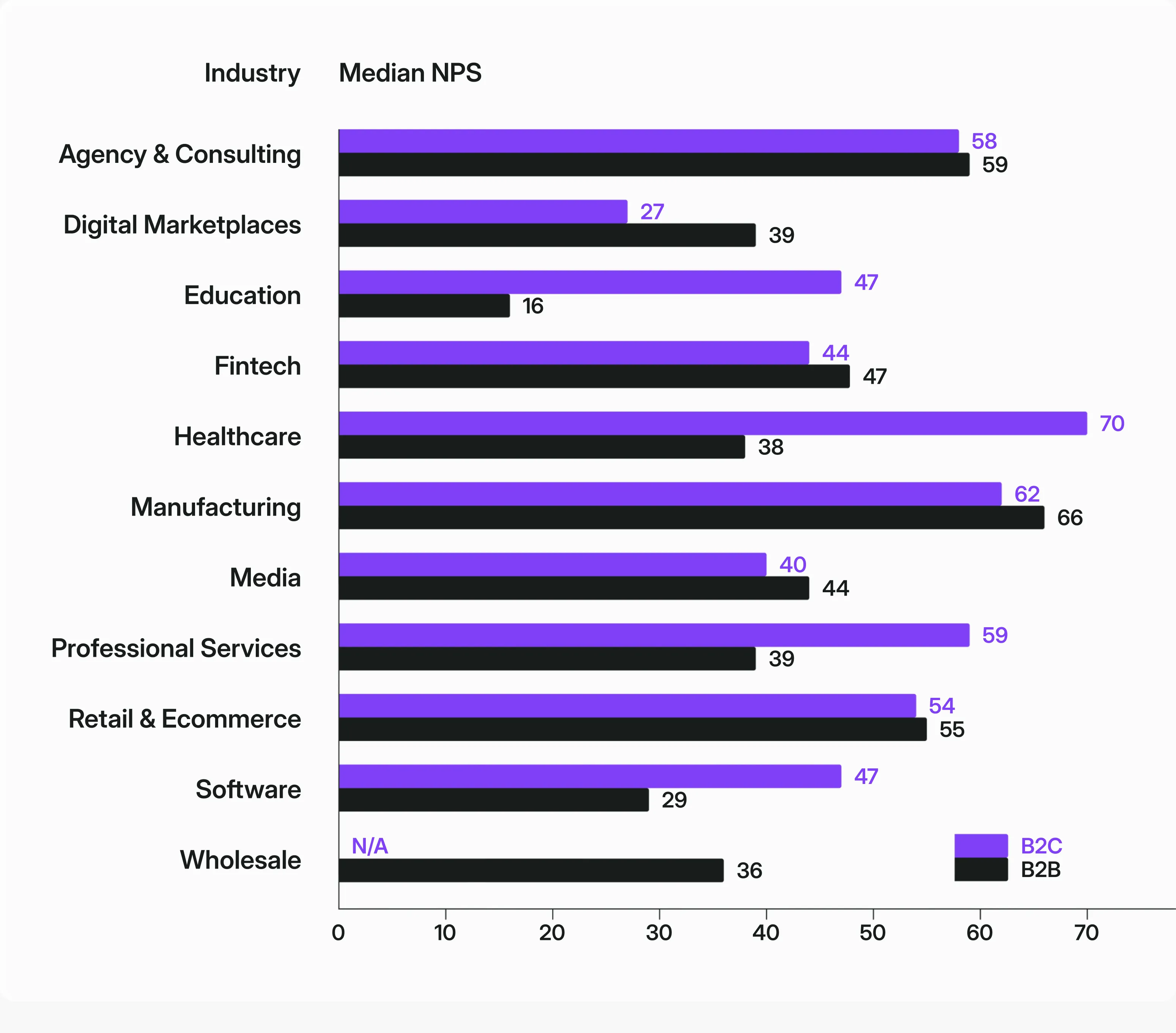
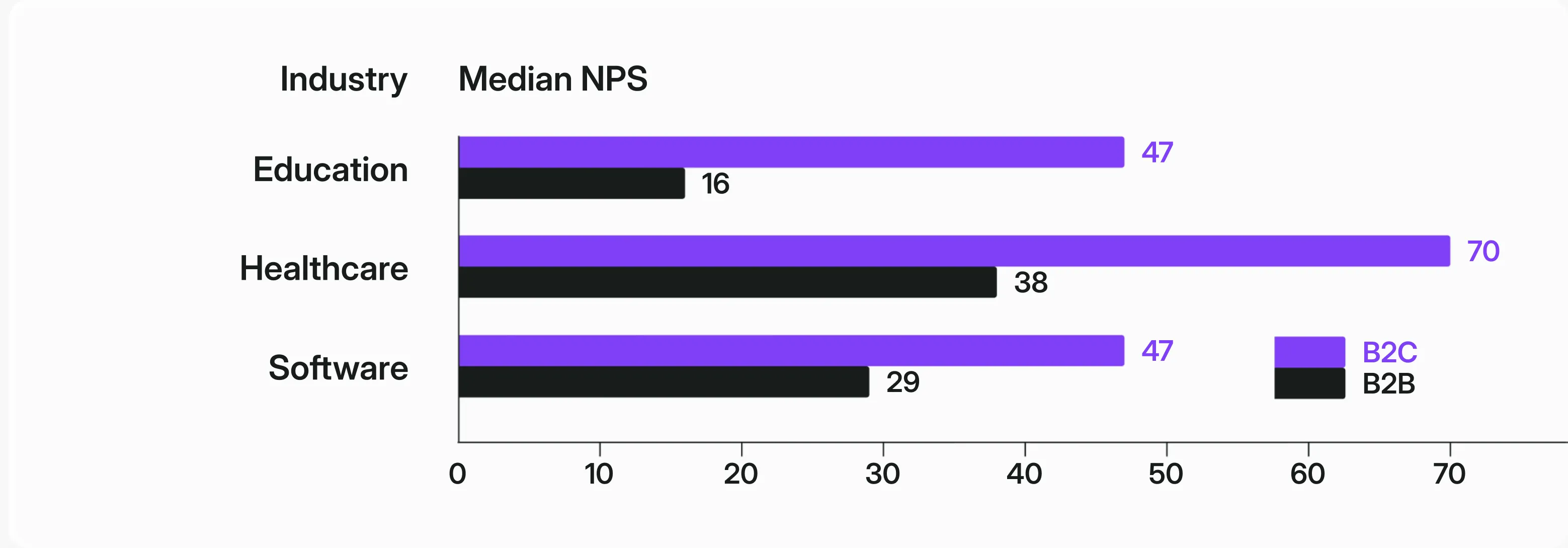
Be sure to benchmark within your industry or product category. NPS can vary dramatically by industry due to different customer expectations. Our report shows industries like Manufacturing, Healthcare, and Professional Services have median NPS well above 50, whereas Software, Digital Marketplaces, and Wholesale were in the 30s. This means a “good” score in Software might be quite different from a “good” score in Healthcare.
Internal benchmarks (year-over-year)
Perhaps the most important benchmark is your own past performance. Is your NPS rising or falling over time? If you run NPS surveys regularly, a “good” score is one that’s better than your last.
As we’ve found in our report, no company can be complacent – many saw declines year-over-year as mentioned. So track your trend. If you improved from 20 to 30, that is a meaningful win even if 30 might seem low externally.
Use industry benchmarks as a reference point, but focus on continuous improvement of your own customer experience. Set realistic goals, for example, “We’re at 25 now; let’s aim for 35 over the next year by addressing key pain points”. Over time, consistently moving your NPS up (even by a few points) is a strong sign of a healthy business.
Consider segmentation
Segment the score by customer type, region, or product line. For instance, maybe your overall NPS is 30, but your enterprise clients rate you 40 while small-business clients rate 20. That shows different experiences. Or, perhaps, one region is dragging down the average due to specific issues. Cultural differences can also play a role – some cultures are less likely to give extreme scores. A +40 might be phenomenal in a market where customers are tough graders.
Bottom line: Don’t panic if your B2B SaaS NPS is lower than the NPS of a famous B2C app as it’s expected. Instead, benchmark against similar companies and focus on improving your own score over time. If you’re a B2C team with a high NPS, congratulations – but remember that it can be a fragile lead.
Why do B2B customers give fewer 9-10 ratings (and what drives loyalty)?
When a business leader fills out an NPS survey, what they’re really evaluating is the decision they made to buy it. This creates a psychological ceiling that rarely exists in B2C transactions.
Ben Townsend, Founder and CEO of Tracker Products, has spent two decades building software for law enforcement organizations. He told us that when an end user (in his case, a police chief), gives the software a 7 instead of a 10, it’s because they’re weighing the political capital they spent to get the budget approved. “If one sergeant complained about the training schedule, the chief might second-guess the entire rollout – even if the software itself is technically perfect,” he said.
So, it’s easy to see why B2B customers are tougher graders.
B2B loyalty = functional loyalty
Customers renew business software because it does its job, not because they feel excited to recommend it. The sense of relief when a tool a professional chooses works is a powerful driver of long-term retention, but it rarely translates into high-enthusiasm scores that consumer brands enjoy.
So, when do promoters in B2B usually emerge?
In our experience, it’s a combination of a few factors:
- when a product clearly improves outcomes,
- feels easy to use,
- integrates well,
- and is backed by strong support.
Picture a new feature suddenly removing 25% of manual work for your client. Or one of your support agents going above and beyond, and jumping into a consultative role. That’s what can trigger strong, positive reactions in B2B.
Can you have a low NPS while the business is healthy?
This is a tricky question. The short answer is yes, it’s possible, but it’s not ideal to stay that way forever. NPS is a measure of customer sentiment and loyalty, which often correlates with business health, but not always perfectly.
Here are scenarios where a company might have a low-ish NPS and still be doing fine (at least in the short to medium term):
High switching costs or lack of alternatives (captive customers)
Often, revenue stays high despite a low NPS because leaving is just too much work. In the B2B world, deep technical integrations and multi-year contracts act like gravity. A customer might renew a subscription they actually dislike because the thought of retraining the whole staff or migrating years of data feels like a nightmare.
In these scenarios, your retention numbers aren't measuring loyalty but inertia. The business stays profitable, but it’s vulnerable to any competitor that makes the "divorce" process easier.
Essential service, but not lovable
Some tools are like the plumbing in an office building. You need it to work, but you’re never going to write a glowing review about it. Compliance software, insurance, and core infrastructure fall into this bucket.
They are essential utilities. Because these services are required for daily operations, a low NPS can live alongside low churn for years. This keeps the business steady, but dissatisfaction builds quietly in the background, waiting for a disruptor to offer a more human experience.
Segment differences
A single number can hide a lot of truths. An overall NPS might look disappointing because a small segment of users is unhappy, even if your biggest, most profitable clients are thrilled. A company can keep growing based on those high-value relationships while the average score suggests a crisis. Ignoring the unhappy fringe is a gamble, though. Those smaller, dissatisfied groups are often the first place a competitor gains a foothold before moving up-market.
What to do next if you’re not satisfied with your NPS?
If you’ve benchmarked your score and realized it’s lower than you’d like (maybe below industry average or just below your own standards), don’t despair, use it as a call to action. Here’s a practical game plan:
Analyze the "why" behind the score
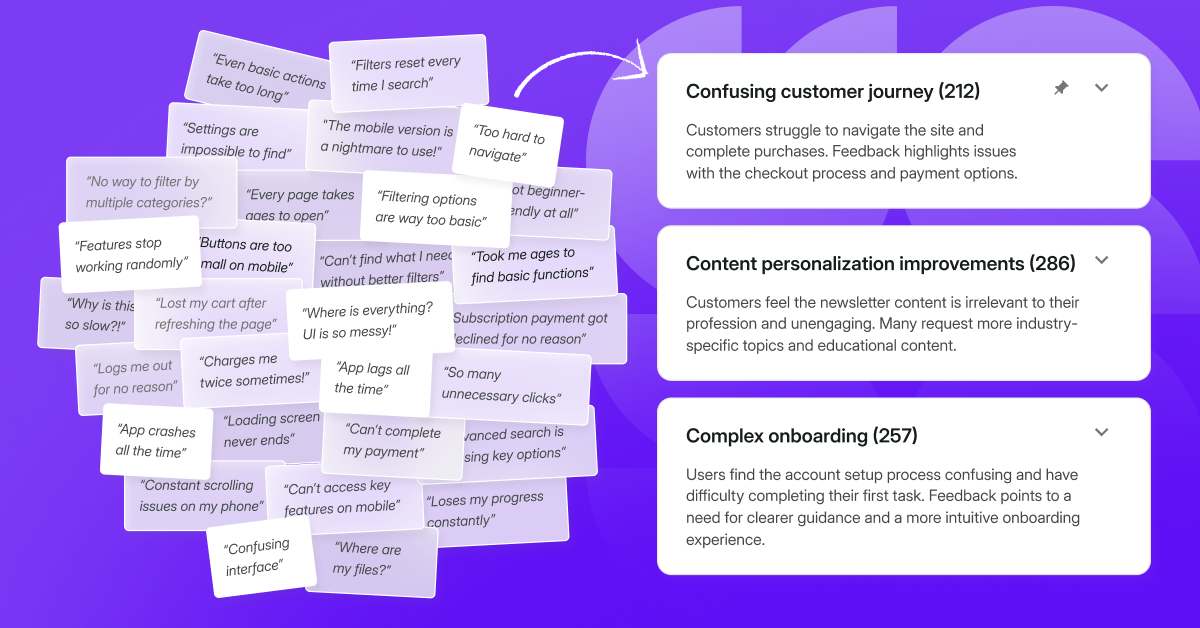
The number alone will not tell you what to fix. You need to analyze the open-ended responses from the follow-up question. Here, we recommend grouping them by themes like usability, reliability, or onboarding.
Once you’ve done that, you can identify the specific friction points that create detractors and the features that promoters praise.
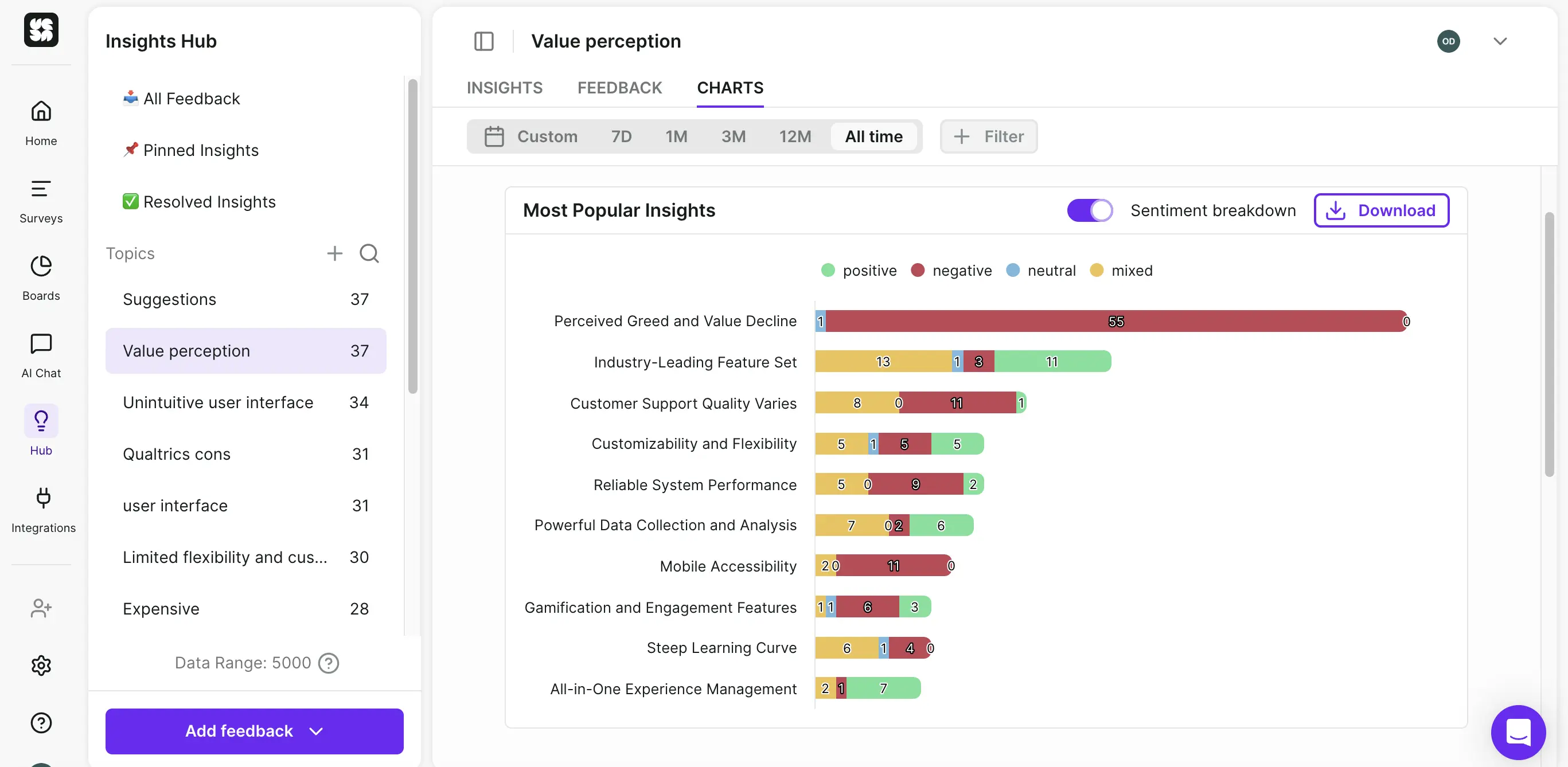
Tip: To know which changes can make the biggest impact, it helps to have a single space for all customer feedback. You can use a tool like Survicate’s Insights Hub to categorize open-ended replies by theme and identify exactly where to focus your energy. Beyond just grouping topics, this centralized view helps you find the specific areas that, once fixed, will move your NPS score the most.
Target the “passives”
At Survicate, we always like to underline that these individuals are your lowest hanging fruit. It is often more effective to move a passive (7-8) to a promoter (9-10) than to convert a detractor on the lower end of the scale.
Analyze your 7-8 scorer’s supplemental replies. Are there any small annoyances or requests? If so, see if you can implement them to turn overall satisfied customers into vocal advocates.
Communicate the changes you’ve made
This part is very important – when you make a change based on survey data, tell your customers. You can send out a short email or trigger a notification for your clients, which will appear once they log into the system.
Communicating that you listened to their requests builds a level of trust that can improve sentiment even before the next survey cycle begins.
Re-run NPS with intent
What we mean here is that you should avoid over-surveying. Re-measure only after your improvements have had time to land – which, as we’ve already established earlier, is usually a quarterly or biannual basis. Pair these results with retention and usage data to give stakeholders a full picture of business health.
Educate your company on what NPS says
Explain NPS in context to stakeholders. It’s easy for a department or leader to feel concerned if your NPS score is lower than an average they’ve seen online.
It’s always a good idea to pair it with retention, usage, and revenue metrics. A clear plan like this helps reduce any potential panic and builds confidence.
Leverage high NPS if you have it
If your score is already high, put it to work! Your promoters can become a growth engine if you ask them for referrals, testimonials, or case studies. High scores are a competitive advantage, provided, of course, you don't let complacency set in.
Treat NPS more like an ongoing conversation – not a static grade
NPS as a number is just a reference point, which you should dig deeper into every time there’s a change in your score. If you ask follow up questions, analyze clients’ answers in context of other communication like email, chat, or customer reviews online, you know what it takes to take that score even higher.
This balanced approach turns raw data into a better product. If you are ready to see where you actually stand, you can use Survicate not only to run NPS surveys but also see how those numbers fit into the bigger picture – from CSAT scores to direct email feedback or even online reviews. Centralizing your feedback gives you the context you need to identify the exact changes that will turn your quiet users into loud promoters.


.svg)

.svg)


