


Remember back in 2021 when Gartner dropped a bombshell prediction? They forecasted that by 2025, more than 75% of organizations would ditch Net Promoter Score (NPS) as a key measure of success – specifically for customer service and support.
Now in early 2026 NPS is still widely used across SaaS retail and other sectors. At first glance that seems to contradict the forecast. The reality is more nuanced. NPS survived in terms of usage but It did not survive in terms of influence.
NPS's broad "how likely to recommend" question often mixes in factors beyond just service – like product quality or pricing – making it tough for support teams to pinpoint actionable fixes. Plus, it can lead to wasted effort chasing insights that aren't directly tied to what agents control.
Some critiques still apply today, especially in pure service roles. But NPS endures because it's simple, loved by executives, perfect for benchmarking loyalty, and, when timed right, delivers highly actionable feedback.
Below, we'll unpack why Gartner predicted its decline, which points still hold up, and why NPS is here to stay far longer than they thought.
Was Gartner really anti-NPS?
Before we go any further, we’d like to clarify – Gartner’s prediction was not an attack on NPS itself. It was a response to how the metric was being used. Many of the organizations they spoke to adopted NPS as a post-transaction survey, even though it was not designed to capture immediate service impressions.
So, the core issue was scope. NPS asks customers to judge their overall relationship with a brand. The 0-10 score your company gets is a blend of opinions on product quality, pricing, brand perception, and, possibly, past experiences with the recent service moment.
Gartner argued that this made NPS a poor indicator of customer service performance, and that reasoning still stands today. NPS alone (i.e., without a text-based, follow-up answer) does not explain what went wrong.
The good news is, many companies learned the lesson and now pair NPS with qualitative feedback and transactional metrics. Instead of abandoning NPS, they corrected its role.
Why do brands still use NPS?
Gartner expected a graveyard by now. Instead, the Net Promoter Score remains the dominant language of customer satisfaction in 2026. Our internal research confirms this trend because 67.7% of our paying customers ran NPS surveys in 2025, which shows that customers still rely on this metric to measure performance.
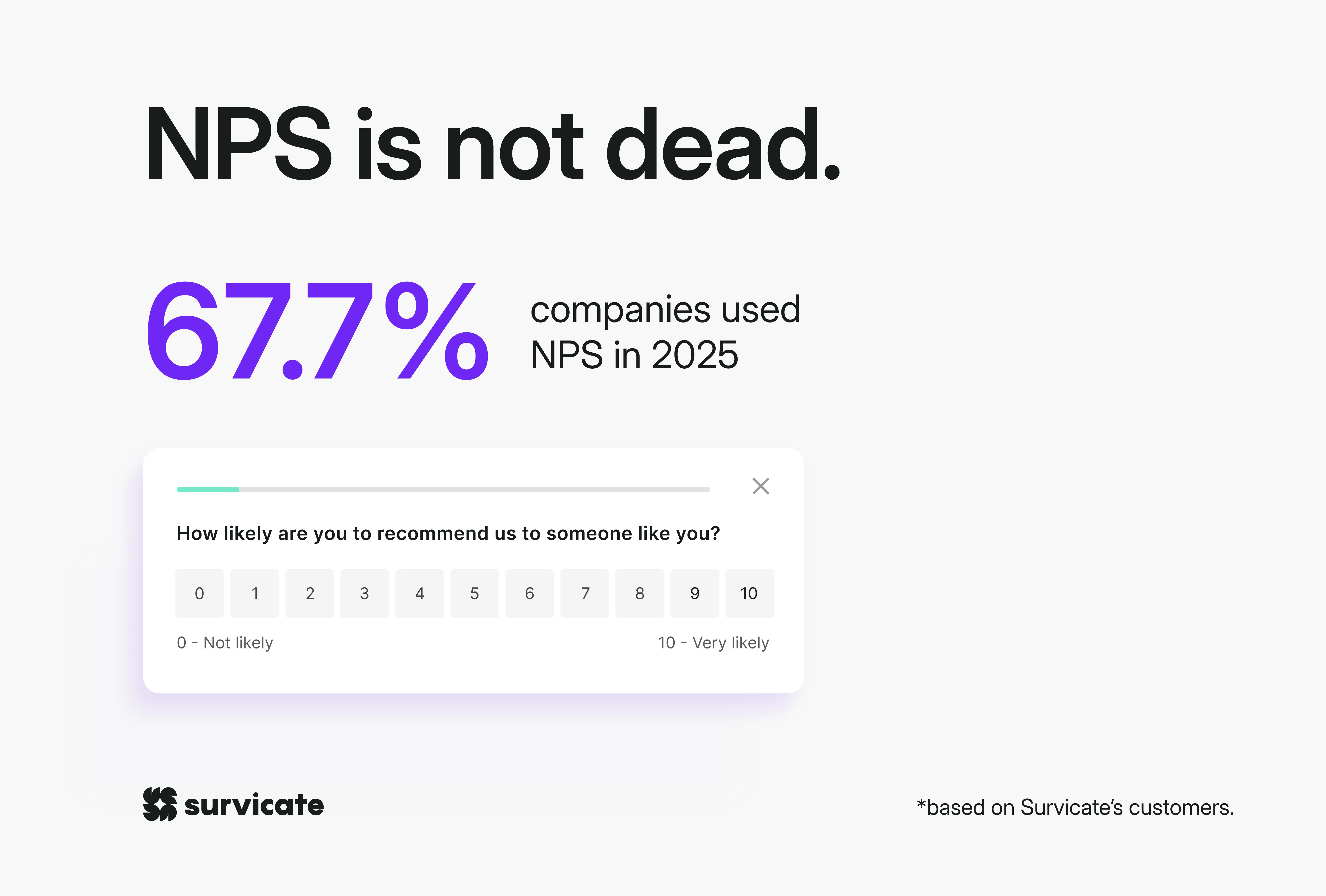
The system survives because it respects the mental energy of the person on the other side of the screen. Most people view a long survey as a chore. They often abandon the task before they finish a single page. A simple request for a number avoids this friction. This convenience protects response rates that hover around 33% but tank the moment questions require paragraphs of thought.
Back in 2021, the Net Promoter Score felt like a blunt instrument because companies lacked the tools to understand the specific reasons for a low score. The technology eventually caught up. Modern tools like Survicate’s Insights Hub now read through mountains of customer comments to find the patterns that humans used to miss. This automation removes the need to manually sort through spreadsheets for hours. It transforms a lonely number into a clear map of operational fixes. The data blind spots that frustrated managers five years ago have mostly disappeared.
Research supports the persistence of the score. A study in the Journal of the Academy of Marketing Science found that consistent tracking offers a window into future revenue growth. Accuracy depends on surveying the whole market rather than just the loyal fans. If a brand watches the trends over several months, the numbers provide a reliable forecast for financial health.
Situations where running an NPS is an optimal choice
Net Promoter Score surveys are a great way to get a read on how loyal your customers really are, but they work best when you send them at just the right time in the customer journey.
For digital products like SaaS tools, mobile apps, or online platforms, popping up an NPS survey at a key moment means you get super fresh feedback that's actually useful for making improvements.
Below, we'll walk you through the best times to send these surveys, with examples that work for both B2B and B2C setups.
After onboarding or early use (first value stage)
The first week of a new customer relationship is a delicate time. Asking for feedback the moment someone signs up is usually pointless, they haven’t even used the product yet. Most experts recommend holding off until the user hits their first meaningful milestone, when they’ve actually experienced real value from the software. Gainsight emphasizes that transactional surveys work best right after that “aha” moment, ensuring you get thoughtful opinions instead of snap reactions to a signup page. This advice sounds clever until you remember the silent graveyard of users who never made it far enough to succeed.
What you're really dealing with here is classic survivorship bias (or sampling bias). You only hear from the people who eventually reached their "aha" moment. The ones who dropped off early, never got value, and quietly disappeared are completely missing from the conversation.
Unless you have a deliberate, separate mechanism to systematically collect feedback from that drop-off group, your insights will almost inevitably skew too positively and paint an overly optimistic picture of the experience.
Dinu Popescu, CEO of Brizy, uses this approach to gauge user confidence. For him, a great tool empowers people to get things done without frustration. His team triggers NPS surveys only after a user finishes building a page or wraps up a support chat. This keeps the developers laser-focused on genuine usability issues.
“I rely on NPS because it helps me see whether our product is truly empowering users, not just functioning correctly,” Popescu explains. “At Brizy, ease of use is everything, so one clear reason we use NPS is to validate if customers feel confident creating pages on their own.”
Thanks to this timing, their response rates hover around 30% – people actually bother to answer because the question feels relevant to what they just accomplished. The feedback quickly reveals friction points that slow down creators or flags when support responses have gotten too complicated.
Free trials offer another golden opportunity. Sending an NPS survey at the very end of the trial captures insights from both the users who convert to paid and those who walk away. You learn precisely what was missing for the skeptics and which features sealed the deal for the converts. With that information, teams can reach out to unhappy trial users, fix issues, and potentially save the relationship before it’s over.
Spotting detractors early can literally save an account. A strong NPS score during onboarding is a great predictor of long-term retention. Timely insights help product teams prioritize the improvements that have the biggest impact on keeping customers around longer.
Post-purchase or after product delivery
Another great moment for an NPS survey is right after a purchase or product delivery. This is prime time for capturing that fresh, emotional feedback.
In B2C e-commerce and retail, brands love sending a quick survey shortly after the package arrives and the customer has had a chance to unbox and try the product. You get honest insights into the whole experience: the buying process, shipping, delivery, and that initial "wow" factor (or any letdowns). The trick is timing it perfectly – wait long enough for them to actually use it, but catch them while the excitement (or frustration) is still high.
The same idea applies to tech and SaaS. Think of a "major purchase" as someone starting a new subscription, upgrading their plan, or kicking off a paid tier. Sending an NPS survey soon after they dive in helps uncover their early impressions and satisfaction.
In retail, it's super common to drop an email with an NPS question about a week after delivery, asking if they'd recommend the product or store to friends.
Timing is powerful because emotions are running hottest right after the purchase or unboxing – whether it's pure joy or a bit of buyer's remorse. On top of gauging immediate satisfaction, an NPS survey at this stage also predicts real referral behavior, which is gold for building loyalty and driving repeat business in e-commerce.
After customer support or service interactions
A support ticket isn't just about fixing a tech glitch – it's often a make-or-break moment for your brand. When customers reach out, they're usually feeling frustrated or vulnerable, and sure, resolving the issue is table stakes. But how do you handle the whole interaction? That's what decides if they stick around or bounce.
The smartest move is to trigger an NPS survey right when the chat ends or the ticket gets marked "resolved." That way, you capture their emotions at peak intensity, while everything's still fresh in their mind.
Greta Guleviciute, Head of Marketing at Ketch, sees these support moments as huge opportunities to build (or lose) trust. Her team handles super sensitive stuff like privacy requests and data compliance – topics that can make anyone anxious. For them, closing a ticket isn't enough; they want customers walking away feeling confident.
Even though their response rates sit between 18-22% (which makes sense given the heavy subject matter), the feedback they get is invaluable for keeping everyone aligned.
“I rely on NPS because it helps us understand why customers feel the way they do, not just whether a ticket was closed,” Guleviciute says. “In daily customer service work, NPS helps us identify where customers feel confused or anxious, improve our tone and response clarity, and align marketing, support, and product teams around building long-term confidence.”
These interactions are "moments of truth". Nail the resolution with empathy and clarity, and you can turn a frustrated user into a raving fan. Botch the vibe (even if you fix the problem), and you've got yourself a detractor overnight.
By surveying right away, companies get a clear picture of just how much a single human touchpoint impacts the overall journey.
Following feature releases or product updates
Launching something fresh is the perfect chance to check how it's landing with your users. Give them a little time to actually play around with it, then hit them with a survey. You'll quickly find out if the new stuff is wowing them or accidentally causing headaches.
In the real world, tech teams often keep a close eye on NPS around releases. For instance, after a UI overhaul or adding some major new functionality, a quick in-app NPS pop-up can reveal how well it's being received. Even better: trigger the survey based on actual usage, like once someone finishes a new workflow or tries the shiny new feature. That way, you're only asking people who've engaged with it, and the feedback is super contextual and timely.
Why does this timing rock? Product managers get those crucial early signals on whether a feature is a hit or needs tweaking. An NPS survey linked to the release basically checks if the changes have made users more (or less) likely to recommend you – giving you a clear read on how the update is moving the needle on loyalty.
To maintain a “pulse” on overall client satisfaction
You might have already heard or seen the term “relational NPS” – which makes sense, because companies usually send the survey on schedule to make sure they’re up-to-date with customer sentiment. Brands often run it quarterly or biannually, as a regular check-in.
A particularly useful moment is a few months before renewal, because it leaves room for action if customer sentiment isn’t on the “safe side”.
The key is to give enough time between surveys so that the relationship has evolved and customers have new experiences to reflect on.
For example, at Nextiva, NPS surveys are sent out at key moments such as onboarding, the first 90 days, and after major escalations. The company’s CMO Yaniv Masjedi explained to us that “every score has a name attached to it,” which keeps teams accountable.
He also told us that the company reviews low scores during group sessions and uses them to improve training and handling.
Meanwhile, at Legiit, NPS is used for long-term loyalty measurement only, while CSAT and CES cover individual touchpoints. Founder and CEO, Chris M. Walker, shared with us that they get an average 28% response rate on their surveys.
The team sends them out after milestones like project completion. Similarly to Nextiva, they’re using feedback from promoters and detractors to understand how they can get better at their work. In their case, it circles around improving onboarding and reducing churn.
Relational NPS works because it tracks long-term sentiment instead of isolated moments. Teams can spot at-risk accounts early enough and identify advocates consistently, too. Over time, they can compare NPS trends with retention and revenue to understand how loyalty connects to business results.
Where collecting NPS might not be enough?
Now, looking at the flip side, what are some situations when brands should reach for additional customer metrics or insight sources?
Here are the three main scenarios:
When your company tends to overstate the role of NPS in post-purchase interactions
Yes, this was exactly the concern raised by Gartner, i.e., that NPS often reflects things customer service teams can’t control. And this also means that they shouldn’t be held accountable for lower-than-ideal NPS scores, because price and product quality are an issue, too.
In those moments, your company could benefit from metrics that ask narrower questions. Customer Effort Score, for example, focuses on how easy or hard it was to complete a task. That makes it far more useful for evaluating support workflows, onboarding steps, or checkout flows.
For example, Founder at Festoon House, Matt Little, tracked NPS across his six warehouse locations. The scores confirmed that customers liked the brand. But they did not explain why certain commercial-grade cables performed better in coastal, high-humidity environments or where buyers struggled during bulk ordering. To get those answers, the team shifted attention to Customer Effort Score and qualitative feedback.
Even with a strong NPS, Festoon House uncovered three technical friction points in the checkout process that almost cost a $15,000 hospitality contract. Fixing those issues increased checkout conversion by 12.45% over six months.
Now, it’s worth mentioning that they did not drop NPS. They still use it as a baseline for monthly board reports. They simply stopped asking it to do too much.
When you don’t ask follow-up questions
When teams collect the score but skip follow-up questions, they lose the context needed to act. This is what Gartner meant by “adapting” NPS. The score should open a conversation.
For example, ask "What's the one thing we could do to make [product name] better?" or “What do you value the most about our product/service?” for scores that were on the higher end. You could try out our ready-to-use survey templates to check how small additions can improve results.
When you have a good NPS, but are still seeing above-average churn
Customers often give positive scores and still leave because of price changes and easier alternatives. Internal purchasing rules can also drive that decision. Even the metric’s own creators noted that building lasting loyalty turns out to be harder than the score suggests.
This was true for GroomsDay. The company’s Managing Partner, Chris Bajda, told us the team tracked NPS for three years and reached a score of 72.45. Customers liked the brand but still raised concerns about shipping and product quality. Refunds sat at 4.12%. A high NPS can co-exist with real problems. When churn remains high, teams need to look beyond sentiment and examine the experience itself.
What worked for GroomsDay particularly was that the team shifted focus to Customer Effort Score to measure how easy it was to personalize products. Eventually, they were even able to cut support tickets by 28.5% within six months.
This, once again, shows that extra context matters.
You could ask your customers questions like what nearly stopped a customer from buying or what made the experience harder.
You don’t have to analyze each answer case by case; you could, instead, use a single-source-of-truth like Insights Hub, which pulls all your customer feedback – surveys, emails, or even external review sites – to analyze certain concerns at scale. For example, if many clients cited pricing concerns or lack of a feature, these could be your potential suspects for a high churn rate.

Conclusion
So, should you still be using NPS in 2026 and beyond? Absolutely yes.
NPS isn't going anywhere – it's simple, fast to deploy, and customer loyalty will always be a critical metric worth tracking. It's designed for big-picture sentiment, not just narrow support performance, which was part of Gartner's 2021 concern.
No single score tells the full story of customer health; customer experience is multidimensional. The real power comes from pairing NPS with qualitative feedback like open-ended responses, managerial insights, and social mentions.
Back in 2021, analyzing those at scale was tough without AI. Today, tools like Survicate make it easier than ever to blend quantitative and qualitative data for a clearer, more actionable view.



.svg)

.svg)


