A few months ago, I wrote an opinion piece comparing CSAT vs. NPS. In that article, I argued that CSAT gives you feedback you can act on in a way that NPS doesn’t, because CSAT is designed to capture immediate, episodic sentiment.
Or at least, that is how it’s supposed to work.
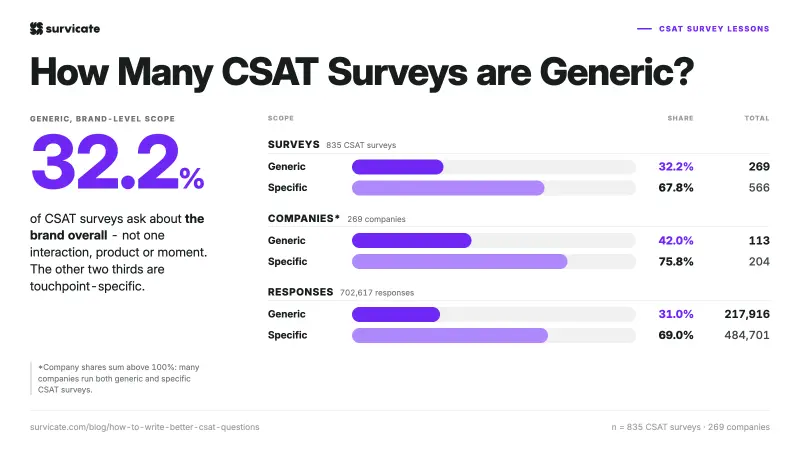
When we pulled our latest dataset to see how teams actually put CSAT into practice, we found a big gap between theory and reality. Instead of using CSAT to zoom in on specific moments, roughly a third of the questions we looked at asked about their brand overall.
To see how deep this pattern runs, we analyzed 835 English-only CSAT surveys across 269 companies from our 2025 customer database. The most common way CX practitioners write CSAT questions turns out to be the least useful one. 32.2% of the questions are pitched at the brand, and 42% of the companies in the sample did it at least once.
Here is what we found, why it happens, and how to fix it.
Nearly 1 in 3 CSAT questions are generic – and ask about the brand instead of the experience
When you set up a new survey, most software provides pre-built templates to speed up the process, ours included.
At Survicate we offer very specific CSAT question templates at the product or feature level:
- How satisfied are you with [product] 's ease of use?
- How satisfied are you with [product] 's reliability?
- How satisfied are you with the [Feature Name]?
And yet, almost a third of CSAT surveys end up asking about satisfaction at brand-level.
In our analysis, 32.2% of all CSAT questions surveyed name the overall company rather than a specific interaction, product feature, or touchpoint. Out of 835 questions analyzed, 269 pitched their scope strictly at the brand level.
CSAT Survey Question Scope: Generic vs. Specific
| Survey Question Scope | Total Surveys | % of Surveys | Total Companies* | % of Companies | Total Responses | % of Responses |
|---|---|---|---|---|---|---|
| Generic (Brand-Level) | 269 | 32.20% | 113 | 42.00% | 217,916 | 31.00% |
| Specific (Touchpoint-Level) | 566 | 67.80% | 204 | 75.80% | 484,701 | 69.00% |
*Note: Company percentages sum to over 100% because 48 companies run both generic and specific CSAT survey questions across their programs
When you ask a question at the brand level, you’re using the exact same broad scope as standard NPS surveys. NPS measures brand loyalty. CSAT is built to capture one experience while it’s still fresh.
Measuring general brand sentiment with CSAT kills the primary benefit of the metric, which is rapid, localized feedback. When you choose a broad scope, you end up paying the cost of a flexible, transactional metric and taking none of the benefit.
Here are examples of real, anonymized examples of brand-level ratings from our dataset:
- "Considering all experiences with [Company], how would you rate our overall performance?"
- "How satisfied are you with [Company]?"
Why generic CSAT persists, and what it really costs
Specific scope always works. A CX practitioner can rephrase a question to ask the exact thing the team needs to know. A generic phrase like "How satisfied are customers with Survicate?" yields an average of everything, and nobody can act on it.
My test for any question in a program is as simple as asking:
What will the team do differently if the score is low?
If there is no answer to that, the question shouldn't exist. Brand-level CSAT fails this test every time.
Plus, vague feedback creates an accountability vacuum. When a brand-level score drops, you cannot route it to a specific team. It’s like holding support reps responsible for an overarching NPS score driven by pricing or product bugs. This produces analysis paralysis, where a metric like "3.4 out of 5 satisfaction" sits in a report with no clear owner or operational next step.
What’s worse, generic surveys foster a dangerous false sense of security. A vague high score hides underlying product and service friction because nobody investigates a good number. As a result, quiet issues compound until churn occurs.
Measuring expectations instead of happiness matters more than question scope
Beyond picking a specific touchpoint, two structural choices dictate whether a feedback program actually works:
- Measure experience against expectations rather than happiness. Happiness is just a mood. A bad day easily turns into an arbitrary 2 out of 5 rating, whereas expectations offer an objective, rateable benchmark.
- Standardize the rating scale across every survey. Using a uniform 1-5 scale, regardless of visual format, allows every CSAT survey question score to aggregate into one company-wide pulse. Mixing scales across touchpoints creates fragmented data that no team can retrofit or normalize later.
51% of "overall" CSAT questions point to nothing specific
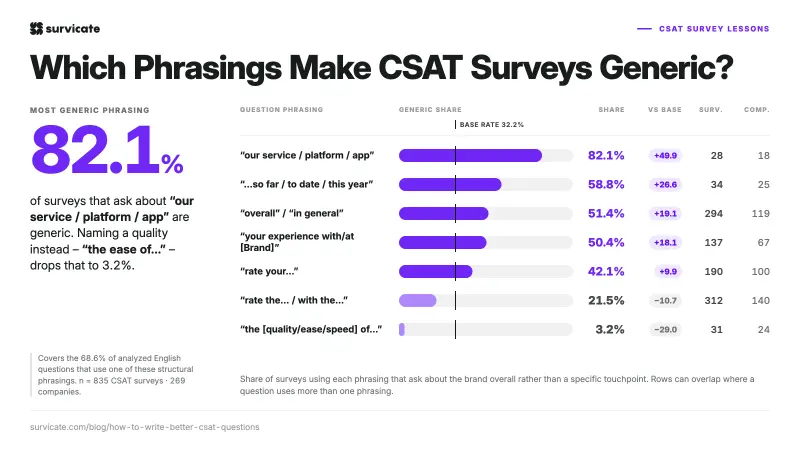
Every CSAT question comes down to one choice. Name something a customer touched, or point back at the company. In English-language surveys, 51.4% of CSAT question examples, which use terms like "overall" or "in general," fail to specify an actual event, feature, or interaction.
When a question focuses on the relationship – using terms like "our service", "your experience with us", or "so far" – it pushes the scope toward general brand sentiment. Across 259 surveys that frame questions around the relationship, 55.2% fall into generic territory.
In contrast, when a prompt targets a tangible object or event, using phrasing like "the resolution", "the new app", or "the speed of delivery", the generic rate drops to just 4.5%.
CSAT Question Groups: Generic vs. Specific
| Question Framing Strategy | Total Surveys | % of Surveys | Companies | % of Companies | Generic Surveys | Generic % | vs Base Rate (pp) |
|---|---|---|---|---|---|---|---|
| "our service / platform / app" | 28 | 3.40% | 18 | 6.70% | 23 | 82.10% | +49.9 |
| "…so far / to date / this year" | 34 | 4.10% | 25 | 9.30% | 20 | 58.80% | +26.6 |
| "overall" / "in general" | 294 | 35.20% | 119 | 44.20% | 151 | 51.40% | +19.1 |
| "your experience with/at [Brand]" | 137 | 16.40% | 67 | 24.90% | 69 | 50.40% | +18.1 |
| "rate your…" | 190 | 22.80% | 100 | 37.20% | 80 | 42.10% | +9.9 |
| "rate the… / with the…" | 312 | 37.40% | 140 | 52.00% | 67 | 21.50% | -10.7 |
| "the [quality/ease/speed] of…" | 31 | 3.70% | 24 | 8.90% | 1 | 3.20% | -29.0 |
Note: Data covers the 68.6% of analyzed English questions that use one of these specific structural phrasings.
Two words often signal which path a survey takes. "Our" and "your" direct focus back toward the company relationship, while "the" and "this" anchor the prompt to a specific item or event.
Here are two examples of real, anonymized examples from our dataset with vague words diluting the focus:
- "How would you rate your overall experience on our site today?"
- "On a scale from 1 to 10, how satisfied are you with [Company] overall?"
Why asking for a rating without a concrete target breaks the metric
A score needs a clear target to mean anything. Ask a buyer to rate how a support ticket was resolved, and an actual event pops into their mind. It happened, it is fresh, and putting a number on it feels natural.
Ask someone to rate a company overall, though, and the brain has to do some heavy lifting. The person tries to average a random bunch of experiences over an unknown period (usually weighted by whatever went wrong that morning).
People will still pick a number, and that is the real trap. The survey collects data, but the final score ends up measuring nothing a team can actually fix. At the end of the day, a useful question names a concrete event; a wasted one just points at a vague relationship.
The channels with the most context ask the vaguest questions
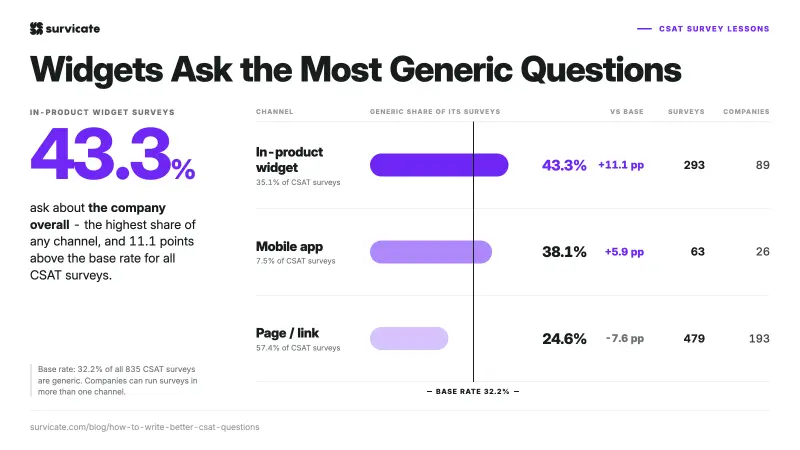
The channels that know the most about where a customer is in their journey are often the ones asking the vaguest questions. In-product widgets score the highest for generic prompts, with 43.3% of in-product surveys asking about the company overall.
Mobile apps follow closely at 38.1%. Meanwhile, email and link surveys, where tracking exact user context requires far more technical setup, ask generic questions only 24.6% of the time.
Share of Generic CSAT Surveys by Survey Channel
| Survey Channel | Total Surveys | % of Surveys | Companies | % of Companies | Generic Surveys | Generic % | vs Base Rate (pp) |
|---|---|---|---|---|---|---|---|
| In-Product Widget | 293 | 35.10% | 89 | 33.10% | 127 | 43.30% | +11.1 |
| Mobile App | 63 | 7.50% | 26 | 9.70% | 24 | 38.10% | +5.9 |
| Page/Link | 479 | 57.40% | 193 | 71.70% | 118 | 24.60% | -7.6 |
This trend directly connects to the first pillar of modern feedback programs, which is event-driven triggers. As covered in our analysis of CSAT vs. NPS, a digital trigger can supply the exact moment a customer takes an action. But a trigger cannot write a good prompt – only the person setting up the survey can choose a specific target for the question.
Examples of vague questions from our dataset, used inside digital products, include:
- "How satisfied are you with your [Brand] experience?"
- "How would you rate your overall experience on the website today?"
What the data shows versus what should actually happen
To be completely honest, I don't know why teams ask such vague questions when they have rich contextual data right in front of them – and I'd rather tell you that than make something up.
We could speculate about laziness, a lack of setup know-how, or simply the fact that nobody ever showed them why specific questions get better results, but it would still just be speculation.
What I can tell you is that these numbers show what is actually happening, not what should be happening. The reality should be the exact opposite. When you know the exact screen, page, or moment someone is at, writing a great question becomes almost effortless.
If your widget fires on the billing page, the context hands you the question on a silver platter. Just ask them about the billing experience or the purchase process.
You don't have to overthink it. Instead, people gladly drop a pop-up right there to ask how satisfied someone feels with the company overall, completely wasting a golden opportunity to capture real, actionable feedback.
When even the survey knows the moment, but the question doesn’t
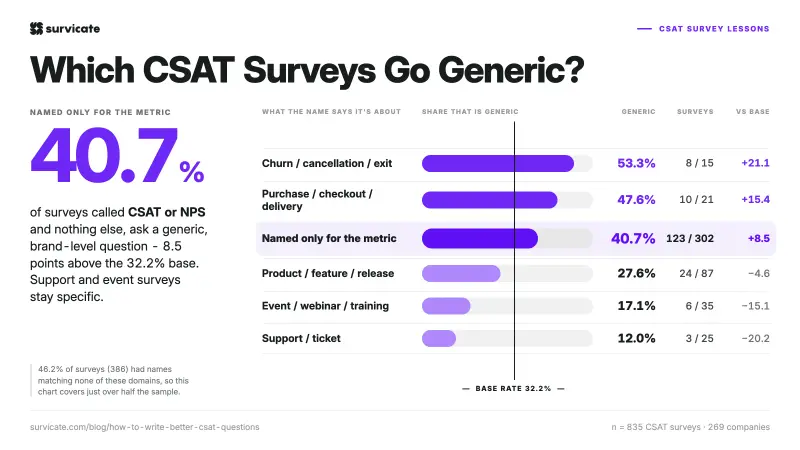
A survey name doesn’t always tell you exactly what a company wants to learn. 302 of the 835 surveys, 36.2%, are named only by the metric they measure, rather than the customer moment they cover. Of the surveys we could classify by name at all, that's about two thirds of them.
In fact, 40.7% of surveys named only for the metric, used a generic, brand-level CSAT question, such as “How satisfied are you with [Company]?”
Even when a survey name does identify a concrete moment (like checkout, cancellation, or a support interaction), the question itself often stays generic. One real-life example from our dataset that illustrates this well comes from a company that wanted to ask clients about their purchase experience.
The survey was titled “Post Purchase Survey”, but the question was a generic “How would you rate your experience with our website or app?”. As you can see, it had nothing to do with the purchase the client had just completed.
Share of Generic CSAT Surveys vs. Survey Name
| What the survey name says it's about | Surveys | % of surveys | Companies | % of companies | Generic surveys | Generic % | vs base (pp) | Largest company's share |
|---|---|---|---|---|---|---|---|---|
| Churn / cancellation / exit | 15 | 1.80% | 11 | 4.10% | 8 | 53.30% | +21.1 | 20% |
| Purchase / checkout / delivery | 21 | 2.50% | 18 | 6.70% | 10 | 47.60% | +15.4 | 19% |
| Named only for the metric | 302 | 36.20% | 60 | 22.30% | 123 | 40.70% | +8.5 | 22% |
| Product / feature / release | 87 | 10.40% | 49 | 18.20% | 24 | 27.60% | -4.6 | 9% |
| Event / webinar / training | 35 | 4.20% | 24 | 8.90% | 6 | 17.10% | -15.1 | 17% |
| Support / ticket | 25 | 3.00% | 20 | 7.40% | 3 | 12.00% | -20.2 | 16% |
Note: 46.2% of surveys (386) had names that did not match one of the domains above, so this table covers just over half of the sample. “Named only for the metric” includes survey names containing terms such as CSAT or NPS.
Why survey names and questions drift apart
From what I've seen, teams often start with the metric they need to report rather than the decision they want the survey to inform. Allow me to explain.
“Customer Satisfaction Survey” works as an internal label, but it doesn't tell you what you're trying to learn or what someone should do with the answer. The 36.2% of surveys named after the metric, and the 40.7% of those that are generic, point to the same problem, i.e., collecting a number instead of answering a question with a clear next step. It’s the NPS mistake I’ve mentioned, all over again.
The survey name doesn't need to be clever. It should simply reflect the customer moment you're trying to understand.
Examples of real-life surveys that lose the moment inside the question include:
- Survey: Offboarding Survey – [company]
Question: How would you rate your experience? - Survey: Exit Intent Survey – Embedded Desktop
Question: How would you rate your overall experience on our site today?”
Support surveys show what happens when the interaction stays in focus
Support and ticket-named surveys were the least likely of the named domains to use a generic question: 3 out of 25.
That makes sense, because when there's a clear interaction behind the survey it's easier to ask something specific. A question about the response, for example, gives you something to investigate, like the conversation, the agent, the resolution, or the process behind it.
That's what I want from CSAT, a score that gives the team a direction. If the question is tied to an actual interaction, a poor score tells you where to start. A generic brand-level score doesn't.
Churn is where the disconnect costs you most
Churn is the most interesting case to me from the whole dataset. On that note, I do need to underline that the sample is small. It's just 15 churn surveys across 11 companies, so I wouldn't treat the 53.3% generic rate as a benchmark. Still, eight of those 15 surveys asked about the brand rather than the cancellation itself.
That's a missed opportunity. Someone who has decided to leave is giving you one of the most valuable feedback moments in the customer lifecycle.
A general satisfaction question isn't inherently useless here. But if the goal is to understand and reduce churn, it doesn't tell you enough.
A low score confirms they're unhappy. A high score leaves you trying to reconcile satisfaction with the decision to leave. Perhaps the budget changed, the project ended, or a champion moved on?
Neither answer necessarily tells you what to do next. I'd ask for the reason for cancellation instead. If you give the customer a short list of likely reasons, with an option to add their own, you'll be able to distinguish genuine product or service problems from churn caused by circumstances outside your control.
When companies get specific, they most often name a specific moment
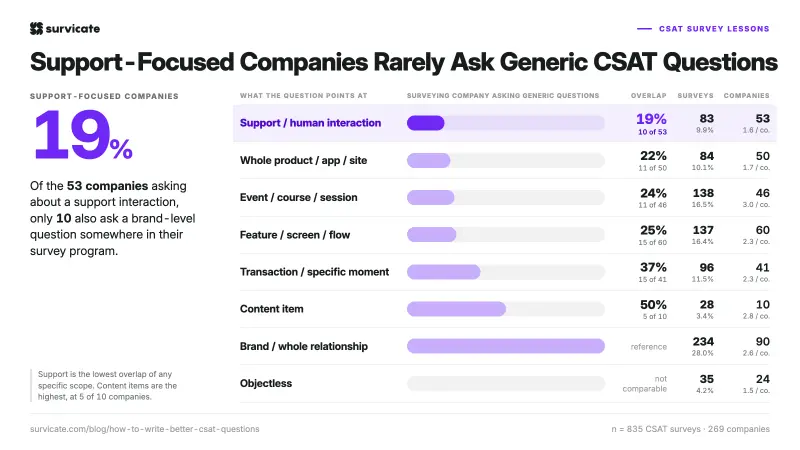
When companies get specific, they don’t all do it in the same way. Some anchor their CSAT question to a customer moment, like a support interaction, purchase, event, or other transaction. Others tie it to a product element such as a feature, screen, flow, or piece of content.
In our data, 317 surveys from 125 distinct companies* point to a customer moment, compared with 249 surveys from 103 companies that point to a specific product, feature, screen, or content item.
CSAT Surveys: What Specific Questions Point At
| What the question points at | Surveys | % of surveys | Companies | % of companies | Surveys per company | Its companies also asking brand-level |
|---|---|---|---|---|---|---|
| Brand / whole relationship | 234 | 28.00% | 90 | 33.50% | 2.6 | — |
| Event / course / session | 138 | 16.50% | 46 | 17.10% | 3 | 11 of 46 (24%) |
| Feature / screen / flow | 137 | 16.40% | 60 | 22.30% | 2.3 | 15 of 60 (25%) |
| Transaction / specific moment | 96 | 11.50% | 41 | 15.20% | 2.3 | 15 of 41 (37%) |
| Support / human interaction | 83 | 9.90% | 53 | 19.70% | 1.6 | 10 of 53 (19%) |
| Whole product / app / site | 84 | 10.10% | 50 | 18.60% | 1.7 | 11 of 50 (22%) |
| Objectless | 35 | 4.20% | 24 | 8.90% | 1.5 | — |
| Content item | 28 | 3.40% | 10 | 3.70% | 2.8 | 5 of 10 (50%) |
*Note: “Distinct company” means each company is counted only once within a category, even if it appears in multiple surveys.
What questions are used in CSAT surveys?
The textbook CSAT use case is a specific customer moment, but only 11.5% of the questions in our sample pointed to a transaction or other defined moment.
That's not necessarily a problem, because a feature, screen, or support interaction can all be perfectly good things to measure. What matters is that the question gives you a defined object or experience to investigate when the score comes back low.
Here’s a handful of real survey examples where you can see that:
- Survey 1: Support / human interaction
Question: “How satisfied are you with the help of the Customer Service Agent?” - Survey 2: Transaction / specific moment
Question: “How satisfied are you with the ease of accessing the building and apartment?” - Survey 3: Objectless
Question: “How was your experience today?”
The last one is the problem. “Today” is technically a moment, but it doesn't tell the team what the customer is evaluating. The first two give you something concrete to work with.
Support doesn't need discipline, It has the right setup
Support is the one place in the data where this doesn't happen. Of the 53 companies asking about a support interaction, only 10 also ask a brand-level question somewhere in their survey program. That's 19%.
Compare that with content. Five of the 10 companies asking about a content item also use a brand-level question. And 37% of companies asking about transactions do the same. It's tempting to look at this and say “support teams are simply better at staying specific”. I don't think that's what's happening.
Support has an advantage because the system already gives you the object. What I mean by that is that there's a ticket, a conversation, an agent, a resolution. The survey doesn't have to invent a subject for the question. It's already there.
Make specificity part of the setup instead of someone's memory
Everywhere else, someone has to make the right decision each time they build a survey. That's a fragile situation. Anything that relies on people remembering a best practice indefinitely will eventually get skipped.
If you want to know what questions are used in CSAT surveys and, more importantly, which ones stay useful, I'd start with two rules.
- Rule number one: Define the purpose before launching. What is the survey measuring, and what will you do with each possible answer? If you can't answer that, the question probably isn't specific enough.
- Rule number two: Put the thing you're asking about into the survey automatically whenever possible. Pull in the order, feature, event, ticket, or other relevant object the same way a support system pulls in the ticket.
The less the respondent (or the person building the survey) has to guess what the question is about, the more consistently specific your CSAT program will be.
More than half of fintech companies (56.7%) ask at least one generic CSAT question – the highest of any industry
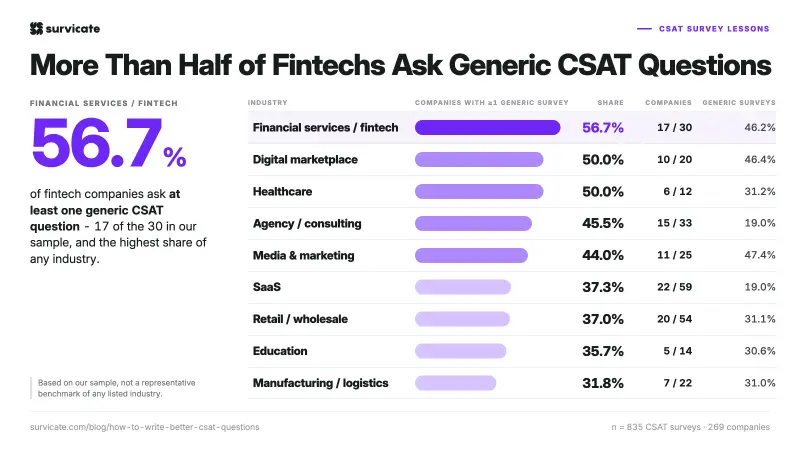
Fintech has some of the richest, most structured customer data you could ask for. Transactions are timestamped, journeys are trackable, and there are usually clear moments across the customer lifecycle. So I find it interesting that, in our sample, fintech companies were more likely than SaaS companies to use generic CSAT questions.
Generic CSAT Question Use by Industry
| Industry | Surveys | % of surveys | Companies | % of companies | Surveys per company | % of this industry's surveys that are generic | Companies with ≥1 generic survey | % of this industry's companies with ≥1 generic survey | Largest company's share |
|---|---|---|---|---|---|---|---|---|---|
| Financial services / fintech | 65 | 7.80% | 30 | 11.20% | 2.2 | 46.20% | 17 | 56.70% | 12.30% |
| Digital marketplace | 56 | 6.70% | 20 | 7.40% | 2.8 | 46.40% | 10 | 50.00% | 23.20% |
| Healthcare | 32 | 3.80% | 12 | 4.50% | 2.7 | 31.20% | 6 | 50.00% | 50.00% |
| Agency / consulting | 121 | 14.50% | 33 | 12.30% | 3.7 | 19.00% | 15 | 45.50% | 36.40% |
| Media & marketing | 156 | 18.70% | 25 | 9.30% | 6.2 | 47.40% | 11 | 44.00% | 42.30% |
| SaaS | 163 | 19.50% | 59 | 21.90% | 2.8 | 19.00% | 22 | 37.30% | 11.70% |
| Retail / wholesale | 177 | 21.20% | 54 | 20.10% | 3.3 | 31.10% | 20 | 37.00% | 28.80% |
| Education | 36 | 4.30% | 14 | 5.20% | 2.6 | 30.60% | 5 | 35.70% | 27.80% |
| Manufacturing / logistics | 29 | 3.50% | 22 | 8.20% | 1.3 | 31.00% | 7 | 31.80% | 10.30% |
Note: This analysis is based on our sample, not a representative benchmark of any listed industry. In fintech, 17 of the 30 companies in our sample used at least one generic CSAT question.
I wouldn't look at these numbers and conclude that, in general, fintech companies don't know how to use their customer data, though. But for the 17 fintech companies in our sample that did use at least one generic question, I have a theory based on what I've seen working with clients in regulated industries.
The survey owner may be far removed from the customer moment
In regulated industries, customer surveys often sit with a central team. It might be CX, compliance, risk, or another function responsible for making sure customer-facing activity gets the right approvals.
That setup makes sense from a governance perspective. The problem is that the team running the survey may own the relationship at a broad level, but not own any particular moment in the customer journey itself.
And the question tends to follow the ownership structure.
If the person responsible for the survey owns the overall customer relationship, a question like “How satisfied are you with [Company]?” is a natural choice. It's broad because their responsibility is broad.
The people who own specific moments (the support lead, product manager, onboarding team, or whoever owns a particular transaction) are much more likely to know exactly what they want to ask. But in a regulated organization, those people can't necessarily launch a survey whenever they need one.
SaaS has a useful advantage – the feedback loop is closer to the workflow
In our sample, only 37.3% of SaaS companies used at least one generic question, compared with 56.7% of fintech companies.
What this suggests is that teams closer to the product and customer workflow may have an easier time building surveys around specific interactions.
That's the model I'd want any organization to move towards, regardless of industry. The person who owns the customer moment should have a clear path to asking about that moment.
Naturally, central governance can (and must) stay in its rightful place. But I believe that, while those in the central team can provide guardrails, the people closest to the experience should be able to define what needs to be measured.
5 tests to run on your CSAT questions
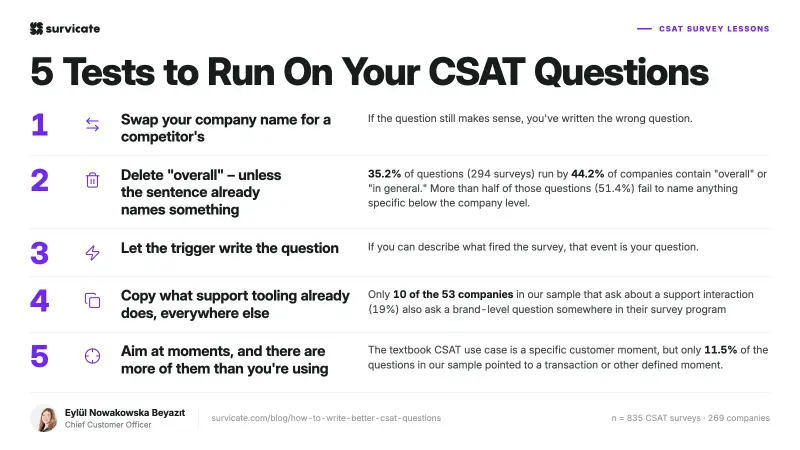
- Swap your company name for a competitor's
If the question still makes sense, you've written the wrong question.
Take a look at how this plays out in practice:
- "How satisfied are you with our service?" survives the swap. You could paste any competitor's name into that sentence, and it would work just as well. That means it fails the test.
- "How satisfied were you with the resolution of your case?" does not survive the swap. It anchors directly to a specific action that just happened inside your workflow.
269 of the 835 questions (32.2%), survive the change. 113 companies write at least one question, which is 42.0% of the 269 questions sampled. Every single one of those questions misses out on capturing specific, actionable feedback.
When you run this swap, you are testing whether you have a concrete target at all.
- Delete "overall" – unless the sentence already names something
If you want an instant fix for your CSAT surveys, start by hunting down the word "overall." Across our sample, 35.2% of questions (294 surveys) run by 44.2% of companies contain "overall" or "in general."
More than half of those questions (51.4%) fail to name anything specific below the company level. Looked at from another angle: 56.1% of all generic questions in our dataset (151 out of 269) rely on this single word.
The distinction comes down to what follows the word:
- "Overall, how satisfied are you with the checkout process?" works fine. The word "overall" is redundant, but the question still points directly at a concrete feature.
- "Overall, how satisfied are you with us?" is the entire problem. It strips away any specific target and leaves the customer rating a vague relationship.
When you strike "overall" from a draft it forces you to name a noun. A feature, a ticket, a checkout.
- Let the trigger write the question
If you can describe what fired the survey, that event is your question. You don't need to overthink the copy, the action your customer just took tells you exactly what to ask about.
This is where so many survey programs break down in practice:
- In-product widgets miss the easiest setups. 43.3% of in-product widgets ask about the company overall, despite the widget knowing the exact screen the customer is viewing.
- Cancellation surveys waste high-intent moments. Out of 15 churn and cancellation surveys analyzed, 8 asked at the brand level. This is one of the richest, most critical moments in the entire customer lifecycle, yet teams reduce it to prompts like "How satisfied were you with our service overall?"
- Support ticket surveys get it right. Surveys tied directly to a resolved support ticket are only 12.0% generic (3 out of 25). Because the ticket itself serves as a clear target, the system naturally supplies the question.
When a customer completes an action, for example, resolving a ticket, upgrading a plan, or completing checkout, the event hands you the noun for your question. You don't have to invent anything; just ask about what happened.
And if you can't name what triggered a survey? That tells you something just as important. A survey with no describable trigger has no clear purpose, and no amount of clever copy or formatting will rescue it. If you don't know why a survey popped up at that specific second, your customer won't either.
- Copy what support tooling already does, everywhere else
Support is a useful model for one reason – the survey doesn't have to rely on someone remembering to be specific. The ticket already gives it a subject.
Only 10 of the 53 companies in our sample that ask about a support interaction (19%) also ask a brand-level question somewhere in their survey program. Compare that with 37% of companies asking about transactions and 50% of those asking about content. I don't think that means support teams are simply more disciplined about CSAT.
The difference is in the setup. A support ticket already tells you what happened, who was involved, and what the customer is responding to. The question almost writes itself.
Elsewhere, being specific is something someone has to remember to do every time they create a survey. That's a much less reliable system. So I'd take the same approach beyond support. Make the order, transaction, feature, onboarding step, event, or whatever else you’re dealing with the starting point for the question.
Specificity shouldn’t be a behaviour people have to remember about.
- Aim at moments, and there are more of them than you're using
There are plenty of useful customer moments beyond the ones teams typically survey. In our sample, 125 distinct companies ask about something that happened, but only 41 ever ask about a transaction.
I'd push teams to look more deliberately at the moments that happen throughout the customer lifecycle. What exactly did your customer just experience that you're asking them about?
That said, I wouldn't build a CSAT program that waits for a customer to do something before it asks for feedback.
If every survey is triggered by a click, purchase, support ticket, or completed action, you only hear from people who generated one of those events. You can miss customers who are disengaged, inactive, or simply sitting between moments.
So I think of moment-based surveys as just one layer of the program. Add feedback at the moments where you most need to understand what happened, and keep a lifecycle layer that doesn't depend on a customer doing anything first.
That gives you both feedback that's tied to real experiences and a way to hear from customers who aren't currently generating an obvious trigger.
Make asking better questions your goal
Here, I'd like to circle back to the CSAT vs NPS piece I've mentioned in the introduction. It ended with a simple idea: stop scoring, start acting. This time, I’d take that one step further. You can't act on a score if the question never tells you what the score is actually about.
That's why this analysis doesn't report a single CSAT score (for this, check out our CSAT benchmark report instead). The number itself isn't the problem. A 60 can be more useful than an 85 if the 60 tells a team exactly what needs fixing.
In fact, I'd argue that a vague question returning an 85 can be more dangerous than a specific question returning a 60, because nobody is likely to investigate a score that looks good.
And I don't think the answer is to turn CSAT into NPS. NPS asks about willingness to recommend, which is a different construct from satisfaction. The overlap between NPS and generic CSAT is the scope. It's not what they're measuring. You should choose between the two based on what you need to understand and your business model.
The problem is that roughly a third of the CSAT questions we analyzed are pitched at the brand level. That's the one scope where CSAT loses its biggest advantage. You're taking a metric designed to capture specific, immediate experiences and asking it to do a job that any broad relationship metric can do.
If you want CSAT to tell you something useful, start before the score. Name the moment, interaction, feature, or decision you're trying to understand. Then ask a question that gives someone a reason to act on the answer.
The goal of running CSAT surveys should be asking better questions, not a better score, with a clear “next step.”
FAQs
What are 10 good CSAT survey questions customers ask?
Here are examples of ten good survey questions that our clients ask using Survicate:
- “How satisfied are you with your experience on our customer support site?“
- “On a scale of 1 to 5, how satisfied are you with the answer of the AI search in the App?“
- “How satisfied are you with this Guidelines article?“
- “How satisfied are you with the [feature name] integration?“
- “How satisfied are you with the Reports page?“
- “How satisfied are you with the new Home Tab and your Personalized Picks Feed?“
- “How satisfied were you with the resolution of your case?“
- “How satisfied are you with the Pay Later offering?“
- “How satisfied are you with the new design and navigation?“
- “On a scale of 1-5, how satisfied were you with the quality of the speakers?“
The common thread is specificity. A good survey question tells you what the customer is evaluating, rather than asking for an opinion about the company as a whole. That makes the response easier to interpret and gives the team a clearer idea of what to investigate if the score is low.
What are the best CSAT questions?
If you’re wondering “what are good CSAT questions?”, then they’re the ones that ask customers about a particular experience, interaction, feature, or moment that the team can act on.
Here are a few real-life customer CSAT questions taken from Survicate: For example:
- “How do you like the new [Company] app experience?”
- “How satisfied are you with the current activity offerings?”
- “How satisfied are you with the ease of finding the update type you needed?”
- “How satisfied are you with the Reports page?”
The exact wording matters less than the scope. Before writing the question, identify what you want to learn and what the team would do differently if the score were low. If you can't answer the second part, the question probably needs to be more specific.
What makes a CSAT question generic?
A CSAT question is generic when it asks about satisfaction with the company, brand, or overall relationship rather than a specific customer experience.
For example, “How satisfied are you with [Company]?” is generic because a low or high score doesn't tell you what caused it. The customer's answer could reflect pricing, product quality, support, delivery, usability, or almost anything else.
A question such as “How satisfied are you with the support you received today?” is much more specific. If the score is low, the team has a defined experience to investigate.
Generic CSAT questions aren't necessarily useless, but they give up one of CSAT's biggest advantages: its ability to capture immediate, localized feedback about a particular experience.