Any serious Qualtrics quote is going to be a big number. That surprises nobody, and “it’s expensive” is where most write-ups stop. It’s also not the most useful thing you can know.
Here’s something worth pondering on more instead: what is the premium actually for, and will your program ever touch the part you're paying extra for?
I'll say this up front, because it's worth keeping in mind as you read: I work at Survicate, so I may have a bias, but my job is to keep it out of this article. Instead, I've tried to do the research as thoroughly as possible.
There are limits to that, because Qualtrics is fairly secretive about the exact contents of its packages and most of its pricing. Every price I could verify comes either from Qualtrics' own pages or from independent contract data from Vendr.
My argument is fairly simple. A large part of the Qualtrics premium pays for research-grade rigor: tools for controlling how studies are designed and sampled, and for testing how strong the findings actually are. Some teams genuinely work at that level. Many CX teams don't, however broad or sophisticated their feedback program may be. Whether yours does is the decision that matters.
TL;DR
- Qualtrics hides most of its pricing. Two tiers carry a public price: a free account at $0, and Strategic Research at $420/month ($5,040/year) for 1,000 responses. Everything a CX or research team actually buys is quote-only.
- Verified contract data (Vendr) puts the median Qualtrics deal at $30,000 a year, with a spread from roughly $7,000 to $140,000. The teams that came to us were rarely at the cheap end.
- Much of the premium goes toward research capabilities such as randomization, quotas, conjoint studies, significance testing, regression, and advanced text analysis.
- The practical question is whether your team needs that level of research. If you're designing controlled studies and testing findings statistically, Qualtrics is built for the job. If you're running NPS, CSAT, CES, dashboards, and closed-loop workflows, you may end up paying for capabilities you rarely touch.
- Modules, seats, response volume, professional services, and renewal increases can all push the contract higher.
How much does Qualtrics cost in 2026?
For most teams Qualtrics is quote-only, and verified purchase data from Vendr puts the median deal at $30,000 a year, with contracts ranging from about $7,000 to $140,000. What a spread that wide really tells you, is that the final number depends heavily on what gets scoped into your contract.
Only two tiers show a number:
- Free account: $0. Capped at 500 total responses for the life of the account, one user, three active surveys, no email distribution.
- Strategic Research: $420/month, billed annually at $5,040, for 1,000 responses a year shared across unlimited users. That works out to about $5 per response. Importantly, this sits in the Strategy and Research suite, not the Customer Experience suite most CX teams are evaluating.
Everything else runs through sales. Qualtrics restructured its packaging into three suites: Customer Experience, Employee Experience, and Strategy and Research. CX pricing is quoted rather than listed:
- For the survey backbone (still called CoreXM in older contracts), third-party guides commonly cite $25,000 to $50,000 a year for a small enterprise team, climbing into six figures once you add modules, seats, and volume.
- The flagship CX suite is quote-based and billed on interactions, with pricing scaling with response volume rather than a fixed public rate.
Is there a Qualtrics free plan and free trial?
There is a free Qualtrics account with some basic survey capabilities. Strategic Research comes with a 30-day trial, but Customer Experience is different: there isn't a self-serve, time-boxed trial of the CX suite, so evaluating the product properly still means going through sales.
What are the limits of the free plan?
The free account is capped at 500 responses total, and that's a lifetime ceiling, not a monthly one. You get one user, three active surveys, a handful of basic question types, and no email distribution. It's enough to click around the builder. But that's nowhere near enough to run a real feedback program, and your response allowance will disappear fast once you start sending surveys to actual customers.
Does the free account unlock the paid CX features?
Would be nice, but no. The free account doesn't unlock the advanced analytics, extra channels, or collaboration features available in the paid suites. If you want to see the Customer Experience suite properly, you need to book a demo. So the free account works more as a way to get familiar with Qualtrics than as a true trial of what you'd eventually be paying for.
How does Qualtrics pricing work?
Qualtrics uses a modular, contract-based model. What you pay depends on how much data you collect, which products you license, and how many people need access.
Customer Experience, Employee Experience, and Strategy and Research are licensed separately, with additional capabilities sold as extensions. External feedback from sources such as reviews and call transcripts, for example, sits in XM Discover under a separate contract.
The pricing metric can also change depending on the product. One contract may revolve around named users or creator seats, another around interactions. That makes the initial quote only part of the picture, because your final cost depends on how the contract is structured and how your usage changes over time.
Why doesn't Qualtrics publish its pricing?
The model gives Qualtrics room to scope each contract around the buyer's size, use case, volume, and mix of products. It also means that serious evaluations move through sales rather than a public pricing page.
That's normal enough in enterprise software, but it makes comparison harder for the buyer. Before you know what Qualtrics will cost in your case, you usually need to explain your requirements, work through the packaging, and get a custom quote.
That's the gap I'm trying to close here: give you enough context to know what you're walking into before that call.
What are you actually paying for?
Plenty of tools build surveys, collect responses, dashboard the result, and push it to your CRM. Qualtrics does all of that, and its dashboards and reporting are genuinely strong. Teams that leave it often say they miss them.
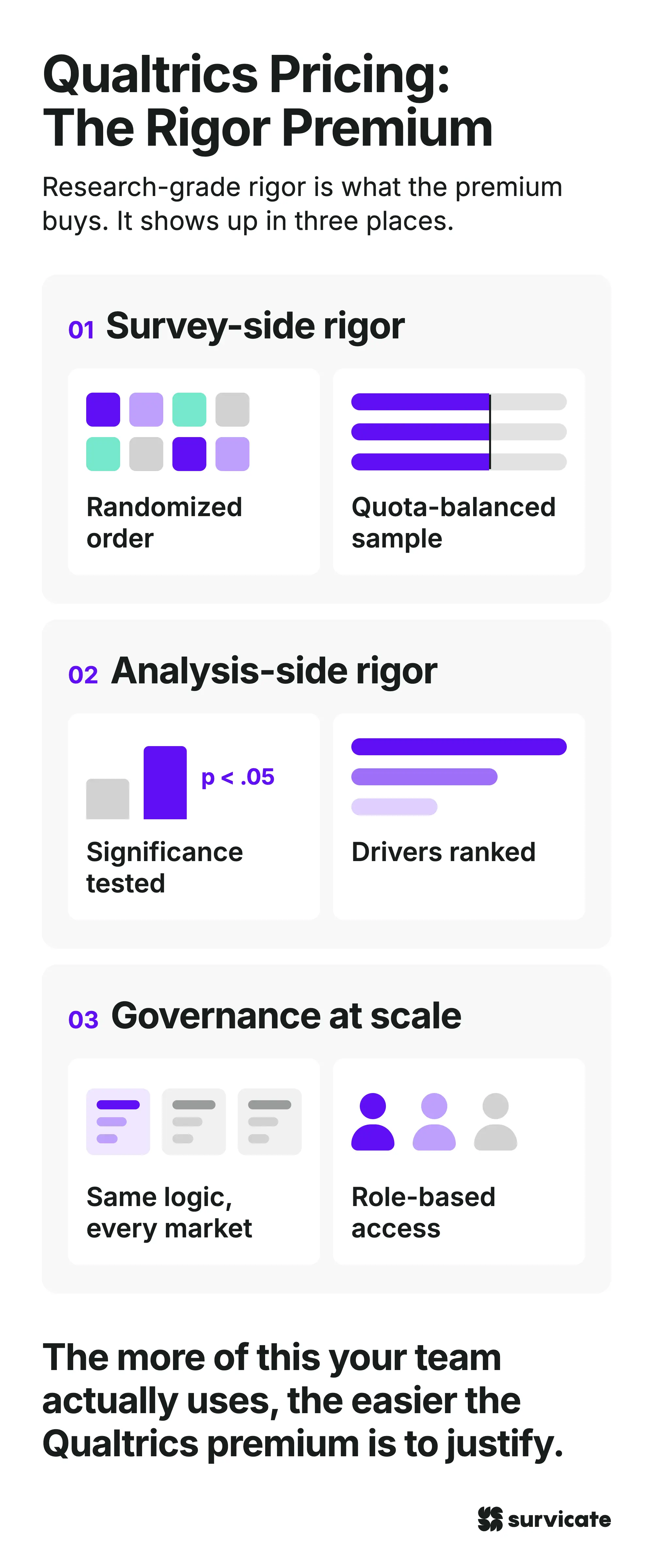
A large part of the premium comes from what Qualtrics adds for serious research: tools for controlling how a study is designed and sampled, and tools for testing how strong the findings actually are. That's what makes the platform particularly useful when a result needs to hold up beyond the immediate dashboard.
I think of that extra research depth as the Rigor Premium. It shows up in three main areas:
- Survey-side rigor: answer and block randomization, quotas, conjoint, MaxDiff, block-level logic, piped longitudinal follow-ups, time-of-day display, built-in respondent panels. None of it builds a nicer survey. Instead, these features help control bias and give researchers more confidence in the sample they're working with.
- Analysis-side rigor: significance testing, regression and key-driver analysis, cross-tabs with t-tests, verbatim text analytics. This is the layer that lets research teams test how robust a finding actually is.
- Governance to run all of that across markets and teams: localized survey logic, role controls, and a large library of question types for organizations running research at scale.
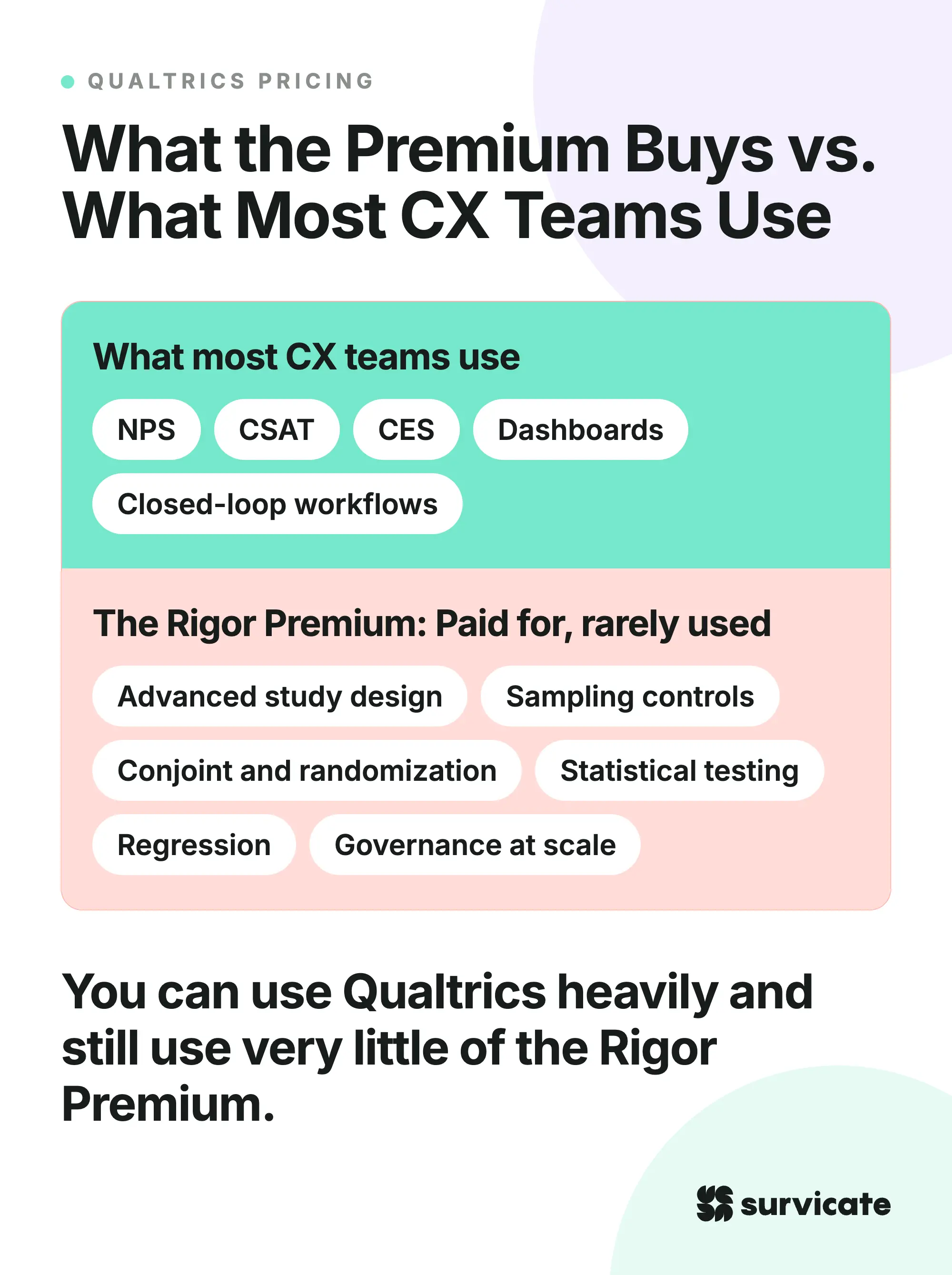
If your team mostly runs NPS, CSAT, or CES, this is where you should look closely at how much of that rigor you actually need. You may use Qualtrics every day, building surveys, checking dashboards, and routing responses into your stack, without ever touching randomization, conjoint, or significance testing. That's still sophisticated CX work. It just doesn't use much of the Rigor Premium you're paying for.
So when Qualtrics feels worth the money, it is usually because the team really does use those research capabilities. When it feels like overkill, the pattern is often simpler: the team relies on the operational side of the platform and pays for a level of research depth it rarely reaches.
What drives Qualtrics pricing up?
The main things that push the cost up are:
- Modules sold separately. CX, EX, and Research are different suites, and text analytics, panels, and external-feedback analysis are add-ons on top.
- Response overages. Contracts include a response cap. Exceed it and you pay per response, which stings for high-volume NPS or CSAT programs.
- Seats. CoreXM is licensed per user, so large or multi-team deployments cost a lot more than a single-team one.
- Professional services. Onboarding and configuration are quoted on top of the license and can add a real chunk to year one. This is one of the lines worth negotiating.
- Renewal uplifts. Buyers regularly report annual increases at renewal. Negotiation data backs up that there's room to push: Vendr notes buyers who clarify costs and negotiate custom tiers often land 15% to 25% lower than an accepted first quote.
Most of those costs are visible before you sign. Renewal increases tend to arrive a year later.
There is also a broader business context worth knowing. Qualtrics is private-equity owned. Silver Lake and CPPIB took it private in 2023 in a deal valued at around $12.5 billion. In October 2025, it agreed to buy Press Ganey Forsta for $6.75 billion. Qualtrics has been consolidating at the other end of the market, too. It acquired Delighted back in 2018 and shut the product down in June 2026, directing customers toward Qualtrics instead.
All that wasn't happening in a vacuum. In his analysis, CX strategist Bill Staikos argued that investors are looking harder at the whole customer-feedback category as AI makes survey collection, text analysis, and insight packaging easier to reproduce.
The value is shifting toward what happens after the insight: whether the software can route it into real workflows and change what the organization does next. He is careful not to put Qualtrics in the same position as the more troubled Medallia, but points to the resistance around Qualtrics' financing as another sign of that broader market reset.
You don't need to follow the business pages of the Financial Times to see why that matters as a buyer. It doesn't mean Qualtrics is in trouble, or that your next renewal will automatically jump. However, it does mean a large, private-equity-owned vendor is operating in a market where incumbents are under more pressure to prove their value.
When your uplift lands higher than you expected, that's the context behind it. But that's also a reason to negotiate the initial price and renewal terms hard rather than treating the offered quote as fixed.
Why do teams choose Qualtrics?
There are good reasons teams still pay for it. Reviewers on G2 and Reddit repeatedly describe Qualtrics as a reference point for enterprise and academic research, and the same strengths come up again and again:
- Analytical range. Statistical testing, hundreds of question types, advanced study design, and panel access in one place.
- In-app interpretation. You can cross-tab, filter, and read results without exporting, which research teams value.
- Governance at scale. Multi-market survey logic, localization, and role controls built for large organizations.
- Integration depth. Connections into stacks like Salesforce and Tableau, plus enterprise support for rollout.
For a team doing heavy quantitative research, that combination is genuinely hard to replicate cheaply. One researcher our sales team spoke to described SurveyMonkey as too basic for advanced work such as statistical analysis and randomization of images and blocks. Qualtrics handled that work better. The problem was the price.
What are Qualtrics' cons, according to users?
Most of the complaints are different versions of the same problem: Qualtrics asks a lot from the team running it.
- Complexity scales with ambition. A basic survey is manageable. Once you move into advanced logic, custom targeting, or module configuration, reviewers describe features buried in menus and a real learning curve. One team we spoke to could no longer make basic changes after the person who had configured the platform moved on.
- Overkill for smaller programs. If you're just running monthly NPS or CSAT, the setup and upkeep become disproportionate to the job you're asking the platform to do.
- Pricing complexity and low predictability. Qualtrics can price different parts of the platform by modules, users, interactions, and add-ons, with much of the structure hidden behind a custom contract. That makes it difficult to know what you'll actually pay as your usage changes, apart from what the initial quote says.
- Limited customization. Reviewers and lost prospects flag branding, survey presentation, and design flexibility as more constrained than expected, the most-cited complaint in our 100-page analysis of real Qualtrics reviews.
- Cost creep over time. Modules bought separately, overage fees, and renewal increases can push the bill up after the initial contract, so the cost rarely stays where it started.
When is Qualtrics worth the price?
I see two cases where the price is much easier to justify.
- Teams working at a research-grade level, whether that's a research group or a CX team: randomized or conjoint study design, cross-tabbing cohorts, significance testing, hundreds of thousands of responses. If that's the work you actually do, Qualtrics is built for it.
- Enterprise CX at scale, across many markets, with governance, localized survey logic, and a dedicated team to run it. Here Qualtrics and Medallia are the two that fit, and both price by quote in the high five to six figures. (If that's your bracket, our rundown of enterprise-grade Medallia competitors is a useful second read.)
When does Qualtrics pricing become a problem?
The teams that struggle most with the cost tend to have a few things in common:
- They run an operational program around NPS, CSAT, CES, dashboards, and closed-loop workflows. Most of the Rigor Premium goes unused.
- Their response volume runs well below the capacity they're paying for.
- They use only one slice of the platform, email surveys, for example, while paying for a much broader XM setup.
- They have no dedicated admin. Qualtrics tends to work best with someone explicitly responsible for managing it, so lean teams often end up carrying more platform overhead than they’re capable of.
- They need it for a short project or a temporary intercept campaign, where an annual enterprise contract makes little sense.
We see the same patterns in our own sales and customer conversations. The examples below come from companies that either used Qualtrics or evaluated it during a buying process. I've paraphrased the conversations and kept the companies anonymous, but the situations themselves are real:
- One international education team told us they were overpaying for capacity they didn't use, sitting on a monthly budget of thousands of dollars against a plan built for far more.
- A long-time Qualtrics user came to us because the intercept solution was too expensive for a short, few-month project. What they wanted instead was flexible monthly pricing for up to 5,000 responses.
- One team we spoke to abandoned Qualtrics after they couldn't make basic admin changes once the person who set it up left. Confusing trigger/survey logic made them ultimately leave the platform.
- A company we spoke to needed to replace Delighted for NPS surveys, before the official shut-down. Qualtrics did offer replacement but at three to five times the current cost with unnecessary features.
Qualtrics pricing vs Survicate, Medallia, SurveyMonkey, and AskNicely
The tools below aren't ranked. What matters here is how easy their pricing is to understand before you talk to sales: some publish enough to budget around, while others keep most of the cost behind a quote.
Survicate and SurveyMonkey publish enough pricing to give you a reasonable budget before a sales call. Qualtrics, Medallia, and AskNicely largely don't, which makes the initial comparison less straightforward. We cover more of the transparent options in our guide to SurveyMonkey alternatives, and we have a dedicated guide to SurveyMonkey's pricing here.
And with Medallia's per-record pricing and Qualtrics's modular contracts, the number you first see can still end up looking quite different from what you pay once usage and add-ons are factored in.
My hot take: how does Survicate compare to Qualtrics?
I work at Survicate, so this is the part where I owe you a clear answer about where Survicate makes more sense than Qualtrics, and where it doesn't.
Let me start with what Survicate gives up. Qualtrics is better at advanced dashboards and analytics, deep survey logic such as piped longitudinal studies and randomized designs, and large-sample statistical work. Those gaps are real, and they map onto exactly the parts a tracking CX program rarely touches.
If you need that depth, Qualtrics or Medallia will serve you better. Survicate is built around a different job: collecting feedback continuously across website, product, mobile, and email, then helping teams understand it and get it back into the tools where someone can act on it. That's a different job from a more traditional research repository engine, and at a different price.
Take a fairly ordinary CX workload: NPS after a customer has been with you for a while, CSAT after support, a survey inside the product when someone uses a new feature, comments accumulating alongside tickets, reviews, and call notes. You don't need a quant research team to get value from that setup.
There are three areas where Survicate makes that job easier than Qualtrics:
- Pricing you can see and plan around.
- One place to work with feedback from surveys, reviews, support tickets, and calls, rather than keeping survey data and external feedback in separate products.
- Open-text analysis you can start using without building your own topic models. Research Hub, Survicate’s own AI research repository, pulls those sources together and can draft reports that remain traceable to the comments and conversations behind them.
Qualtrics gives you much more room to design and analyze serious quantitative research. If most of your work is collecting feedback continuously, understanding what customers are telling you, and getting the right signal to the right team, you may be buying a lot of Qualtrics that never gets used.
With Survicate, there’s less platform to carry, too. A lean CX or product team has fewer capabilities to configure and fewer things to learn just to run the program it wanted in the first place. If you want to see how the repository side compares across tools, we tested the field in our guide to research repository tools.
As one researcher and customer of ours once put it during an interview:
"I've used Qualtrics before, but I felt like I needed a PhD. It supports much larger surveys and datasets, outside of my wheelhouse."
SurveyMonkey and AskNicely sit elsewhere again: the former is a familiar general-purpose survey tool with published pricing, while the latter is much more focused on operational NPS for frontline teams. Neither is trying to be the research engine Qualtrics is.
What to ask before you sign a Qualtrics contract
If you're heading into a quote, define the deal before it defines you. In order of what saves the most money:
- Map your real usage first. List responses, seats, and the modules you'll genuinely use, because if you don't define the workflow, the quote will, usually with modules you didn't ask for.
- Ask what's included versus a paid upgrade. CX, EX, and Research are separate suites, and external-feedback analytics and many extensions cost extra.
- Itemize professional services. Get configuration and onboarding broken out as a separate line item, then negotiate it down rather than treating it as a fixed part of the licence. This is one of the easier places to push on the first quote.
- Cap the renewal uplift in writing. If the contract allows annual increases, negotiate the ceiling before you sign. It's much easier to limit the uplift now than fight it at renewal, when switching costs are already working against you.
- Benchmark against the median. Hold your quote against the roughly $30,000 midpoint and the known ranges, and assume there's room to negotiate.
- Pilot on your own data. Run a real question through the platform before committing to a multi-year term.
- Price the exit up front. The most under-rated cost of Qualtrics isn't the licence, it's leaving: migration is manual and slow, and buyers routinely tell us switching effort, not price, is what keeps them locked in. Scope the export, the rebuild, and who does the work before you sign, not at renewal when you have no leverage.
The bottom line: who should actually pay for Qualtrics?
Pay for Qualtrics if your team will actually use the platform you're buying. Research-grade study design and statistics, multi-market enterprise CX with governance, a dedicated team running the platform: in those cases, the Rigor Premium has a clear job to do.
If your program is mostly continuous NPS, CSAT, and CES tracking, wired into your CRM, with occasional open-text analysis, the calculation changes. You may still use Qualtrics heavily, but much of the research depth behind the price can sit untouched. A lighter platform can cover that kind of program with less cost and administration, which is why we keep a running list of Qualtrics alternatives for lean CX and research teams.
So before asking whether Qualtrics is worth the price, ask how much of the premium capabilities your team will actually use. If the answer is “not much,” that's your cue to start collecting and acting on feedback somewhere lighter.
FAQ
How much does Qualtrics cost per year on average?
Verified contract data (Vendr) puts the median at $30,000 a year, with deals ranging from about $7,000 to $140,000 depending on modules, seats, and response volume. The only publicly priced paid tier is Strategic Research at $5,040 a year for 1,000 responses.
Why is Qualtrics so expensive?
A large part of the premium pays for the research capabilities: randomized and conjoint study design, quotas and sampling controls, advanced analysis, and statistical testing. Those capabilities can justify the price for teams doing serious quantitative research. If your program mostly revolves around NPS, CSAT, dashboards, and closed-loop workflows, much of that Rigor Premium may go unused.
Can you negotiate Qualtrics pricing?
Yes. Most Qualtrics pricing is custom, so the contract leaves room to negotiate scope, professional services, renewal increases, and other terms. Vendr reports average savings of about 11% across the Qualtrics deals in its dataset, which is a good reason not to treat the first number you receive as fixed.
Is Qualtrics worth it for a small team?
It can be, if the team does research that needs advanced study design and statistical analysis. Qualtrics even positions its $420/month Strategic Research plan for small teams and lower response volumes. For a small team running a straightforward NPS or CSAT program, though, the cost and administration are much harder to justify. Lighter, published-price tools get the job done faster, cheaper and with lower effort on your end.
What's the cheapest way to use Qualtrics?
The free account ($0, 500 lifetime responses) for evaluation, or Strategic Research with a 30-day free trial, priced at $420/month if you need up to 1,000 responses a year with advanced analysis. Anything beyond that means a custom quote for a suite.
Author's note (last verified: 18 September 2026): Statements such as "best" reflect our opinion and typical use cases, not a universal guarantee. This comparison is based on publicly available information and our best understanding at the time of writing. Vendors may change features, pricing, and packaging without notice. For the latest details, please check the official sources or reach out to the vendor directly.


.webp)
.webp)
.svg)

.svg)