Searching for an AskNicely alternative looks like a feature comparison. It usually isn’t. The harder question is whether the platform can carry the feedback program you want to run. A tool may handle NPS perfectly well and still leave everything around it scattered across your stack.
This guide is written for a Customer Success or CX lead at a B2B SaaS company who already runs NPS and wants one platform for CSAT, CES, and in-product feedback as well. Responses need to reach HubSpot, Intercom, and the rest of the stack. Product managers responsible for in-app feedback should find it useful too.
One lens runs through every review: not just collecting customer feedback beyond NPS, but analyzing it and acting on it across in-app, web, and email. Listed brands are not placed in order of importance or ranking of any sort.
TL;DR
If your NPS program has outgrown a single email score, the tools below all go further, in different directions. You will find my full reasoning throughout the article, and here’s the short version of how I view each of them.
Why do people look for AskNicely alternatives?
AskNicely is a capable NPS tool for frontline, service-led businesses. Still, teams start looking elsewhere for several reasons.
First, pricing transparency. AskNicely does not publish plan prices on its pricing page and routes buyers to sales for a quote. We know officially that plans start at 500 feedback responses per year and scale with response volume, with overage charges once the allowance is exceeded. AskNicely's blog has mentioned thresholds of $449, $849, and $999, but you still need to book a demo to plan your budget for this tool.
Second, scope. AskNicely centers on NPS for coaching frontline staff, and its survey side is limited to four question types: NPS, CSAT, CES, and 5-star ratings. Teams that want richer question types, in-product targeting, or open-text analysis will eventually need more room.
Third, plan packaging. In-app surveys, CX goals, team huddles, and frontline coaching are reserved for Transform, the top plan, while NiceAI remains an optional add-on across all three tiers. If coaching is the reason you are considering AskNicely, the entry plans do not include the full workflow.
How I did this review
I used the same judgement for every tool: can a SaaS team run NPS, CSAT, and CES across in-app and web, and then send the responses to the tools it already uses? I work at Survicate, so you'll see where I think we're the strongest fit. I've been just as clear about where we aren't, and which tool to pick instead.
What I looked for
While gathering information on each tool, I considered targeting, integration depth, open-text analysis, support, and whether you can see the price without talking to sales or booking a demo. Pure form builders and enterprise research suites are outside the scope of this review.
How I validated the claims
I started with each vendor's product documentation and pricing pages. I then used G2, Capterra, and Reddit to check how the product and support worked in practice, and flagged anything I could not confirm. I also used our own competitor tests and common themes from sales conversations with teams looking at these tools. When a vendor does not publish pricing, I make that distinction clear.
Inside look: how 6 NPS tools handle the SaaS feedback loop
Here are the six alternatives, each reviewed the same way: what it does, who it's for, ease of use, support, pros, cons, pricing, and my take on how well it supports a SaaS feedback program growing beyond NPS.
Survicate: multichannel NPS, CSAT, and CES with a built-in AI research repository
Survicate is a customer feedback platform for product and CX teams running NPS, CSAT, CES, and custom surveys across the customer journey. Alongside surveys, it offers an AI research repository for analyzing feedback from multiple sources.
What does Survicate do?
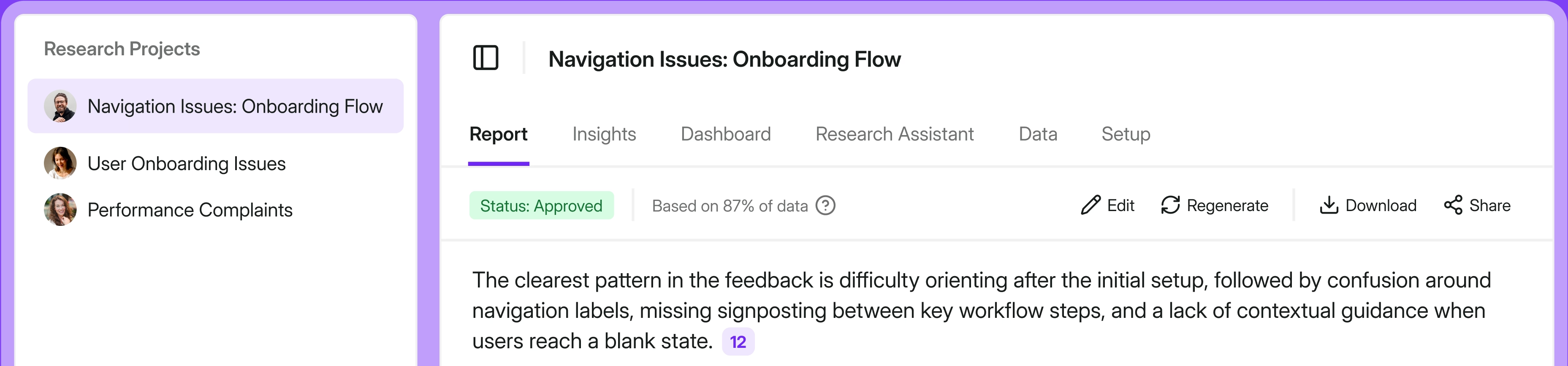
It runs surveys across website pop-ups, in-product (web and mobile SDK), email embeds, link, and Intercom, then centralizes the feedback for analysis. The second half of the platform is Research Hub that pulls in survey responses plus sources like Intercom conversations and support tickets, then runs AI analysis across all of it. That's the collect, analyze, and act loop in one place.
Who is Survicate primarily for?
Customer Success and CX teams at B2B SaaS companies running recurring NPS and CSAT programs. It also suits product teams that want to trigger in-app surveys based on user behavior. Survicate fits teams that live in HubSpot, Intercom, Segment, or Amplitude and want feedback flowing both ways.
What's Survicate's ease of use?
Setup is self-serve, so you can start without booking a demo. G2 reviewers describe the builder as easy to use and the surveys as straightforward to embed. The mobile SDK is light to install for in-app surveys.
What's Survicate's customer support like?
Every plan includes live chat with a human agent rather than a bot. Survicate reports a 97% satisfaction rate and an average first-response time of two minutes.
What are the main pros of using Survicate?
- Multichannel coverage across web, in-product, mobile app, email embeds, and link from one platform.
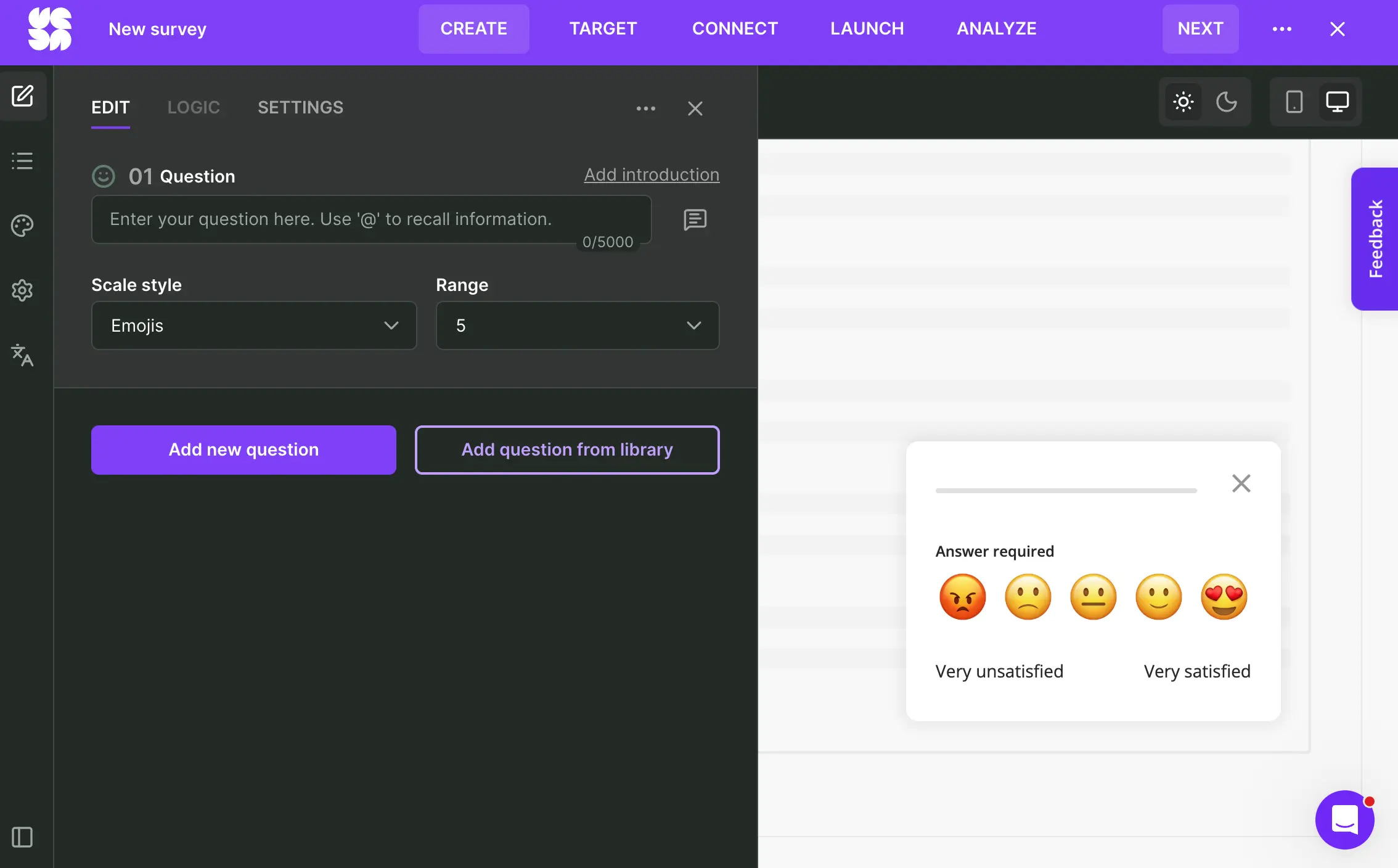
- 15 question types (against AskNicely's four) plus a question library and 400+ templates.
- Deep website and in-app targeting: custom attributes, events, exit intent, display frequency, and URL rules for precise SaaS user targeting.
- 40+ native integrations, with two-way sync into HubSpot, Intercom, Segment, Amplitude, and Mixpanel.
- Research Hub can analyze open-ended survey responses alongside support conversations and other imported feedback, so teams can move from understanding the score to acting on it.
- Signup is self-serve, and every plan includes human support.
What are the main cons of using Survicate?
- Survicate does not manage closed-loop follow-up inside the platform. Responses flow into tools such as HubSpot, Intercom, or Zendesk through native integrations, and the team takes action there.
- High-volume programs may need larger response and Research Hub data-point limits, which raises the price.
- Survicate is not designed for long academic questionnaires or advanced methods such as conjoint analysis.
Pricing
Survicate pricing starts at $56/mo on the Growth plan, with higher tiers for larger teams and Enterprise, ranging from $349 to $569. The free trial covers all pro-level features, with no credit card to start.
My hot take: how does it compare to AskNicely?
For a B2B SaaS team, Survicate is the more natural fit. It lets you run NPS, CSAT, and CES as one program, add contextual surveys on your website and inside the product, then analyze the comments together with feedback from support conversations in Research Hub. You can test that workflow for free without going through a sales-led demo first, and the pricing is fully disclosed.
AskNicely makes more sense when customer feedback is used to manage frontline performance. Its leaderboards, team huddles, recognition, and coaching features are built for managers running service teams across locations. If that is the job, choose AskNicely, or look at an enterprise platform like Medallia.
Refiner: feedback and microsurveys for product-led SaaS
Refiner is an in-app survey tool built specifically for SaaS and digital products. It connects survey delivery with user data and product events rather than operating as a general-purpose form builder.
What does Refiner do?
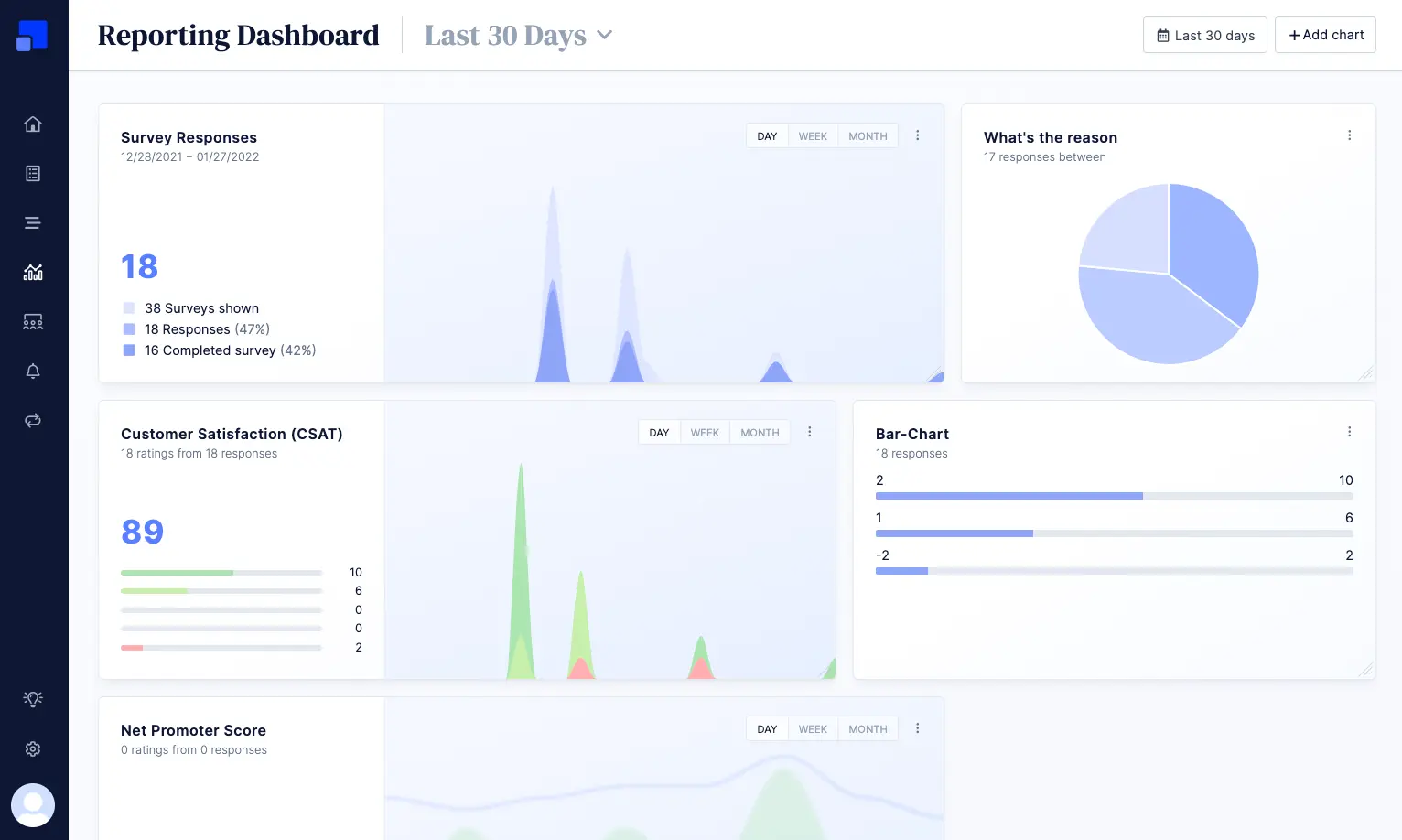
It triggers NPS, CSAT, CES, and PMF microsurveys inside your web or mobile app, targeted at a specific user segment at a specific moment. It also supports email and link surveys as secondary channels.
Who is Refiner primarily for?
Refiner is built for product-led SaaS teams. It is a good fit when NPS, CSAT, CES, and follow-up surveys need to appear at specific moments inside the product, based on what a user has done or who they are.
What's Refiner's ease of use?
Refiner is self-serve, and G2 reviewers often report getting their first survey live in one session. Web surveys require the JavaScript SDK, while mobile surveys use native SDKs for iOS, Android, React Native, and Flutter.
What's Refiner's customer support like?
Reviewers generally describe Refiner’s support as quick and helpful. The team works European business hours and says it usually replies within two hours. Enterprise customers get a dedicated point of contact.
What are the main pros of using Refiner?
- Target surveys using customer data or product events, down to a specific point in the user lifecycle.
- Unlimited survey responses on every paid plan, plus a 30-day trial with all features and integrations.
- Native mobile SDKs and integrations with Segment, Amplitude, Mixpanel, and HubSpot.
What are the main cons of using Refiner?
- Event tracking, multilingual surveys, and Refiner's main SaaS integrations require Growth plan. Essentials supports trait-based segmentation, but it cannot trigger surveys from tracked product events.
- Analysis is centered on Refiner survey responses. AI tagging helps organize open-text feedback, but Refiner is not a multi-source research repository for combining survey data with support tickets or call transcripts.
- Refiner charges for active users, not responses; if 50,000 people use your product each month but only 500 answer a survey, your price is still tied to the larger number. So, for SaaS products with a large free user base, that can be a poor fit.
Pricing
Refiner prices its paid plans by monthly active users and includes unlimited survey responses. Essentials starts at $99 a month and Growth at $239 a month. The 30-day trial allows up to 100 responses; after it ends, the account moves to a free plan capped at 25 responses per month.
My hot take: how does it compare to AskNicely?
Refiner makes more sense than AskNicely when the survey needs to appear during product use. You can ask for feedback immediately after someone tries a feature or reaches an important milestone. Amplitude and Mixpanel cohorts let you narrow the audience further. AskNicely now has in-app surveys too, but its real strength is helping managers use customer scores to coach frontline teams.
The analysis stops at Refiner’s survey responses. It won’t pull in Intercom conversations or other feedback sources. If you want to make sense of all of that together, you’ll need a broader platform. Plus, I’d check the Growth plan before committing: event triggers and the integrations that make this setup useful sit there. MAU-based pricing can also get expensive as your user base grows.
SurveySparrow: conversational NPS and CX surveys
SurveySparrow is an omnichannel survey platform known for chat-style surveys that feel like a conversation rather than a form.
What does SurveySparrow do?
SurveySparrow runs NPS, CSAT, and CES across email, web, in-app, SMS, WhatsApp, and shareable links. Its signature format shows one question at a time in a chat-like flow, which SurveySparrow says it improves response rates. SurveySparrow also supports more than 130 languages.
Who is SurveySparrow primarily for?
SurveySparrow is primarily for CX and Customer Success teams that want one tool for NPS, CSAT, and CES across email, web, SMS, and WhatsApp. It also fits companies that plan to use the same platform for employee or market research.
What's SurveySparrow's ease of use?
G2 reviewers consistently cite the interface and conversational UX as reasons for choosing SurveySparrow. Building a survey is straightforward, although reporting can be harder to navigate, and advanced customization often takes trial and error.
What's SurveySparrow's customer support like?
On Basic and Starter, you contact support by email. Live chat starts with Business, while Enterprise adds a dedicated Customer Success Manager. SurveySparrow targets a first response within two hours on paid plans, and G2 reviewers are generally positive about the team.
What are the main pros of using SurveySparrow?
- One-question-at-a-time surveys that can make longer questionnaires easier to finish.
- Broad channel and language coverage.
- Integrations with HubSpot, Salesforce, Intercom, and Zendesk.
What are the main cons of using SurveySparrow?
- The standard Surveys plans include only one active CX survey. If you want to run separate NPS, CSAT, and CES programs at the same time, you may need the separately priced CX Suite.
- Some design and reporting controls are limited to higher plans. If the standard setup does not fit your workflow, you may have to upgrade rather than configure your way around it.
- SurveySparrow gets expensive when the feedback program is shared across a team. The plans include few seats, and every additional user adds another monthly charge.
Pricing
SurveySparrow’s published survey plans cost from $19 to $79 per month when billed annually at their lowest response tiers. Each plan provides three allowance options with different prices. Pricing for Enterprise and CX Suite is available only on request.
My hot take: how does it compare to AskNicely?
SurveySparrow gives you more room than AskNicely to run different kinds of surveys, and you can explore the product without a sales call. I see its one-question-at-a-time format as the clearest reason to consider it, especially when an NPS or CSAT follow-up contains enough questions to start feeling like homework.
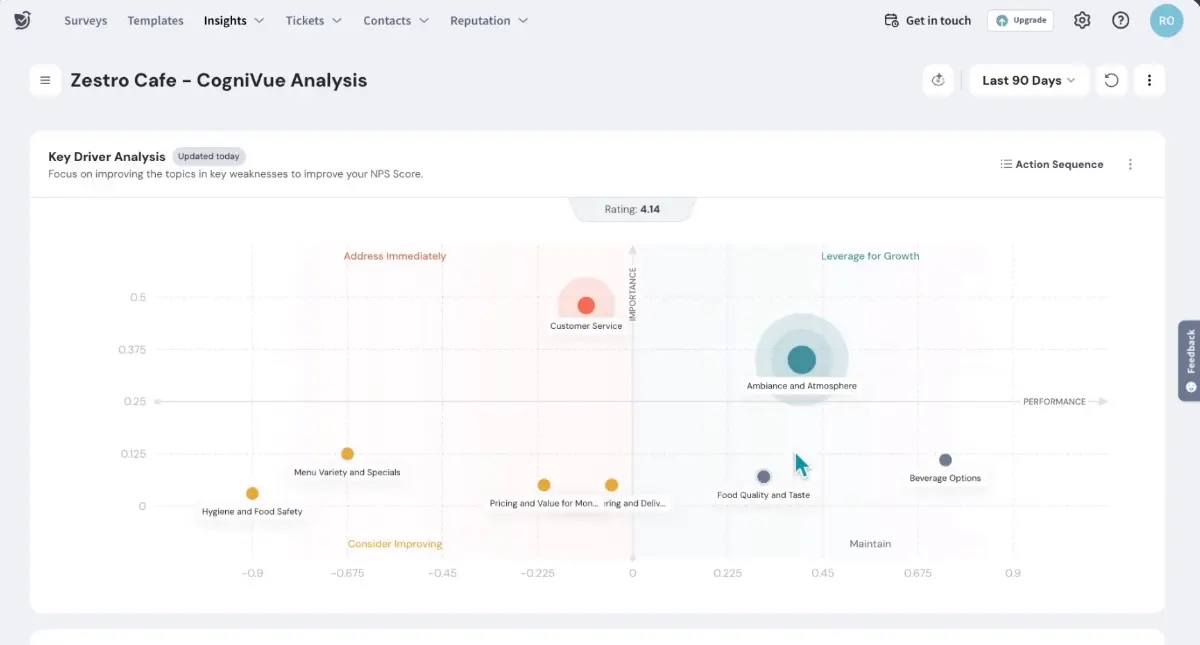
The two platforms take the next step after collection in different directions. SurveySparrow gives CX teams executive dashboards and journey charts for comparing feedback across touchpoints. AskNicely has dashboards and case management too, but organizes them around frontline performance, coaching, and follow-up. That makes AskNicely a more natural fit for multi-location service businesses; SurveySparrow is the broader survey and CX platform.
If your CX or Customer Success team plans to run NPS, CSAT, and CES together, check the packaging before the feature list wins you over. The standard SurveySparrow plans allow only one active CX survey, while the full CX Suite is priced separately. Additional users also raise the bill. The $19 starting price tells you very little about what the complete program will cost.
Zonka Feedback: omnichannel feedback across web, SMS, and WhatsApp
Zonka Feedback is an AI-powered feedback platform that combines web and in-product surveys with messaging, kiosk, and offline collection.
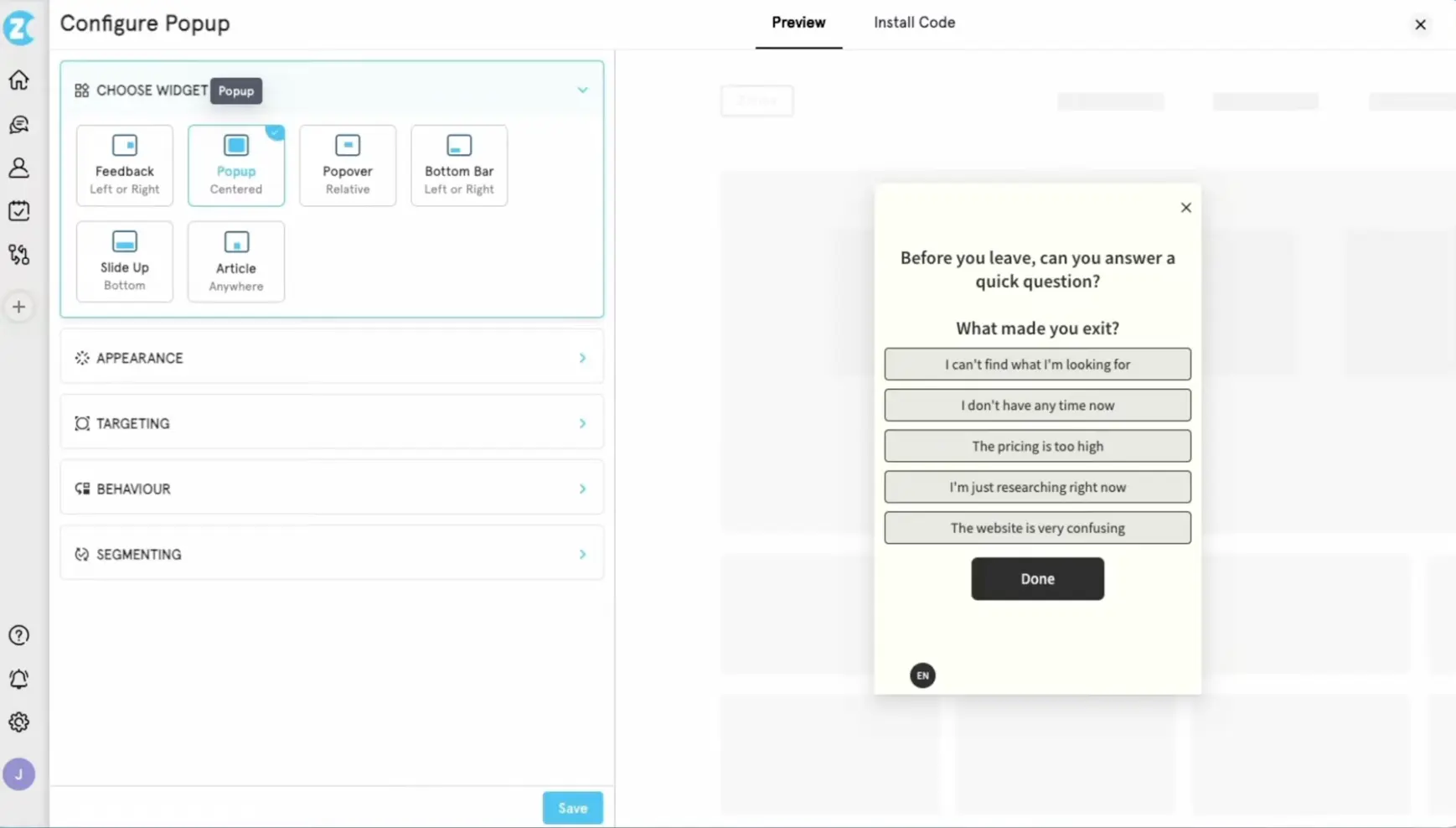
What does Zonka Feedback do?
It runs NPS, CSAT, CES, and custom surveys through email, SMS, WhatsApp, web, in-app, kiosk, and offline channels. The core platform handles reporting, case management, and follow-up. AI Feedback Intelligence, which is sold separately, can combine survey responses with support tickets, live chats, and reviews; it then analyzes themes, sentiment, and their impact on CX metrics.
Who is Zonka Feedback primarily for?
Zonka is primarily for CX teams whose customer journey includes both digital and physical touchpoints. It suits multi-location and frontline businesses, as well as SaaS companies that rely on SMS or WhatsApp alongside web and in-app surveys.
What's Zonka Feedback's ease of use?
Users often praise how quickly they can build and launch a survey. Advanced automation and custom reporting take longer to learn, although reviewers also credit the support team with helping them through the setup.
What's Zonka Feedback's customer support like?
Support is a standout in reviews, with users repeatedly praising responsiveness. It's one of the platform's most-mentioned strengths on G2.
What are the main pros of using Zonka Feedback?
- Broad channel coverage, including email, SMS, WhatsApp, web, in-app, kiosks, and offline devices.
- AI Feedback Intelligence can combine surveys with tickets, chats, and reviews, then analyze themes, sentiment, and their impact on CX metrics.
- Closed-loop workflows with a shared inbox and integrations into HubSpot, Salesforce, Intercom, and Zendesk.
What are the main cons of using Zonka Feedback?
- No public pricing: the site is quote-only with a trial after a demo call and no free plan, which is the same friction that pushes people off AskNicely.
- Cross-source AI analysis is not part of Feedback Management. Bringing surveys together with tickets, chats, and reviews requires the separately priced (and reportedly much more expensive) AI Feedback Intelligence product.
- If your feedback stays inside web, product, and email, you may have little use for the kiosk, offline, SMS, and WhatsApp capabilities.
Pricing
Zonka does not publish numerical prices on its site. Current third-party listings (G2, TrustRadius) place the starting price for Feedback Management between $99 and $199 per month, and AI Feedback Intelligence $999 per month. Treat those ranges as estimates: Zonka now calculates quotes mainly by survey response volume for Feedback Management and data credits for AI Feedback Intelligence. The products can be bought separately or bundled, and a 14-day trial is available upon a demo call.
My hot take: how does it compare to AskNicely?
Zonka offers a broader route beyond NPS than AskNicely. It can run richer surveys across digital and physical touchpoints, then pull tickets, chats, reviews, and survey comments into AI Feedback Intelligence. That breadth becomes an advantage only when the program uses it.
To me, AskNicely is easy to judge: either branch managers will work with customer scores every day, or the product loses much of its point. With Zonka, the risk is paying for channels and data sources that never become part of the program.
I would put it on a B2B SaaS shortlist when SMS, WhatsApp, kiosks, or offline surveys already matter, or when the team needs to analyze tickets and chats alongside survey responses. “We might use them later” is not enough. If most feedback comes from the product, website, and email, the distinctive channels may sit untouched.
Add AI Feedback Intelligence and the estimated starting cost moves toward four figures a month. For a focused digital feedback program, that is a lot of platform to carry.
Retently: automated feedback across the B2B customer lifecycle
Retently is a dedicated NPS, CSAT, and CES platform built around recurring and event-triggered survey campaigns.
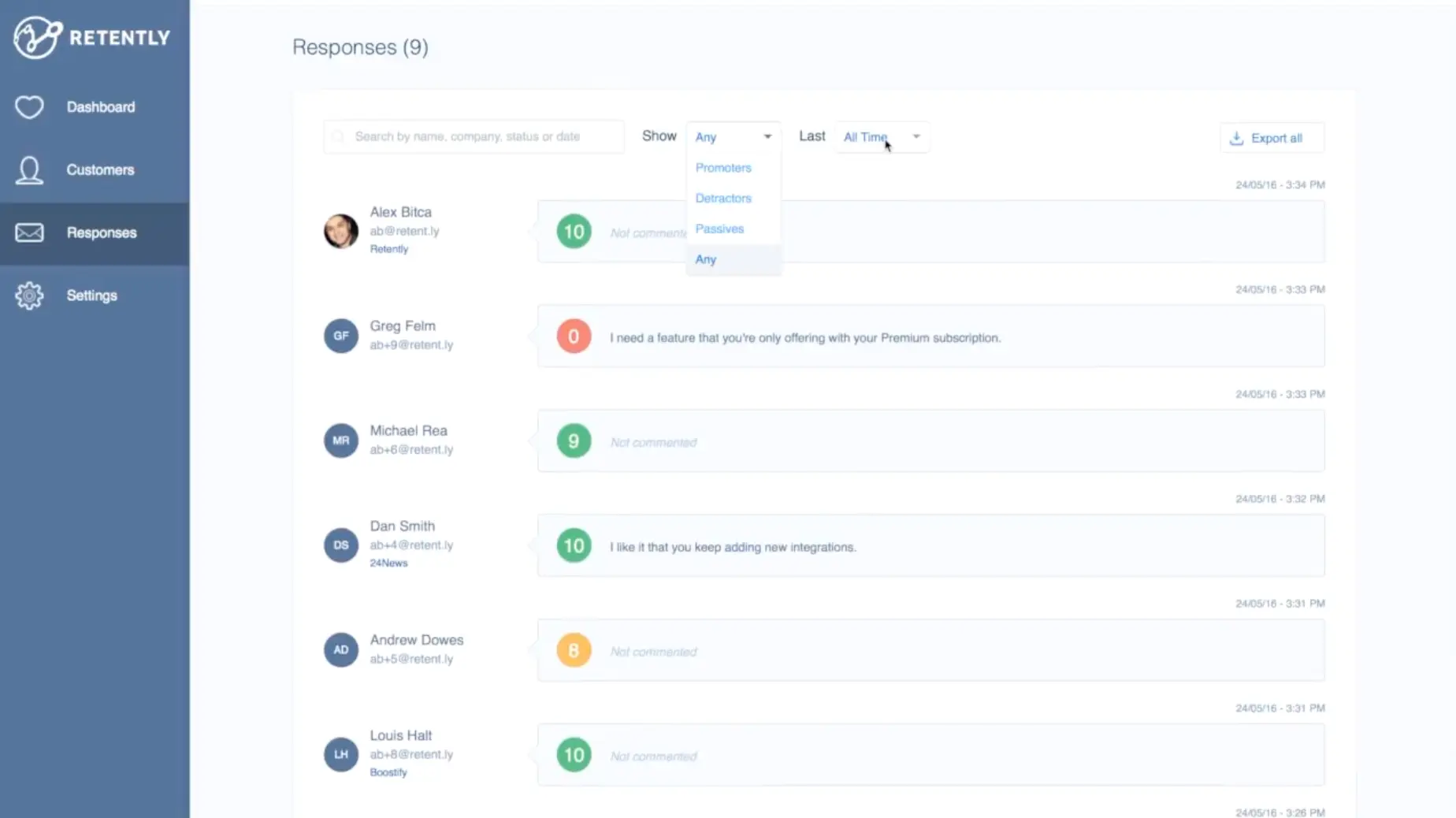
What does Retently do?
Retently can run recurring relationship surveys or trigger feedback after events such as a purchase or closed support ticket. Surveys go out by email, link, or web pop-up. Retently then groups open-text feedback by topic; on B2B Pro, it can also show NPS and CSAT at the account level.
Who is Retently primarily for?
Retently suits CX and Customer Success teams that want feedback to run automatically at fixed points in the customer lifecycle. In B2B SaaS, it makes most sense when the program stays close to NPS, CSAT, and CES and the results need to reach HubSpot or Intercom.
What's Retently's ease of use?
Retently has a strong reputation for being quick to set up. One Capterra reviewer who switched from AskNicely imported the company’s data and had a campaign ready to send within a day.
What's Retently's customer support like?
Support draws exceptional reviews. G2 users repeatedly describe the chat team as responsive and willing to go beyond the ticket. The catch is plan gating: live chat and Zoom support start on Pro, while Basic is email and knowledge base.
What are the main pros of using Retently?
- Once a lifecycle program is set up, Retently keeps it moving: NPS runs on schedule, CSAT or CES goes out after the right customer event, and reminders and follow-ups happen automatically.
- Retently connects natively with HubSpot and Intercom on the B2B side, and with Shopify and Gorgias for ecommerce. Zapier covers much of the long tail.
- Public, tiered pricing and a no-card free trial.
What are the main cons of using Retently?
- Basic plan only sends surveys by email or link. Connecting Retently to a CRM or showing a web pop-up requires Pro.
- The three campaigns on the Basic plan can disappear quickly once NPS, CSAT, and CES run at different stages of the customer lifecycle. Pro raises the limit to ten.
- Retently can use up a survey credit without collecting an answer. Email invitations and reminders count when they are sent, while link, Intercom, and web pop-up surveys count when someone opens them.
Pricing
Retently has separate plans for B2B and ecommerce. B2B pricing starts at $90 a month, while ecommerce starts at $89. Pro starts at $269 in both cases, and Enterprise is quote-only. A free trial is available without a credit card.
My hot take: how does it compare to AskNicely?
Retently earns its place on this list through automation. Set NPS to run on a schedule, trigger CSAT or CES after a customer event, and let reminders and follow-ups handle themselves. The results can go straight back to the tools your team already uses. AskNicely puts more weight on turning scores into frontline coaching. Retently’s appeal is that the feedback program can keep running in the background. If that is what you need, it may keep its place on the shortlist.
But I would skip the $100 B2B Basic plan. It only sends surveys by email or link and cannot connect to a CRM, which strips out much of the automation that makes Retently interesting. HubSpot, Intercom, Segment, and web pop-ups start with Pro at $299 a month. Salesforce means Enterprise.
Even then, in-app is not Retently’s deepest area. You can trigger a survey after a product event through Segment or the API, but that takes more plumbing than it does in Refiner or Survicate. Its in-app channel is a web pop-up, while those product-first tools also cover native mobile apps. Retently can also use a survey credit before anyone answers. I would choose it for automated lifecycle surveys, not for a product feedback program.
Nicereply: post-ticket CSAT, CES, and NPS for support teams
Nicereply is a focused CSAT, CES, and NPS tool that embeds one-click surveys into support workflows.
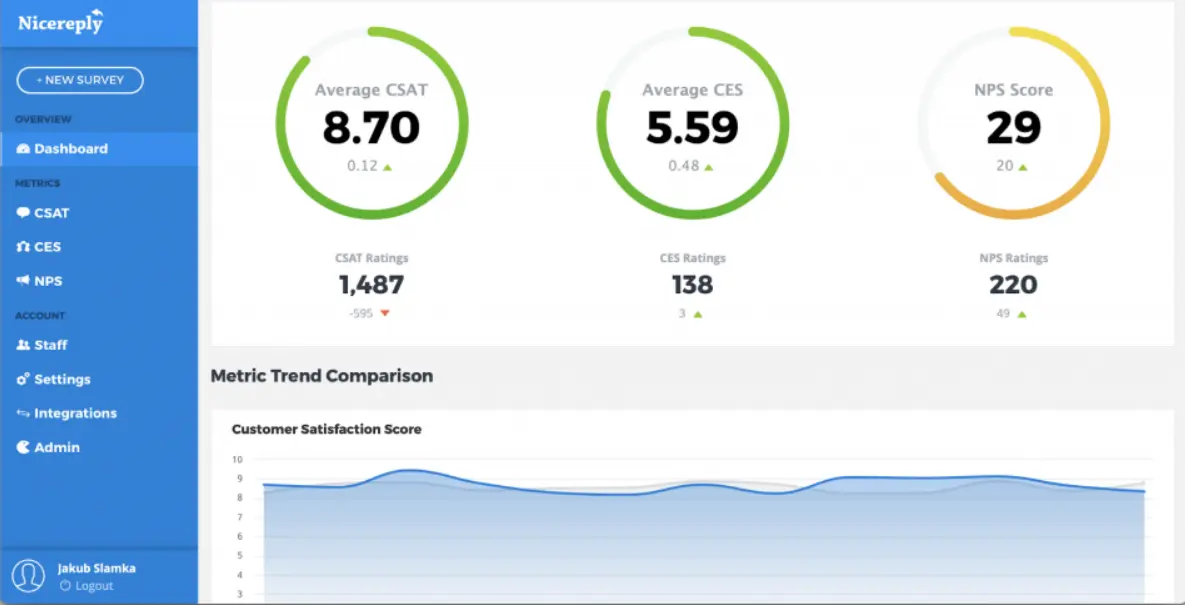
What does Nicereply do?
Nicereply puts one-click surveys where support teams already work: at the end of a resolved ticket or inside an agent’s email signature. Surveys can also be shared by link or shown as a website pop-up. Ratings flow back to the original ticket and into per-agent reports.
Who is Nicereply primarily for?
Nicereply is built primarily for support teams that want every rating tied to the ticket and agent behind it. It also fits Customer Success teams whose feedback program still revolves around support interactions.
What's Nicereply's ease of use?
Nicereply is quick to set up once it is connected to the helpdesk, and reviewers often praise how little training it takes. The builder stays simple too.
What's Nicereply's customer support like?
Nicereply offers a help center, email support, and free setup calls. Customer service scores 4.7 out of 5 on Capterra. G2 reviews are less uniform, with some users describing slow, repetitive troubleshooting over email.
What are the main pros of using Nicereply?
- Automated post-resolution surveys write ratings back to the original helpdesk ticket.
- Transparent, response-based pricing.
- Every integration is available on every plan, including Zendesk, Front, Help Scout, and Freshdesk.
- Per-agent leaderboards connect customer ratings to support performance.
What are the main cons of using Nicereply?
- Surveys stay close to NPS, CSAT, and CES. You can add extra questions, but there is no branching logic.
- Built-in pop-up targeting covers pages, timing, frequency, and exit intent. Triggering a survey from product behavior requires custom code.
- Analysis is limited to Nicereply’s own ratings and comments. It does not bring tickets or other feedback sources into the same research view.
Pricing
Plans run from $59 to $449 a month. Tiers scale by responses and users, with the same features and integrations throughout. The 14-day trial needs no card.
My hot take: how does it compare to AskNicely?
Nicereply is the easiest tool here to rule in or out. If support owns the feedback program and surveys should fire from the helpdesk, it does exactly that job. Ratings return to the ticket, agent leaderboards are built in, and every integration is available on every plan. I would consider picking it over AskNicely for a support team that wants post-ticket CSAT without the wider frontline coaching setup.
Move beyond the helpdesk, and the gaps show quickly. Nicereply can put a pop-up inside a web app, but triggering it from product behavior takes custom code. Surveys still revolve around NPS, CSAT, and CES. Once Customer Success wants lifecycle feedback or Product wants to analyze survey comments alongside other sources, Nicereply becomes one more tool next to the broader platform the team still needs.
When should you move beyond AskNicely?
AskNicely is at its strongest when customer scores feed frontline coaching across locations. For a B2B SaaS team, the wall appears when NPS grows into a broader feedback program that reaches into the product and the rest of the stack. Any tool in this comparison can run the NPS survey. The choice turns on what happens after a response comes in and whether the platform still fits as the program grows.
Which AskNicely alternative should you choose?
- For a B2B SaaS team moving from NPS into CSAT, CES, and in-product feedback that has to reach the rest of the stack: Survicate is a strong fit. It covers the main digital channels and uses Research Hub to analyze survey comments alongside tickets and conversations. But Survicate does not handle closed-loop follow-up natively. That work stays in the tools the CX team already uses, connected through native integrations.
- For product-led SaaS teams that want short surveys at precise moments inside the product: Refiner is the sharper specialist, provided its lighter reporting and Growth-only integrations will not become bottlenecks.
- For teams that care most about a conversational survey experience and broader CX reporting: SurveySparrow is worth considering, but price the separate CX product rather than relying on the cheaper headline survey plans.
- For teams that need to reach customers through SMS, WhatsApp, kiosks, or offline touchpoints: Zonka Feedback makes a strong case. It can also analyze tickets and chats alongside survey responses, but it is easy to pay for channels and AI capacity that a digital-only program will never use.
- For teams that want lifecycle surveys to keep running in the background: Retently is strong on automation. The setup most B2B SaaS teams will want begins with Pro at $299 a month, and its in-app surveys remain shallower than those of product-first tools.
- For support teams that want one-click CSAT after a ticket closes and agent-level reporting inside the helpdesk: Nicereply keeps the job simple. Once Customer Success or Product needs feedback outside the support workflow, it is too narrow to carry the program on its own.
FAQ
What features matter most when replacing AskNicely for a complete customer feedback program?
Look beyond NPS itself. Check whether the tool supports CSAT and CES across in-app, web, and email, can target surveys using customer or product data, and sends responses into the systems where your team acts on them. Open-text analysis becomes important as response volume grows.
Look beyond NPS itself. A complete program should collect feedback at meaningful moments in the customer journey, using CSAT, CES, or a custom question when they fit better. Check whether the tool covers in-app, web, and email, can target surveys using customer or product data, and sends responses to the systems where someone can act on them. As volume grows, open-text analysis becomes important too.
How do I avoid overpaying when I switch CX customer feedback tools?
Start with two numbers: how many customers you want to reach and how many usually respond. Run the same calculation for the user base you expect in a year. Survicate, SurveySparrow, Nicereply, Retently and Zonka’s Feedback Management scale mainly with responses, while Refiner uses MAU. Before comparing totals, add extra seats and any higher plan or separate CX or AI product your setup requires.
Which AskNicely alternatives support in-product surveys?
Survicate, Refiner, SurveySparrow, and Zonka Feedback support in-product surveys. Refiner focuses most narrowly on product microsurveys, while Survicate combines in-product targeting with website and email surveys. Retently offers web surveys but less product-level targeting.
Do I need a broad feedback platform or a specialist survey tool as an AskNicely alternative?
Choose a broad platform if NPS is expanding into CSAT, CES, in-product feedback, and analysis across several feedback sources. Survicate, SurveySparrow, and Zonka Feedback cover this wider scope. A specialist makes more sense when one workflow dominates: Refiner for product microsurveys, or Retently for recurring and event-triggered surveys
Author's note (last verified: 24 August 2026): Statements such as "best" reflect our opinion and typical use cases, not a universal guarantee. This comparison is based on publicly available information and our best understanding at the time of writing. Vendors may change features, pricing, and packaging without notice. For the latest details, please check the official sources or reach out to the vendor directly.


.webp)

.webp)
.svg)

.svg)